


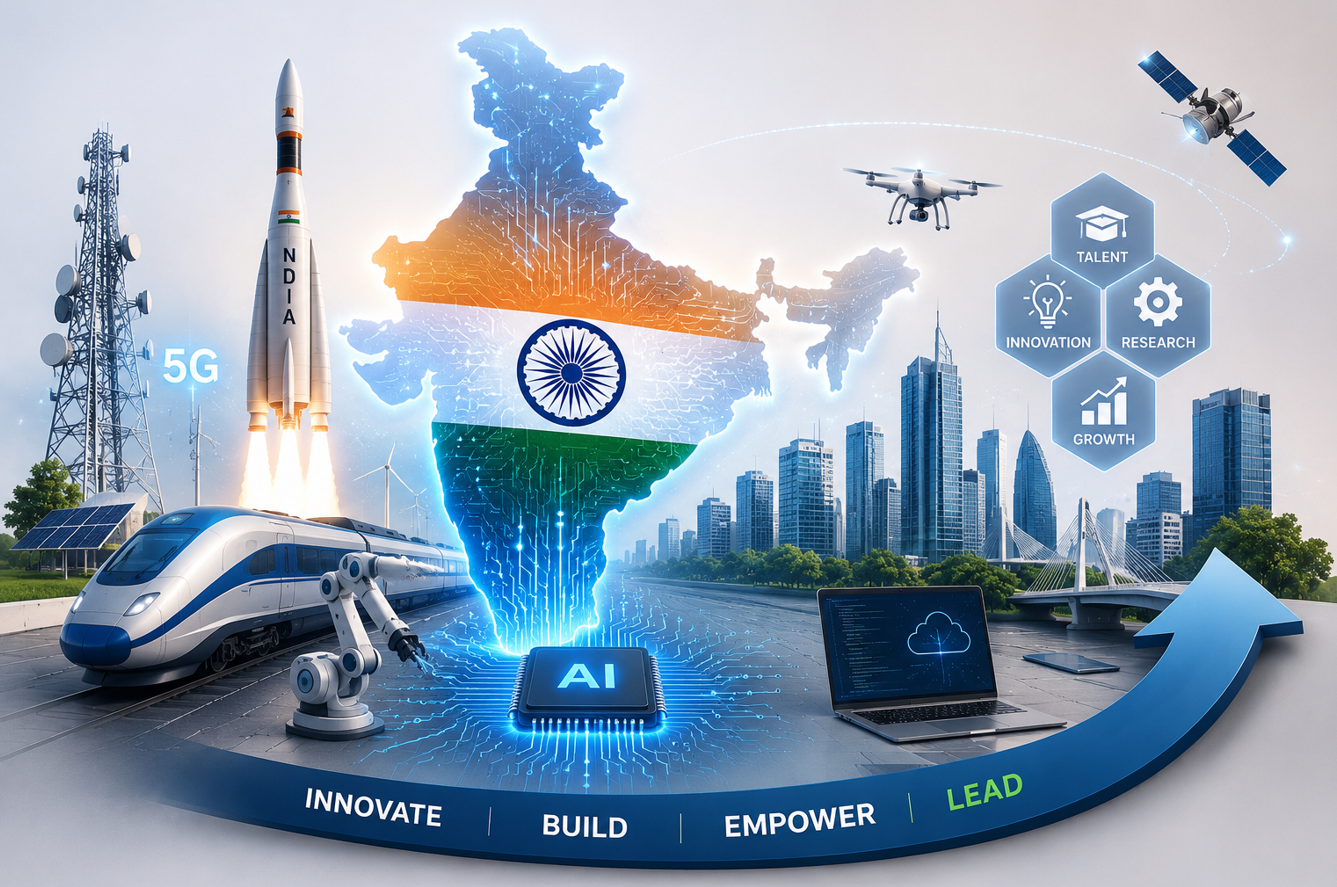
Every year on May 11, India celebrates National Technology Day, but in 2026 the day feels especially relevant. This is not only a moment to remember a historic milestone from 1998 when success of the Pokhran-II nuclear tests (Operation Shakti) was successfully carried out. It is also a checkpoint to measure how far have we come, and what must we do next if India wants to lead, not follow, in the global technology race?
The country has already shown that scale is possible. What now matters is depth, product quality, research strength, and the ability to convert breakthroughs into globally trusted solutions.
Where India stands in 2026
India’s current technology story is strongest in digital public infrastructure and large-scale adoption. UPI continues to operate at massive scale, with official updates in early May 2026 highlighting over 22 billion monthly transactions. This proves that India can build systems that are affordable, fast, and useful to ordinary citizens, not just premium users.
Another clear indicator is policy-backed deep-tech momentum. In May 2026, the Union Cabinet approved new semiconductor units under the India Semiconductor Mission, including projects linked to advanced display and packaging capabilities. This is significant because semiconductors are the foundation of electronics, mobility, telecom equipment, and AI hardware.
AI capability building is also moving from talk to build something significant. The approved IndiaAI Mission gives the country a framework to improve compute access, datasets, startup support, and talent pipelines. In simple terms, India is no longer looking at AI only as a consumer technology; it is trying to build a domestic innovation base.
India’s progress in space and defence technology has also strengthened its 2026 position. ISRO’s continued mission cadence, private-sector spacetech participation, and growing launch capabilities show that India is moving from cost-efficient execution to strategic innovation. In defence, the push for indigenous platforms, advanced electronics, and domestic manufacturing under long-term self-reliance goals is improving both national capability and export potential. These sectors show India is not only scaling digital systems but also building hard-tech strength with global relevance.
At the ecosystem level, the startup and research conversation is maturing. Indian startup founders are now building products useful in spacetech, chips, climate finance, enterprise software, and manufacturing-led categories. That shift matters because it reduces dependence on pure consumption apps and creates long-term strategic capacity.
Where India can get ahead of the world
India can lead globally if it executes on three fronts with discipline.
First, it must move from “digital scale” to “deep-tech ownership.” Building and owning core IP in semiconductors, AI models, industrial software, and critical materials will decide long-term competitiveness. Adoption is a strength, but ownership creates strategic power.
Second, research-to-market conversion must become faster. India has strong talent in institutes and startups, but commercialization remains uneven. The next leap requires closer industry-academia collaboration, faster testing environments, and procurement pathways that help Indian products win real contracts.
Third, India must lead in trusted and inclusive technology. The world is now asking tougher questions on privacy, safety, transparency, and AI ethics. India can build an advantage by proving that technology can be both scalable and responsible, especially for multilingual, low-cost, high-diversity populations.
The road ahead
National Technology Day should not be treated as a ceremonial date. It should be a national performance review. India has already demonstrated execution capacity in digital payments and platform-scale innovation. The next phase is about becoming a creator of frontier technology products that the world adopts.
If policy, capital, talent, and research institutions stay aligned, India can move from being a major technology market to becoming a major technology maker. That transition is the real opportunity ahead to set the benchmarks.
AI Generated Image, so ignore if any discrepancy
Discover more from Newskart
Subscribe to get the latest posts sent to your email.

Comments are closed.