

UP’s Big Noida Bet – India’s Largest Robotics and AI Hub Could Change Advanced Manufacturing


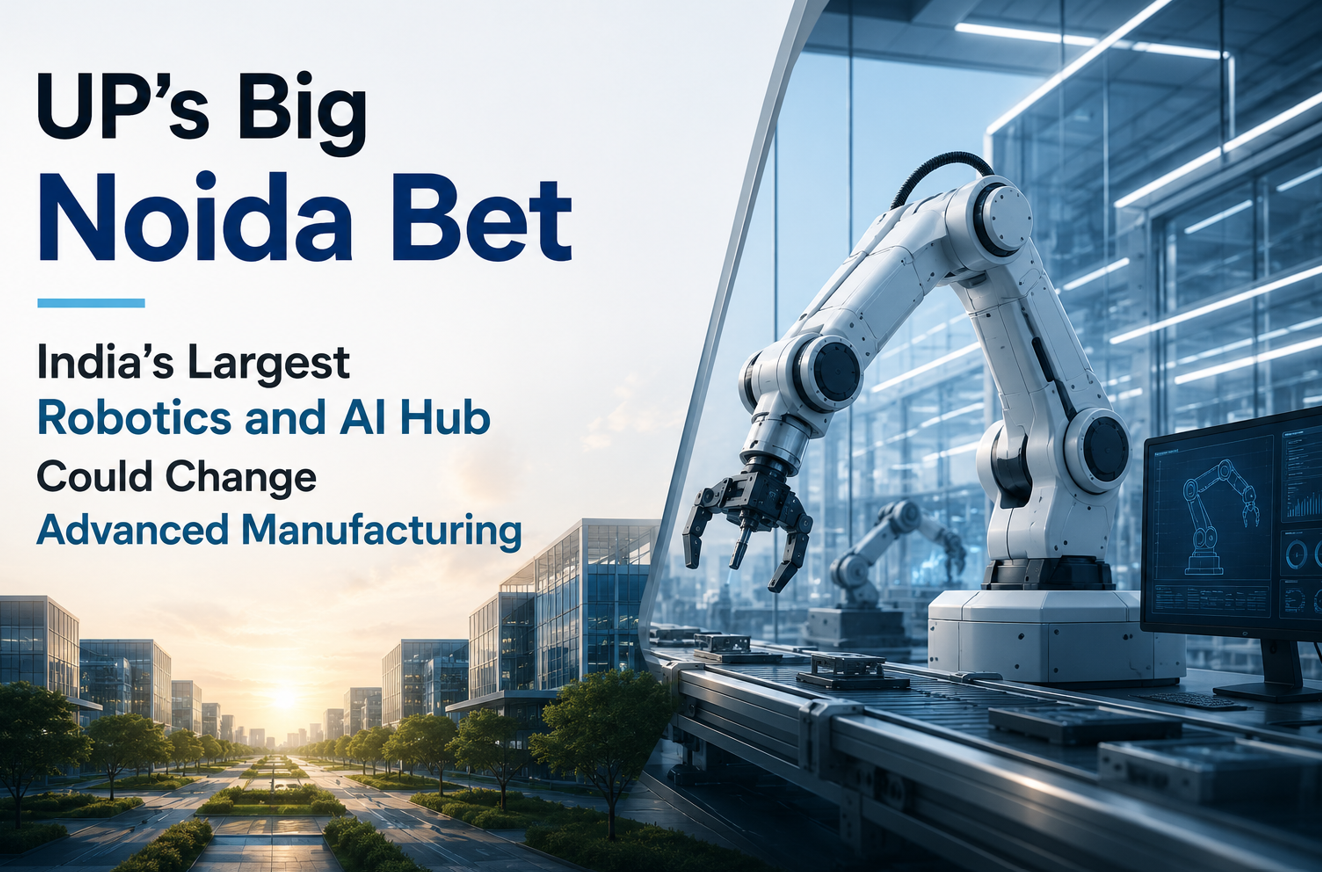
Uttar Pradesh is preparing a major technology push with a planned robotics and AI manufacturing hub in Noida. The project is being presented as India’s largest integrated robotics and advanced manufacturing cluster, and the idea is much bigger than building one more industrial park.
The hub, called PRAGATI, is expected to bring together robotics, artificial intelligence, GPU clusters, testing labs, manufacturing facilities, startups and research teams in one place. For a state that already has a strong electronics and mobile manufacturing base around Noida and Greater Noida, this is a clear attempt to move up the value chain.
In simple words, UP does not want to only assemble devices. It wants to help companies design, test and manufacture the intelligent machines that may run future factories, hospitals, warehouses, airports, farms and defence systems.
What exactly is planned in Noida?
Chief Minister Yogi Adityanath has approved the plan to develop PRAGATI in Noida. PRAGATI stands for Park for Robotics, Artificial Intelligence, GPU Clusters and Advanced Technical Innovation.
The proposed hub will be spread across about 75 acres. According to reports, it will include robotics testing and certification facilities, rapid prototyping units, manufacturing infrastructure, AI compute capacity, GPU clusters, motion capture labs, physical AI data centres, startup incubation facilities and co-working spaces.
That sounds heavy, so let’s break it down.
A robotics company cannot grow only with a laptop and a coding team. It needs hardware, sensors, motors, cameras, test spaces, simulation tools and manufacturing support. A robot made for a warehouse, for example, must be tested for movement, safety, battery life, load handling and navigation. The Noida hub is being planned as a place where such companies can build and test products faster.
Why does UP need this hub?
India has a large market for automation, but much of the high-end robotics and AI hardware still depends on imports or foreign technology. This creates a gap. Indian companies may use automation, but fewer Indian firms build complete advanced robotic systems at scale.
UP wants to use Noida’s existing electronics ecosystem to close part of this gap. The region already has mobile phone manufacturing, component suppliers, expressway access, industrial land and proximity to Delhi-NCR’s talent pool. Adding robotics and AI manufacturing to this base is a natural next step.
The need is also linked to jobs. Reports say the project could create more than one lakh direct and indirect jobs and add over Rs. 2,000 crore in gross value over the next five years. These jobs may not be limited to engineers. A robotics ecosystem also needs technicians, machine operators, assembly workers, quality testers, logistics staff, trainers and support teams.
The aim and purpose of the initiative
The main aim is to make Uttar Pradesh a serious player in deep technology. Deep tech simply means technology built on serious engineering and research, not just a simple app or website.
The purpose is also industrial. Robots and AI systems are now becoming part of manufacturing, healthcare, logistics, agriculture, defence, surveillance, education and smart city projects. If UP can attract manufacturers and research centres early, it can become a supplier to these fast-growing sectors.
There is another important purpose – reducing the gap between research and real products. India has strong engineering talent, but many ideas struggle to move from lab to factory. A cluster with prototyping, testing, certification and manufacturing support can help startups and companies make that jump.
For example, a startup building a delivery robot may need a test track, sensors, metal fabrication, software support and safety certification. If all of this is scattered across different cities, the process becomes slow and expensive. A common hub can make the journey easier.
Why Noida makes sense
Noida is already one of North India’s strongest technology and electronics regions. Greater Noida and the Yamuna Expressway belt have attracted mobile manufacturers, electronics companies and data centre investments.
Invest UP says Uttar Pradesh accounts for a large share of India’s mobile phone manufacturing and has more than 230 operational electronics system design and manufacturing companies. Greater Noida is also home to major phone makers such as Samsung, OPPO and Vivo.
This matters because robotics is not only about software. It needs electronics, chips, sensors, cameras, boards, motors, batteries, casings and precision parts. A region that already understands electronics manufacturing has a better chance of building a robotics supply chain.
The upcoming Jewar airport may also help in the long run by improving cargo and global connectivity, especially if companies want to export components or finished products.
What kind of companies may come?
The hub is expected to attract global manufacturers, component suppliers, research and development centres and specialized technology service providers.
This could include companies working on industrial robots, warehouse automation, drones, autonomous machines, AI cameras, robotic arms, smart factory systems, defence robotics and healthcare robots.
Startups may also benefit. A young robotics startup usually struggles with cost. Buying testing equipment or setting up a small manufacturing line is expensive. If the hub offers shared facilities, incubation and technical support, it can reduce the early burden.
Bigger companies may use the hub for manufacturing, testing, pilot projects or partnerships with local suppliers.
How this links with UP’s wider AI plan
The Noida robotics hub is not a standalone idea. UP has also been working on AI City in Lucknow, the UP AI Mission, electronics manufacturing clusters, semiconductor-related opportunities and centres of excellence.
Invest UP’s AI City plan for Lucknow includes incubation, AI-focused workspaces, high-performance compute capacity, testing labs and simulation labs. The state has also talked about expanding the technology ecosystem beyond Noida and Ghaziabad into tier-II and tier-III cities.
This is important. If all new technology investment stays only in one belt, the impact remains limited. A wider network can help universities, startups and local businesses across the state connect with the deep-tech economy.
Competitors and other states to watch
UP is not the only state trying to become a technology hub. Karnataka is pushing hard on AI, with plans around AI education, innovation and data centres. Andhra Pradesh has been in the news for large AI and data infrastructure investments around Visakhapatnam. Telangana, Tamil Nadu, Gujarat and Maharashtra also compete for electronics, semiconductor, data centre and advanced manufacturing investments.
Noida’s advantage is its existing electronics base and NCR location. Its challenge will be execution. Announcing a hub is easier than building one that companies actually use every day.
The state will need quick approvals, reliable power, skilled workers, good testing facilities, strong industry partnerships and clear rules. Robotics companies will not come only for land. They will come if the ecosystem saves them time and money.
Challenges ahead
- The first challenge is talent. Robotics needs mechanical engineering, electronics, embedded systems, AI, computer vision and manufacturing skills. UP will need strong training and certification programmes, as the government has already indicated.
- The second challenge is supply chain depth. A robot is made of many parts. If key components still need to be imported, local manufacturing may remain limited.
- The third challenge is real demand. Companies will invest only if they see buyers in factories, hospitals, logistics, defence, agriculture and public services.
- The fourth challenge is patience. Robotics is not quick commerce. Products take time to build, test, certify and commercialize. The state must support companies beyond the launch phase.
Conclusion with key takeaways
The UP robotics and AI manufacturing hub in Noida could become an important project if it moves from announcement to strong execution. It brings together the right themes – AI, robotics, manufacturing, startups, GPU infrastructure and testing support.
For India, the bigger message is clear. The next phase of technology growth will not be only about apps. It will also be about machines, sensors, chips, automation and physical AI systems that work in the real world.
Key takeaways
- UP plans to develop PRAGATI, a 75-acre robotics and AI manufacturing hub in Noida.
- The project is being presented as India’s largest integrated robotics and advanced manufacturing cluster.
- It may include testing labs, GPU clusters, AI compute, prototyping units, data centres, manufacturing facilities and startup spaces.
- The hub is expected to create more than one lakh direct and indirect jobs and add over Rs. 2,000 crore in gross value over five years.
- Noida’s existing electronics and mobile manufacturing base gives the project a practical starting point.
Facts Input- Tele net, Startup UP, UPLC, Invest UP,
Discover more from Newskart
Subscribe to get the latest posts sent to your email.

Comments are closed.