


India’s private space sector is moving from excitement to execution. Startups are no longer only talking about rockets and satellites. They are building real products for communication, navigation, defence, climate monitoring, agriculture, logistics, and space infrastructure.
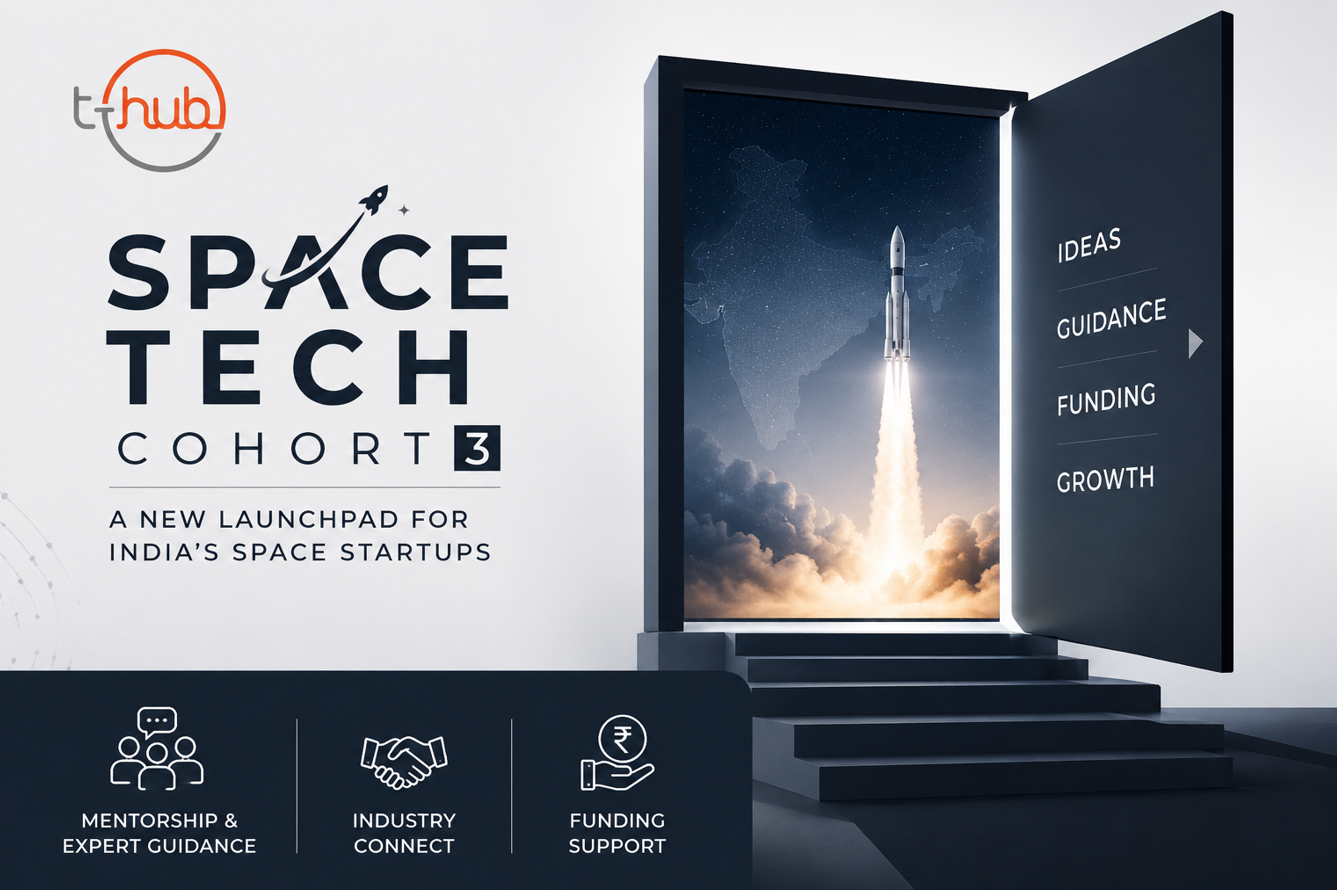
T-Hub, through AIC T-Hub, has now launched the third cohort of its SpaceTech program called ORBIT. The program is designed to help early-stage Indian SpaceTech startups move from prototype and validation to pilots, partnerships, funding readiness, and commercialization. This is important because SpaceTech is not like a normal software startup. A founder building a satellite component, propulsion system, communication device, or space-data platform needs technical validation, regulatory clarity, testing access, capital, and industry trust. ORBIT Cohort 3 is built around that exact need.
What Is T-Hub’s ORBIT SpaceTech Program
ORBIT is AIC T-Hub’s dedicated SpaceTech incubation program. T-Hub describes it as one of India’s first focused SpaceTech incubation programs aimed at building a stronger space startup ecosystem in the country.
T-Hub itself was incorporated in 2015 as a Section 8 not-for-profit innovation hub. It follows a public-private partnership model, bringing together government, industry, corporates, and academic institutions. Over the years, it has supported thousands of startups through incubation, mentorship, corporate access, investor connects, and ecosystem programs.
The ORBIT program focuses on startups working in space-related technologies. These can include satellite technology, spacecraft technology, orbital launch vehicles, space communication, space materials, uplink and downlink systems, and even space tourism-related ideas.
The third cohort, also called ORBIT Cohort 3, was launched in May 2026. Public updates from participating startups mention that the launch day was held on May 13, 2026, at T-Hub in Hyderabad.
Who Can Apply
ORBIT Cohort 3 is mainly for early-stage SpaceTech startups registered in India. T-Hub’s program page says startups from the idea-to-early-revenue stage can apply, with Technology Readiness Level 3 or above preferred.
Technology Readiness Level, or TRL, is a way to measure how mature a technology is. TRL 3 usually means the basic idea has moved beyond theory and some proof-of-concept work has started.
A pilot or proof of concept is preferred, but not mandatory. This is useful for deep-tech founders because many SpaceTech products need long development cycles before commercial revenue starts.
The selection criteria also focus on a strong founding team, relevant industry experience, MVP readiness, active work toward commercialization, and willingness to participate seriously in the program.
In simple words, ORBIT is not only for founders with polished sales numbers. It is for startups with serious technology, a committed team, and a clear path toward building a real space business.
What Startups Get Inside The Program
The main value of ORBIT is not just office space or a certificate. The program is structured around mentorship, market access, technology partnerships, funding support, and visibility.
Startups get access to domain experts, researchers, corporate leaders, and SpaceTech mentors. T-Hub’s ecosystem also includes 290-plus mentors, 200-plus corporates and MNCs, 46-plus international partners, 100-plus investors, and connections with government institutions.
For a SpaceTech founder, these connects can be more valuable than a short-term cheque. A startup may need help with testing, regulatory approvals, pilot customers, defence or government use cases, investor preparation, and global market entry.
The program also mentions engagement with space ecosystems in Australia, France, and the USA. That can help Indian startups understand export opportunities and international collaboration routes.
Program Structure And Timeline
The ORBIT program runs in a structured format across 12 weeks. It is divided into three broad phases – Assess, Learn, and Deliver.
In the first phase, startups work on company structure, business model, validation, founder mindset, and milestone planning. This helps teams understand where they are and what must be fixed first.
The learning phase includes discussions on government initiatives, global space markets, low-cost manufacturing, localization, legal basics, compliance, India’s space policy, go-to-market strategy, financial modelling, branding, and sustainable design.
The final phase focuses more on market access and funding readiness. Startups get pitch deck reviews, investor connects, corporate market access opportunities, and milestone tracking. T-Hub also mentions knowledge visits to places such as Skyroot Aerospace and ISRO labs.
The program fee listed by T-Hub is Rs. 50,000 plus GST. T-Hub also states that it does not take equity or stake in participating startups.
Why This Matters For India’s SpaceTech Market
India’s space sector has changed after policy reforms and the rise of private companies. Startups such as Skyroot Aerospace, Agnikul, Dhruva Space, Pixxel, Bellatrix Aerospace, Digantara, and others have shown that private Indian firms can build serious space technologies.
But the journey is still difficult. SpaceTech startups face high development costs, long sales cycles, strict technical standards, and limited testing infrastructure. Unlike a consumer app, a satellite or propulsion product cannot be casually launched, tested, and fixed overnight.
This is where an incubation program can help. A founder may have strong engineering skills but still need support with customers, compliance, manufacturing, procurement, government programs, and investor communication.
T-Hub’s ORBIT Cohort 3 is trying to become that bridge between engineering ambition and commercial reality.
Examples From Cohort 3
Some startup names have already appeared publicly through LinkedIn updates. So far, 13 startups are selected for this cohort and they are as below-
Nibiaa, a startup from Manipur, announced that it was selected for AIC T-Hub SpaceTech Program Cohort 3. The company says it is working on satellite-powered asset tracking technology for logistics, construction, and remote environments.
Sanyark Space Technologies also shared that it was part of ORBIT Cohort 3 Launch Day. The company is working on navigation and communication solutions.
Zoove Space, founded in 2025 and based in Bengaluru, has also said it was incubated under AIC T-Hub SpaceTech Cohort 3. The startup describes its work around guidance, navigation, and control systems for spacecraft.
Apart from above, the cohort includes Trishul Space, Kessler Dynamics, Velotrax, Space OS, Humanity Space, Landlens, STAR Labs, Red Balloon Aerospace, Astro Voltaics, and Orbit Grid. These examples show that ORBIT is not limited to rocket companies. It also supports startups building communication, tracking, navigation, and spacecraft systems.
Competitors And Similar Programs
T-Hub’s ORBIT will compete and collaborate with other deep-tech and SpaceTech support programs in India.
IN-SPACe plays a major role in enabling private space companies by supporting authorization, facilitation, and access to India’s space ecosystem. ISRO’s technology transfer and industry engagement also remain important for startups.
Other incubators and accelerators such as IIT Madras Incubation Cell, SanchiConnect, Gujarat i-Hub, Social Alpha, and AWS Space Accelerator programs have also supported deep-tech or space-related ventures.
The difference with ORBIT is its focused SpaceTech incubation model and T-Hub’s large startup ecosystem in Hyderabad. For founders who need both sector mentorship and business-building support, that combination can be useful.
Conclusion With Key Takeaways
T-Hub’s ORBIT Cohort 3 comes at the right time for India’s space economy. The country has the talent, policy momentum, and startup ambition. What many young companies now need is structured guidance, access to testing, market connects, and investor readiness.
The program is best suited for Indian early-stage SpaceTech startups with serious technology and a clear intention to commercialize. It can help founders move from prototype thinking to customer, funding, and scale thinking.
Key takeaways
- T-Hub has launched the third cohort of its AIC T-Hub SpaceTech program, ORBIT.
- The program supports early-stage Indian SpaceTech startups.
- Focus areas include satellites, spacecraft, launch vehicles, communication, space materials, and related technologies.
- Startups get mentorship, corporate access, investor connects, regulatory and testing support, and global ecosystem exposure.
The program fee is Rs. 50,000 plus GST, and T-Hub says it does not take equity.
Discover more from Newskart
Subscribe to get the latest posts sent to your email.

[…] India, founders may also look at programs from T-Hub, Nasscom, Google for Startups, corporate innovation labs and sector-focused venture funds. Y […]