


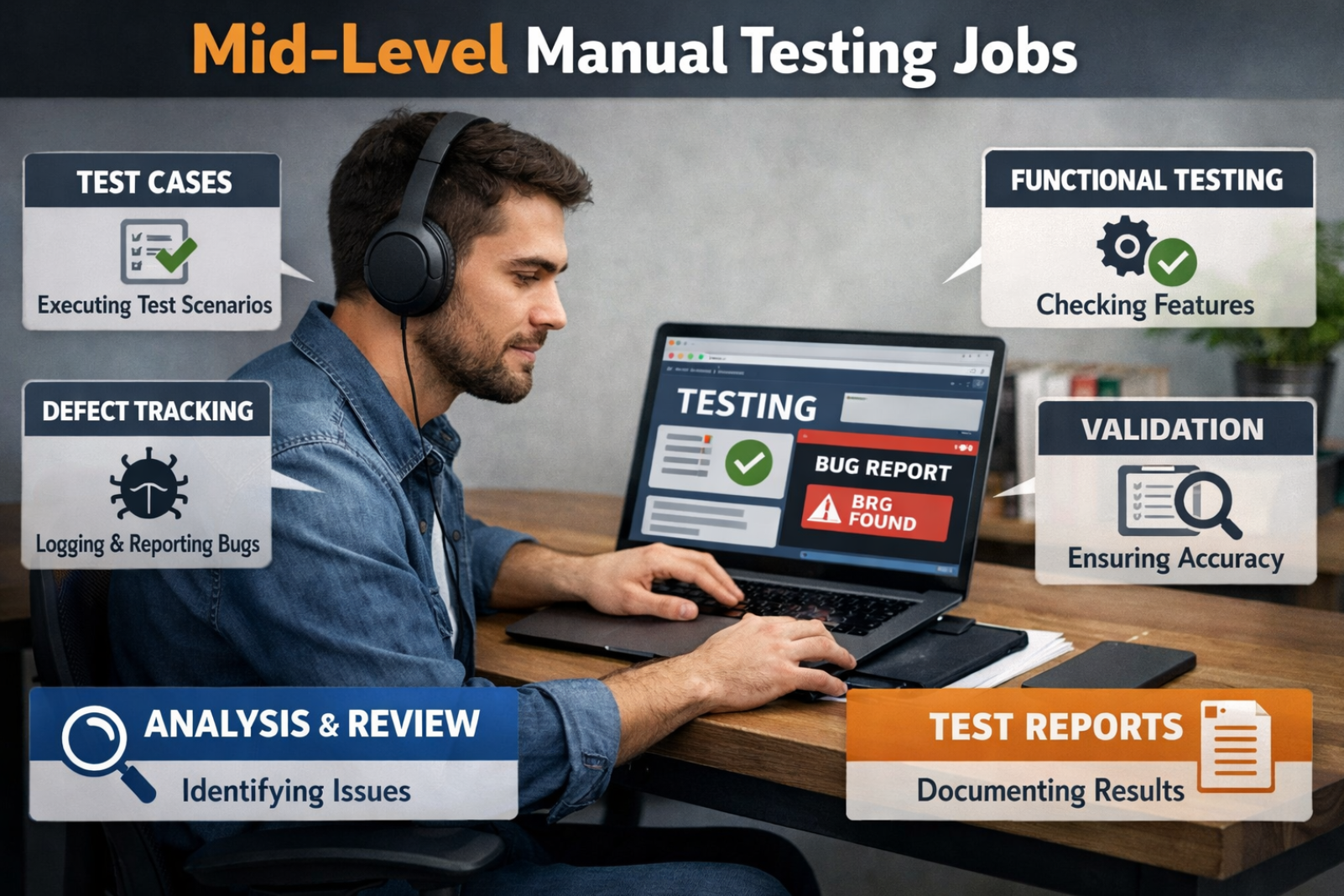
Manual testing is still a core skill in software teams, even when automation is growing. For mid-level roles, interviewers look beyond textbook definitions. They want to see how you think, how you prioritize risk, and how you communicate quality decisions under deadlines with practical approach.
This guide along with previous interview questions is designed for practical interview preparation. The answers are written in simple English and reflect real project situations, so you can understand concepts and explain them naturally in interviews.
1. How is mid-level manual testing different from entry-level testing?
At entry level, most work is execution-driven: follow test cases, log defects, and report status. At mid-level, expectations are broader: you are expected to identify risk, improve coverage, estimate efforts, and contribute to release decisions. You should also coach juniors and communicate quality trade-offs clearly to product and engineering teams.
2. How do you approach testing a new feature when requirements are not fully clear?
I first list unclear points and validate them quickly with BA/PO so assumptions are visible. Then I create provisional scenarios for confirmed behavior and start testing high-risk areas early instead of waiting. As requirement updates come in, I revise cases and traceability so coverage stays aligned with the latest business intent.
3. How do you perform requirement analysis for testing?
I break each requirement into testable conditions, then identify dependencies, validations, role impacts, and integration touchpoints. I map those conditions to scenarios and note any gaps before execution starts. This avoids late confusion, reduces rework, and improves confidence in coverage.
4. How do you identify high-risk areas in an application?
I prioritize areas where failure impact is high and defect probability is high. Typical examples are login, payments, checkout, permissions, and any module with frequent recent changes. I also look at production incident history, because repeat problem areas often need deeper test depth.
5. What is risk-based testing, and how do you apply it in real projects?
Risk-based testing means spending the most effort where business damage would be highest if defects escape. In practice, I classify scenarios as high, medium, and low risk and execute in that order. This helps when timelines are tight because critical user journeys still get strong coverage.
6. How do you create effective test scenarios?
I start with user behavior and business outcomes, not only screen-level checks. For each feature, I include positive, negative, boundary, role-based, and integration scenarios so coverage is realistic. Good scenarios are clear, traceable, and easy for anyone in the team to understand.
7. How do you ensure your test cases are maintainable?
I write concise cases with reusable structure and stable language so minor UI tweaks do not break documentation value. I avoid unnecessary step noise and keep expected results measurable. I also review and refresh cases regularly so regression suites do not become outdated.
8. How do you review another tester’s test cases?
I verify requirement mapping first, then check whether edge cases and negative paths are covered. I review clarity, data needs, and expected-result precision so execution is consistent across testers. If gaps exist, I suggest concrete additions instead of generic feedback.
9. How do you decide when testing is “enough” for release?
I use agreed exit criteria: critical flow stability, unresolved high-severity defects, pass trend, and business risk tolerance. Testing is never about “zero bugs”; it is about acceptable risk with evidence. I present clear risk statements so release decisions are informed and transparent.
10. How do you handle frequent requirement changes during sprint testing?
I do quick impact analysis on scenarios, data, and regression scope whenever a story changes. Then I re-prioritize execution and communicate what is now covered, deferred, or risky. The key is rapid alignment, because silent scope changes are a common reason for release surprises.
11. How do you perform end-to-end testing?
I validate the complete user journey across UI actions, API responses, data persistence, and downstream effects like notifications/reports. I ensure state transitions are correct at each stage, not just that pages load. End-to-end validation confirms real business outcomes, not isolated functionality.
12. How do you handle testing when build quality is unstable?
I begin with smoke checks to determine if the build is testable at all. If major blockers exist, I log them immediately with evidence and continue with unaffected modules in parallel. This keeps momentum and gives development a fast, actionable feedback loop.
13. How do you prioritize defects?
I evaluate defects by user impact, business impact, reproducibility, and release urgency. Severity alone is not enough; context matters, especially near release. I align priority with product/development so fix order reflects business reality.
14. What makes a defect report high quality?
A strong defect report is reproducible, precise, and context-rich. It includes build/environment, clear steps, expected vs actual behavior, and useful evidence such as screenshots, logs, or recordings. Good bug reports reduce clarification cycles and speed up fixes.
15. How do you handle “Cannot Reproduce” defects from developers?
I retest with exact data, account state, and environment to rule out mismatch causes. If still reproducible, I provide deeper evidence, including timestamps, payloads, and videos. If needed, I do a live triage with developers to isolate the trigger condition together.
16. What is defect leakage, and how do you reduce it?
Defect leakage means defects missed in testing but found in production. I reduce leakage by strengthening risk-based regression, adding tests for escaped defects, and improving requirement clarity early. I also analyze root cause so process gaps are fixed, not repeated.
17. How do you contribute to sprint planning as a manual tester?
I provide realistic test effort and highlight risk/dependency concerns before commitment. I also call out stories that are too large or unclear for reliable testing within sprint boundaries. This improves planning quality and reduces end-sprint instability.
18. How do you estimate test effort for a story?
I consider feature complexity, integration points, data preparation needs, environment constraints, and regression impact. I use relative sizing patterns from prior sprints for consistency. Good estimation is not perfect prediction, but it prevents major planning errors.
19. How do you manage testing in tight deadlines?
I prioritize in layers: smoke, critical flows, top risks, then secondary scenarios. I keep stakeholders aware of what is tested and what risk remains untested due to time. This approach preserves quality where it matters most and avoids false confidence.
20. How do you perform exploratory testing effectively?
I define a focused charter, timebox the session, and target uncertain or high-risk areas. I record observations in real time so discoveries become actionable defects or future regression cases. Structured exploration gives better results than random clicking.
21. How do you test APIs manually as a mid-level tester?
I validate method, endpoint, auth, headers, payload, status code, schema, and business rules. I include negative tests such as invalid tokens, missing fields, and malformed data. API checks are essential because many critical failures happen below the UI layer.
22. How do you validate data integrity in manual testing?
I verify that UI actions produce correct API/DB outcomes and that data remains consistent across systems. I check for truncation, wrong mapping, stale values, or duplicate records. Data integrity testing is key in finance, orders, and profile management flows.
23. How do you test role-based access controls?
I validate allowed and restricted actions for each role across UI and APIs. I also test direct URL access and endpoint attempts to confirm unauthorized actions are blocked. This prevents privilege escalation and strengthens security posture.
24. How do you test forms thoroughly?
I check mandatory fields, format rules, length limits, boundary values, duplicate handling, and validation messaging. I verify both client-side and server-side behavior where applicable. Good form testing improves data quality and user success rate.
25. How do you test notifications (email/SMS/push)?
I validate trigger conditions, content accuracy, template variables, delivery timing, and link behavior. I also test failure handling, retries, and expired-token conditions. Notification defects can directly affect user trust and support volume.
26. How do you test third-party integrations?
I cover success, timeout, invalid response, retry, and fallback behavior under realistic conditions. I verify whether the system fails safely and communicates clear messages to users. Integration testing ensures reliability when external services are unstable.
27. How do you handle environment issues that block testing?
I raise blockers immediately with clear evidence and business impact. While waiting for fixes, I switch to parallel tasks like test design, API checks, or unaffected modules. This keeps team productivity high and shortens recovery time.
28. How do you ensure good test data management?
I maintain reusable datasets for positive, negative, and boundary cases, with role-specific variations. I ensure sensitive data is masked and reset strategy is available for repeatability. Stable test data is a major factor in consistent execution quality.
29. What metrics do you track in manual testing?
I track execution progress, pass/fail trend, defect severity mix, reopen rate, and production leakage. Metrics are useful only when they drive decisions, such as adjusting priority or adding regression depth. I avoid vanity metrics that do not improve outcomes.
30. How do you report daily QA status to stakeholders?
I share concise updates covering tested scope, blockers, major defects, current risk, and next actions. I keep the message business-relevant, not tool-noise heavy. Clear reporting helps teams make faster release and prioritization decisions.
31. How do you decide Go/No-Go for release?
I assess unresolved critical defects, risk on core user journeys, and stability trend from latest runs. Then I provide a recommendation with evidence and explicit risk statement. Final call is business-owned, but QA must present facts clearly.
32. How do you test backward compatibility?
I test critical flows on supported older browsers/devices/app versions and validate compatibility with existing API consumers. I focus on high-traffic platforms first. Backward compatibility prevents breakage for current users during upgrades.
33. How do you approach cross-browser testing in limited time?
I prioritize browsers by production usage and business impact, then validate core workflows before secondary screens. I also target browser-specific risk areas like rendering, file upload, and input behavior. This gives practical coverage with limited time.
34. How do you validate usability as a manual tester?
I observe task completion effort, wording clarity, navigation friction, and error recovery experience. If users can perform actions but struggle, I still log it as usability debt. Good usability feedback improves adoption and reduces support burden.
35. How do you perform accessibility testing manually?
I check keyboard-only navigation, focus visibility/order, form labels, contrast, and screen-reader basics on key pages. Even simple manual checks find many accessibility defects early. This improves inclusivity and helps compliance readiness.
36. How do you handle conflicts with developers on defect severity?
I align discussion around evidence and business/user impact rather than opinions. If disagreement remains, I involve product owner for priority alignment. Collaborative triage avoids unnecessary escalation and keeps delivery moving.
37. How do you mentor junior testers?
I review their scenarios and defect reports with practical feedback, then explain the reasoning behind risk and priority decisions. I encourage them to think in user journeys, not only field-level checks. Over time this raises team consistency and quality maturity.
38. How do you improve QA process in a team?
I identify recurring pain points and introduce small, measurable improvements such as better checklists, review rules, and defect templates. I validate impact through metrics like reopen rate or leakage trend. Process improvement works best when iterative and practical.
39. How do you contribute in Agile ceremonies?
In grooming, I raise testability and ambiguity questions. In planning, I provide realistic effort and risk visibility. In standups, I surface blockers early, and in retrospectives I suggest concrete improvements to quality flow.
40. How do you handle production issues reported by users?
I triage fast, reproduce reliably, assess severity, and support hotfix validation. I also add regression coverage for the root cause path to prevent recurrence. Fast and structured response minimizes customer impact.
41. How do you test bug fixes without missing side effects?
I retest the exact defect first, then run focused regression on related modules and shared components. I use change impact to pick adjacent scenarios likely to break. This catches side effects early and improves fix confidence.
42. How do you prevent duplicate defects in tracking tools?
I search existing tickets by symptom, module, and error pattern before creating new issues. If related defect exists, I link additional evidence there. This keeps backlog clean and helps faster triage.
43. How do you test a release candidate build?
I perform smoke checks, critical regression, and validation of high-priority fixes. I also verify environment/config differences that can affect production behavior. RC testing focuses on release confidence, not full retest of everything.
44. How do you handle flaky or inconsistent test outcomes?
I isolate variables like data state, timing, and environment, then rerun with controlled conditions. I document reproducible patterns and attach evidence before escalation. Converting flaky behavior into deterministic steps is key for resolution.
45. How do you test payment workflows manually?
I cover success, failure, timeout, retry, duplicate prevention, cancellation, and refund/reversal consistency. I validate both user-facing confirmation and backend transaction state. Payment testing demands strict state and reconciliation checks.
46. How do you ensure regression coverage evolves with product growth?
I regularly review regression suite relevance, add cases for new features and escaped defects, and remove low-value duplicates. I keep high-risk business paths always included. This keeps regression efficient and meaningful over time.
47. What is your approach to UAT support?
I prepare stable data, clear scenarios, and business-friendly guidance for UAT users. I triage findings quickly and separate true defects from change requests. Strong UAT support improves confidence and speeds sign-off.
48. How do you handle pressure to release with known defects?
I present clear risk statements: affected users, severity, workaround, and potential business impact. I avoid emotional arguments and provide factual recommendation. This ensures release decisions are accountable and transparent.
49. What qualities make a strong mid-level manual tester?
A strong mid-level tester combines functional depth with risk thinking and communication clarity. They take ownership, collaborate well, and consistently produce high-quality defects and scenarios. They improve both product quality and team quality process.
50. Where do you see your testing career moving next?
A practical next step is moving toward QA leadership or hybrid quality engineering role. That includes stronger strategy ownership, deeper API/system testing, and contribution to preventive quality practices. The goal is to influence quality earlier, not only validate at the end.
Conclusion
Mid-level manual testing interviews test practical thinking more than memorized definitions. If you can explain risk, prioritization, communication, and real-world handling of defects, you will stand out. Use these 50 questions to build confidence and answer in your own words during interviews.
Featured Image- AI Generated
Discover more from Newskart
Subscribe to get the latest posts sent to your email.

Comments are closed.