

India’s Digital Future Needs Resilient Telecom-Why Satellite, AI, and Fiber Must Work Together


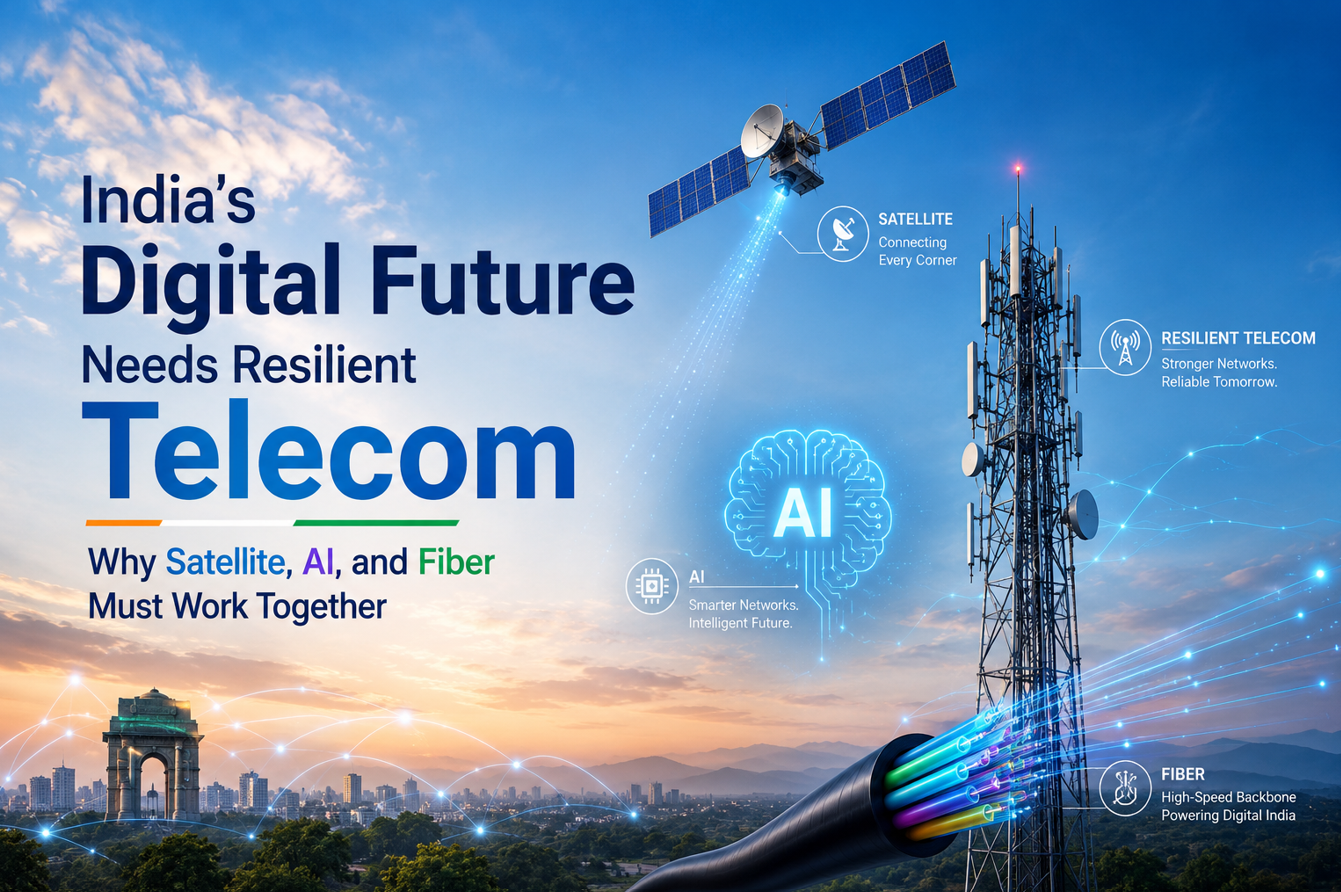
India’s digital economy is growing fast, but growth alone is not enough anymore. The next big challenge is reliability. If networks slow down during peak hours, fail during disasters, or miss remote regions, digital progress becomes uneven. That is why industry leaders are now pushing a clear message which is India needs resilient telecom networks powered by satellite, AI, and fiber. This is not just a technology slogan. It is a practical roadmap for keeping services stable as data demand rises across education, healthcare, fintech, ecommerce, and public services.
Recent discussions at telecom and digital infrastructure forums in 2026 have repeated the same point that is the future network cannot depend on one layer alone. Fiber provides capacity, AI improves network intelligence, and satellite extends reach where terrestrial links are weak or absent.
Why “Resilience” Is the New Telecom Priority
For years, telecom conversations were mostly about coverage and speed. Now the focus is shifting to continuity and trust. A resilient network means services remain available even when one part of the system fails. Think of it like transport in a large city. If one road is blocked, traffic should still move through alternate routes. Telecom needs the same logic. If a fiber cut happens, traffic can be rerouted. If tower congestion rises, AI can rebalance capacity. If terrain makes towers difficult, satellite can bridge the gap.
This matters because India’s digital life now depends on real-time connectivity. UPI payments, telemedicine calls, cloud-based classrooms, emergency response systems, and logistics tracking all need stable uptime, not just good average speed.
Industry speakers have also highlighted that resilience is now linked with national competitiveness. Countries that build robust digital infrastructure attract more innovation, enterprise investment, and advanced technology deployment.
The Three-Pillar Model- Fiber + AI + Satellite
1) Fiber: The high-capacity backbone
Fiber is still the core layer for high-volume data movement. It carries massive traffic between cities, data centers, and telecom exchanges with low latency and high reliability. In simple words, fiber is the heavy-duty highway of the internet. But fiber alone cannot solve all problems. It can be expensive or slow to deploy in difficult terrain, and accidental cable cuts can disrupt service.
2) AI: The brain of modern networks
AI helps telecom networks become proactive instead of reactive. Instead of waiting for complaints, AI systems can predict failures, detect unusual behavior, optimize routing, and improve energy use. A practical example: if a sports event suddenly increases demand in one area, AI-driven network management can shift capacity quickly and reduce call drops or poor data experience. AI can also strengthen security by detecting spam and suspicious traffic patterns faster. That improves user trust, which is now a major part of telecom quality.
3) Satellite: The reach extender
Satellite connectivity is crucial for areas where laying fiber or maintaining dense tower infrastructure is hard. It also acts as a backup path during floods, landslides, earthquakes, or other events that damage terrestrial networks. India’s geography makes this especially relevant: mountains, islands, border regions, and low-density rural belts all need stronger last-mile strategies. Satellite does not replace fiber; it complements it.
The strongest approach is hybrid architecture i.e. fiber where feasible, wireless for mobility, and satellite for continuity and reach.
What This Means for Daily Users and Businesses
For most people, this may sound technical, but the impact is very practical-
- Fewer service disruptions during peak traffic
- Better connectivity in remote and semi-rural areas
- More reliable digital payments and online services
- Stronger support for telehealth, remote learning, and small business tools
For businesses, resilient networks reduce downtime risk. A kirana using QR payments, a hospital sharing diagnostic data, or an SME running cloud software all depend on stable links.
A simple example can be like in a district where fiber outages are frequent during monsoon, a satellite-enabled backup can keep banking kiosks, schools, and local offices online. That is resilience translated into real outcomes.
Competitive Landscape: Who Must Execute Better
The resilience push also raises the competitive bar for telecom players and ecosystem partners.
- Operators will compete not only on tariff, but on uptime and service consistency.
- Infra providers will be judged by how fast they restore outages and secure critical routes.
- Satellite and cloud partners will compete on integration quality and cost efficiency.
- Enterprise connectivity providers will differentiate through SLA-backed reliability, not just bandwidth claims.
In short, the market is moving from “who is cheapest?” to “who is most dependable at scale?”
Policy and Execution Gaps India Must Solve
Leaders have also flagged that technology alone is not enough. India still needs coordinated action across policy and operations-
- Faster clearances for right-of-way and fiber expansion
- Clear rules for satellite-terrestrial integration
- Stronger protection and redundancy for subsea and long-haul links
- Common resilience benchmarks for critical digital services
- Skilled workforce for AI-native network operations
Without these steps, the vision may stay fragmented. With them, India can build a future-ready telecom architecture that supports both growth and stability.
Conclusion – India’s Next Telecom Leap Will Be About Reliability
The message from industry discussions is clear which is that India’s digital future depends on networks that are not only fast, but resilient by design. Fiber gives capacity, AI brings intelligence, and satellite adds reach plus backup strength. If these three layers are developed as one coordinated system, India can unlock more inclusive and dependable digital growth. That will matter not just for telecom companies, but for every citizen, startup, school, hospital, and enterprise that now runs on connectivity. The next phase of India’s digital journey will be won by those who deliver reliable connectivity everywhere, every day.
Source- Indian Economic Observer, TelecomDrive, ETGovernment, Voice&Data, Fortune India
Discover more from Newskart
Subscribe to get the latest posts sent to your email.

[…] India’s Digital Future Needs Resilient Telecom-Why Satellite, AI, and Fiber Must Work Together […]