


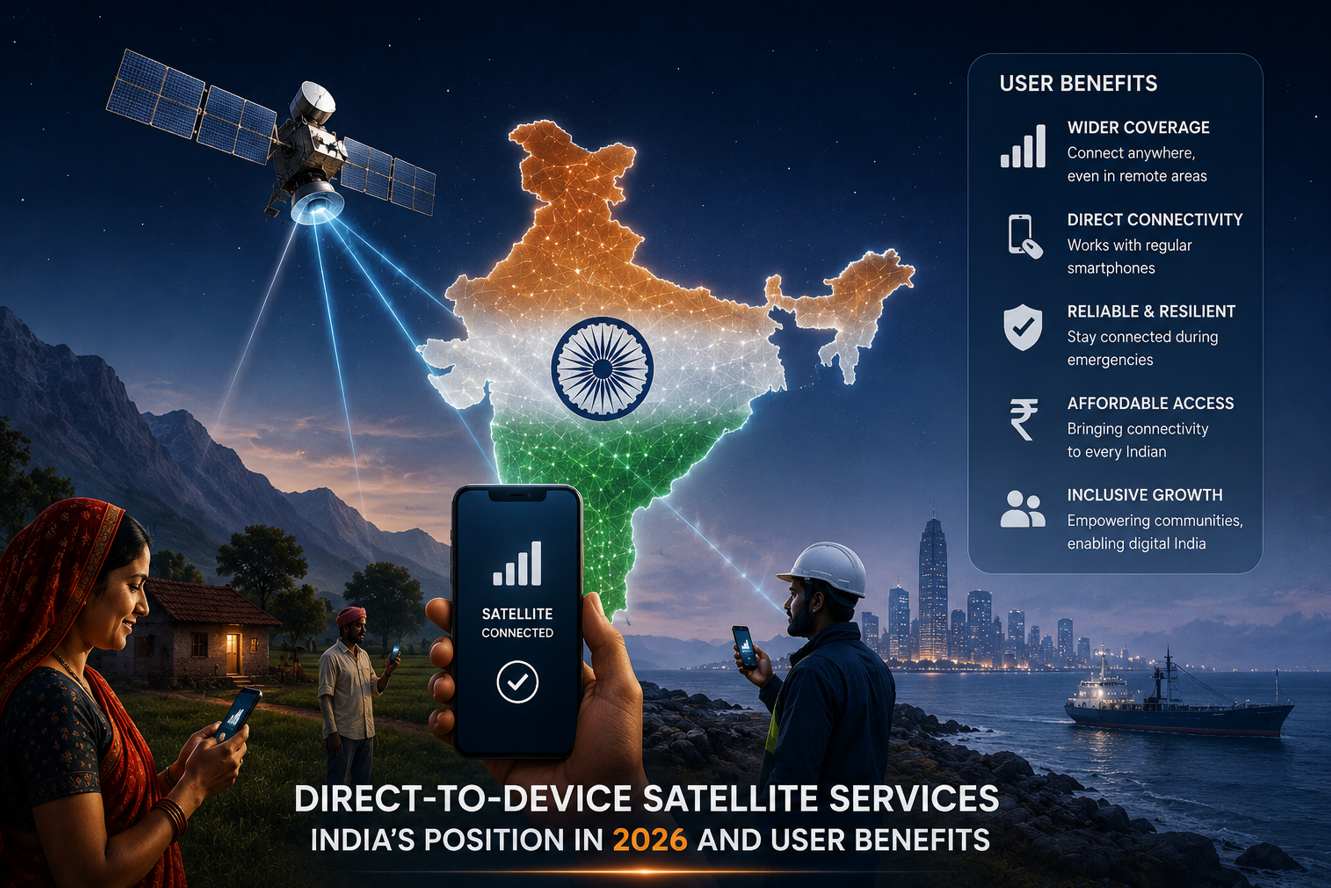
Mobile connectivity has improved in India, but everyone still knows one familiar problem i.e. network black spots. You may get full signal in the city and almost no coverage on a highway, in hilly areas, deep rural zones, or during disasters. This is where Direct-to-Device (D2D) satellite service is being discussed as a game-changing layer.
In simple words, D2D means satellites communicate directly with ordinary mobile phones (or near-standard phones), instead of depending only on ground towers. The goal is not to replace normal telecom networks in cities. The goal is to fill coverage gaps where terrestrial networks are weak or unavailable.
What Is D2D Satellite Service and How Is It Different?
Traditional satellite internet usually needs a dish or special terminal. D2D is different because it is designed to connect with handheld devices using mobile-operator spectrum and standards. Think of it as “mobile network from space” for places where towers cannot reliably reach.
In early phases, D2D services globally are mostly expected to focus on-
- Emergency messaging
- Basic text and low-bandwidth communication
- Backup connectivity in remote areas
As new satellite launches and device support is improving day by day, higher-level services like broader voice and data can also be improved. But that is gradual. So it is important to keep expectations realistic. D2D is evolving as a complementary layer, not instant full-speed broadband everywhere.
Where India Stands in 2026
India has not yet reached mass commercial D2D rollout for everyday users, but 2026 has seen important policy movement. On 8 April 2026, TRAI released a major consultation paper on satellite communication network authorization and spectrum assignment. This matters because spectrum and licensing rules are foundational for any D2D-scale rollout in India.
The consultation process reflects a practical reality: India wants satellite growth, but also needs a clear framework on authorization, pricing logic, and coexistence with terrestrial telecom operators. In parallel, global D2D players are scaling launches and approvals in other markets, which increases pressure for India to finalize a robust but balanced framework.
So, India in 2026 can be described as policy-progress stage with high potential, but not full consumer D2D adoption stage yet.
How Indians Could Benefit from D2D Services
If implemented well, D2D can solve real public problems such as follows-
- Coverage in remote regions
Villages, hilly belts, border locations, and sea routes can get backup communication support where towers are difficult to deploy. - Disaster resilience
During floods, earthquakes, cyclones, or landslides, terrestrial networks may fail. D2D can provide emergency continuity. - Safer travel and logistics
Highway transport, trekkers, field workers, fishermen, and remote project teams can stay connected in low-network zones. - Public service delivery support
Government and emergency agencies can improve communication reliability in difficult terrain. - Digital inclusion over time
While D2D won’t replace fibre or 5G in dense cities, it can reduce complete disconnect risk for underserved geographies.
The biggest long-term benefit is not speed; it is availability. For millions, even basic always-on communication in remote areas can have major social and economic value.
Conclusion
Direct-to-Device satellite services are one of the most important connectivity shifts to watch. In 2026, India is not fully there yet, but the policy groundwork is clearly moving forward. If spectrum, licensing, and operator partnerships are aligned, D2D can become a strong support layer for remote coverage and emergency communication. For Indian users, the message is simple that this technology may not replace your everyday 4G/5G city experience soon, but it could dramatically improve network reliability where it matters most-when towers are absent, weak, or down.
Facts Input- TRAI Consultation Papers, TRAI Press Release, Telecoms[dot]com
AI generated image
Discover more from Newskart
Subscribe to get the latest posts sent to your email.

Comments are closed.