

Delhi Approves Rs. 400 Crore Start-Up and Incubation Policy to Turn Students into Job Creators


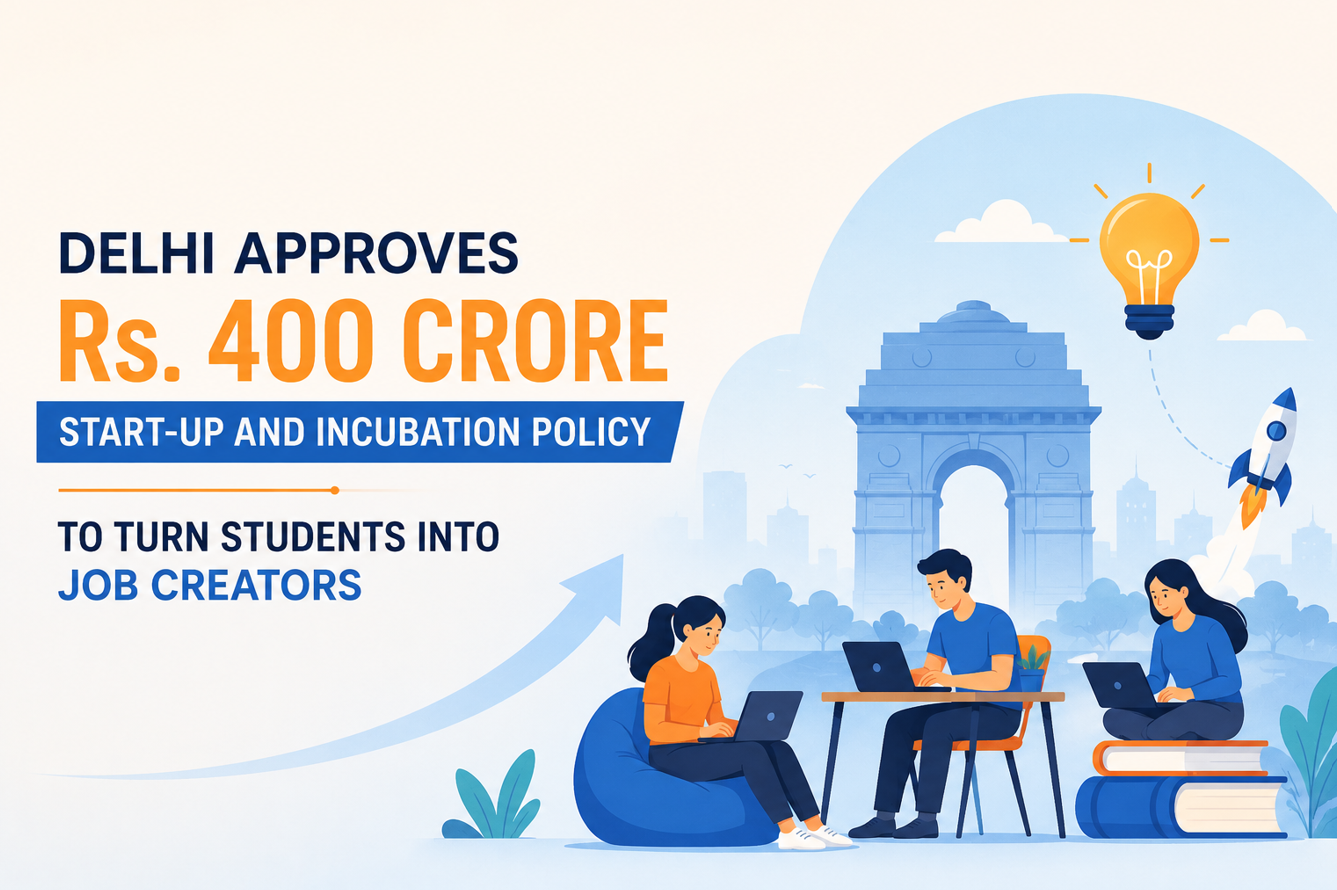
Delhi has approved a new Start-Up and Incubation Policy with more than Rs. 400 crore planned over the next five years. The policy is aimed at students, young founders, researchers and first-time entrepreneurs who often have ideas but lack money, mentoring and a proper place to build.
Chief Minister Rekha Gupta said the policy is meant to help Delhi’s youth move from being job seekers to job creators. That line is important because the policy is not only about funding startups. It is also about building an entrepreneurship culture inside universities, colleges, ITIs and polytechnic institutions.
If implemented well, this could give Delhi a stronger startup pipeline, especially from students who do not come from business families or already-funded founder networks.
What the Delhi Start-Up and Incubation Policy covers
The policy will cover 11 state universities, 13 government-aided colleges, government ITIs and polytechnic institutions.
Students from Delhi government schools will also be able to access benefits through these institutions. This is a useful detail because startup support often begins too late, only after graduation. Delhi is trying to expose younger students to innovation and entrepreneurship earlier.
The government will support incubation centres in these institutions. These centres are expected to provide workspace, labs, testing facilities, mentorship, networking and guidance for building early-stage ideas.
In simple words, a student with a working idea should not be left alone with only a notebook and enthusiasm. The policy wants to give that student a place, people and some financial support to move forward.
Aim and purpose of the policy
The main purpose is to make entrepreneurship easier for young people in Delhi.
Many students have ideas for apps, small machines, local services, education tools, health products, climate solutions, food brands or social businesses. But most ideas die early because students do not know how to test them, register a startup, find customers, make a prototype or pitch to investors.
This policy tries to solve that early-stage gap.
It also wants to connect education with real-world problem solving. A college project should not always end as a file submitted for marks. Some projects can become useful products or businesses if they get the right support.
How funding may work
Startups linked to the incubation centres will get milestone-based financial assistance.
That means money may be released at different stages, such as idea validation, prototype development, proof of concept, product building, market testing and commercial launch.
This is better than giving one-time money without checking progress. A founder who builds a prototype may need one kind of support. A founder ready to test with customers may need another.
For example, a student team building a low-cost water testing device may first need money for parts and lab testing. Later, it may need support for field trials, packaging, certification and early sales. Milestone-based support can match the startup’s real journey.
Role of incubation centres
Incubation centres will be the heart of the policy.
These centres can help founders with basic but important things – refining the idea, checking whether customers really need it, building a prototype, understanding legal steps, making a pitch deck and meeting mentors.
They can also connect students with industry experts and investors. That is often the missing link in college-level entrepreneurship.
A good incubation centre does not only offer chairs and Wi-Fi. It helps founders avoid common mistakes. It tells them when an idea is weak, when the market is too small, and when the product needs to be changed.
Monitoring and governance
The government will set up a State Incubation Policy Monitoring Committee to oversee implementation.
This committee will include representatives from the government, educational institutions, industry and the startup ecosystem.
That mix matters. If the policy is handled only like an education scheme, it may become too academic. If it is handled only like a business scheme, students may struggle. A combined approach can keep it practical.
The government also plans to hold an annual Delhi Start-up Youth Festival. This can become a useful platform if it brings together students, founders, investors, companies, colleges and policymakers in a serious way, not just as a photo event.
How this can help job creation
Startups create jobs in two ways.
- First, successful startups hire people directly. A small team of three students can become a company with designers, engineers, salespeople, finance staff and operations workers.
- Second, startups create indirect work. A food startup may need packaging, delivery, raw material suppliers and cloud kitchen workers. A hardware startup may need fabricators, testers and service partners. A software startup may hire freelancers, interns and support staff.
Not every startup will become huge. That is normal. But even small local businesses can create meaningful employment if enough of them survive.
Why Delhi is a strong place for this policy
Delhi already has universities, colleges, coaching hubs, young consumers, government institutions, investors, media, service businesses and a large market nearby.
It also has access to NCR cities like Gurugram and Noida, where many startups, corporates and investors are based. That gives Delhi students a wider startup environment if the policy connects institutions properly.
A student building a legal-tech product, education app, mobility service, clean-air device, retail brand or public-service tool can find early users within Delhi itself.
Who may benefit most
Students from universities, ITIs and polytechnics may benefit directly. This includes not only engineering students but also commerce, arts, vocational and diploma students.
That is important because startup ideas do not come only from coders. A fashion student may build a sustainable clothing brand. An ITI student may design a practical tool for repair workers. A commerce student may create a small business service platform. A government school student may notice a local problem adults have ignored.
The policy can work best if it treats all these students as potential founders.
Challenges ahead
The policy sounds promising, but execution will decide its real value.
- The first challenge is quality of mentors. A weak mentor network can turn incubation into paperwork. Students need people who understand product, finance, marketing, technology and customer behaviour.
- The second challenge is speed. Startups move fast. If approvals take months, students may lose interest.
- The third challenge is fair access. Benefits should not go only to already-connected colleges or polished English-speaking founders. Good ideas can come from quieter students too.
- The fourth challenge is follow-up. Funding a prototype is easy. Helping it reach customers is harder.
Conclusion – Key takeaways
Delhi’s Rs. 400 crore Start-Up and Incubation Policy is a strong step toward building a student-led innovation ecosystem.
The policy will support universities, colleges, ITIs and polytechnic institutions with incubation centres, mentoring, funding and industry links. It also gives Delhi government school students a pathway to access startup support.
Its real success will depend on how quickly and fairly the money reaches serious founders, how strong the mentors are, and whether incubation centres help students build businesses that solve real problems.
Facts Input- HT, Delhi Industries Department
Discover more from Newskart
Subscribe to get the latest posts sent to your email.

Comments are closed.