

Delhi Doubles Priority Household Ration Card Income Limit to Rs. 2.5 Lakh, Know who may benefit


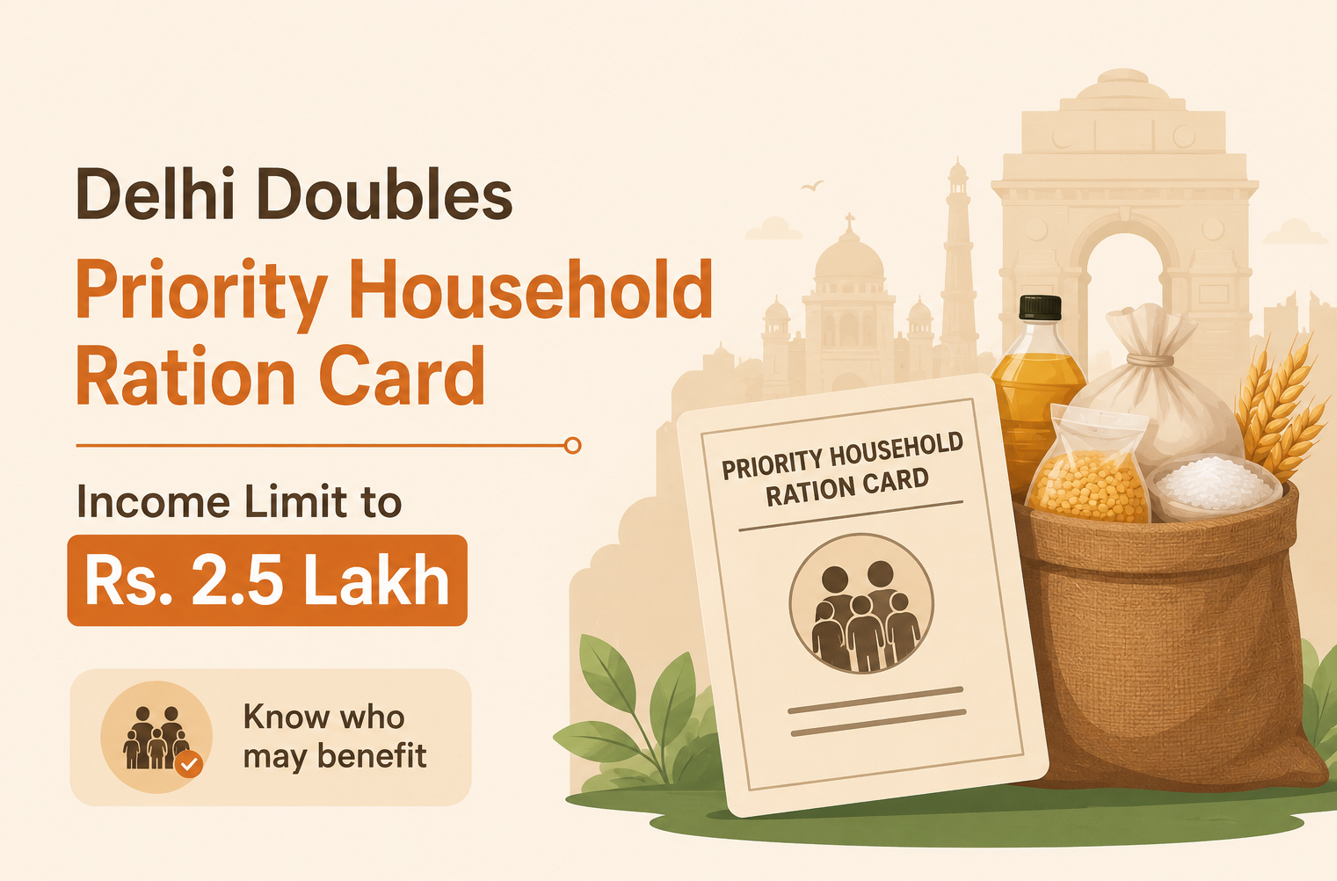
Delhi has raised the annual income limit for Priority Household ration card eligibility from Rs. 1.2 lakh to Rs. 2.5 lakh. The decision is expected to bring more low-income families under the Public Distribution System and help them access subsidized food-grain.
This change matters because many working families in Delhi were earning slightly above the old limit, but were still struggling with rent, food, transport, education and healthcare costs. For them, the earlier income ceiling had become too low for today’s living expenses.
The Delhi Cabinet approved the proposal in May 2026. The government has also reopened online applications for new ration cards and family member additions through the e-District portal.
What has changed
Earlier, households with annual family income up to Rs. 1.2 lakh were eligible under the Priority Household category. Now, that limit has been doubled to Rs. 2.5 lakh per year.
This means families earning up to Rs. 2.5 lakh annually may now be able to apply for ration card benefits, subject to other eligibility rules.
The change is especially important for informal workers. Domestic workers, construction workers, drivers, street vendors, helpers, small shop workers and daily-wage families often earn above the old limit but still do not have stable financial security.
Why Delhi changed the income limit
The old income limit did not match Delhi’s current cost of living.
A family earning Rs. 10,000 to Rs. 20,000 per month may still find it difficult to manage basic expenses in the capital. Rent alone can take away a big part of income. Add school fees, medicines, transport and food, and the pressure becomes clear.
Delhi Food and Supplies Minister Manjinder Singh Sirsa said the earlier limit was too low in today’s conditions. The government has argued that the new limit will help more deserving families get subsidized ration.
How this can affect beneficiaries
The biggest impact will be food security.
Families that were earlier excluded because their income was slightly above Rs. 1.2 lakh may now become eligible. If approved, they can get subsidized foodgrain through fair price shops under the National Food Security Act framework.
This can reduce monthly food expenses. For a low-income household, even a few hundred rupees saved on food can be used for school notebooks, medicines, travel or emergency needs.
It can also help families with irregular earnings. A driver or daily-wage worker may earn decently in one month and very little in another. Ration support gives such families some stability.
New applications and vacant slots
The Delhi government carried out a verification drive and removed around 7.72 lakh invalid or ineligible beneficiaries from ration records.
According to reports, some names were removed because beneficiaries were above the income limit, some had not collected ration for over a year, some were deceased, and some were found to be duplicate entries.
This has opened space for new eligible applicants. The government has said fresh applications and requests for adding family members are now being accepted online.
How to apply Household Ration Card
Applicants can apply through Delhi’s e-District portal.
The process is now online for services such as fresh ration card applications and addition or deletion of family members. People can apply from home or through facilitation centres if they need help.
Documents may include Aadhaar cards of family members, Delhi residence proof, income certificate from the Revenue Department, mobile number, and other supporting documents as required.
Applicants should keep details consistent across documents. Name mismatch, wrong address or incomplete income proof can delay approval.
Why this helps women too
Under Delhi’s food security rules, applications are linked to the head of the household, generally the eldest female member. This gives women a more central role in the ration card process.
For many households, women manage food, kitchen expenses and family nutrition. A ration card in the woman’s name can give her more control over basic household support.
This may look small on paper, but in many families it can improve dignity and decision-making. Recently, Delhi Government also launched Lakshmi Yojna in the state.
Impact on Delhi’s PDS system
Delhi has around 1,943 fair price shops using electronic point-of-sale machines. These machines help record distribution digitally.
With more eligible families coming in, the system will need to handle applications, verification and ration delivery smoothly. If the process is slow, families may still struggle despite the higher income limit.
The government is also exploring a digital currency-based ration distribution model in the future. That idea is still developing, but it shows Delhi is trying to modernize the ration delivery system.
Possible challenges
- The first challenge is verification. Delhi has many migrant workers, rented households and informal earners. Proving income and residence can be difficult for them.
- The second challenge is awareness. Many eligible families may not know that the income limit has changed.
- The third challenge is digital access. Online applications are useful, but not everyone is comfortable using portals. Facilitation centres and local help desks will be important.
- The fourth challenge is avoiding fake claims. The government will need to ensure that genuinely needy families are included while duplicate or ineligible entries are kept out.
What beneficiaries should do now
Families earning up to Rs. 2.5 lakh per year should check eligibility and keep documents ready.
Do not pay agents who promise guaranteed approval. Apply only through official government portals or authorized centres.
If an old application is pending, check whether fresh submission is needed under the updated rules. Reports suggest earlier applicants may be asked to apply again because income, residence and family details may have changed.
Conclusion – Key takeaways
Delhi’s decision to raise the Priority Household ration card income limit to Rs. 2.5 lakh can help many low-income families who were earlier left out.
The move can reduce food expense pressure, support informal workers and bring more households into the food security net. But its success will depend on fast verification, simple online applications, clear communication and fair selection.
For eligible families, the next step is simple – check the official portal, keep documents ready and apply through the proper channel.
Facts Input- The Tribune
Discover more from Newskart
Subscribe to get the latest posts sent to your email.

Comments are closed.