


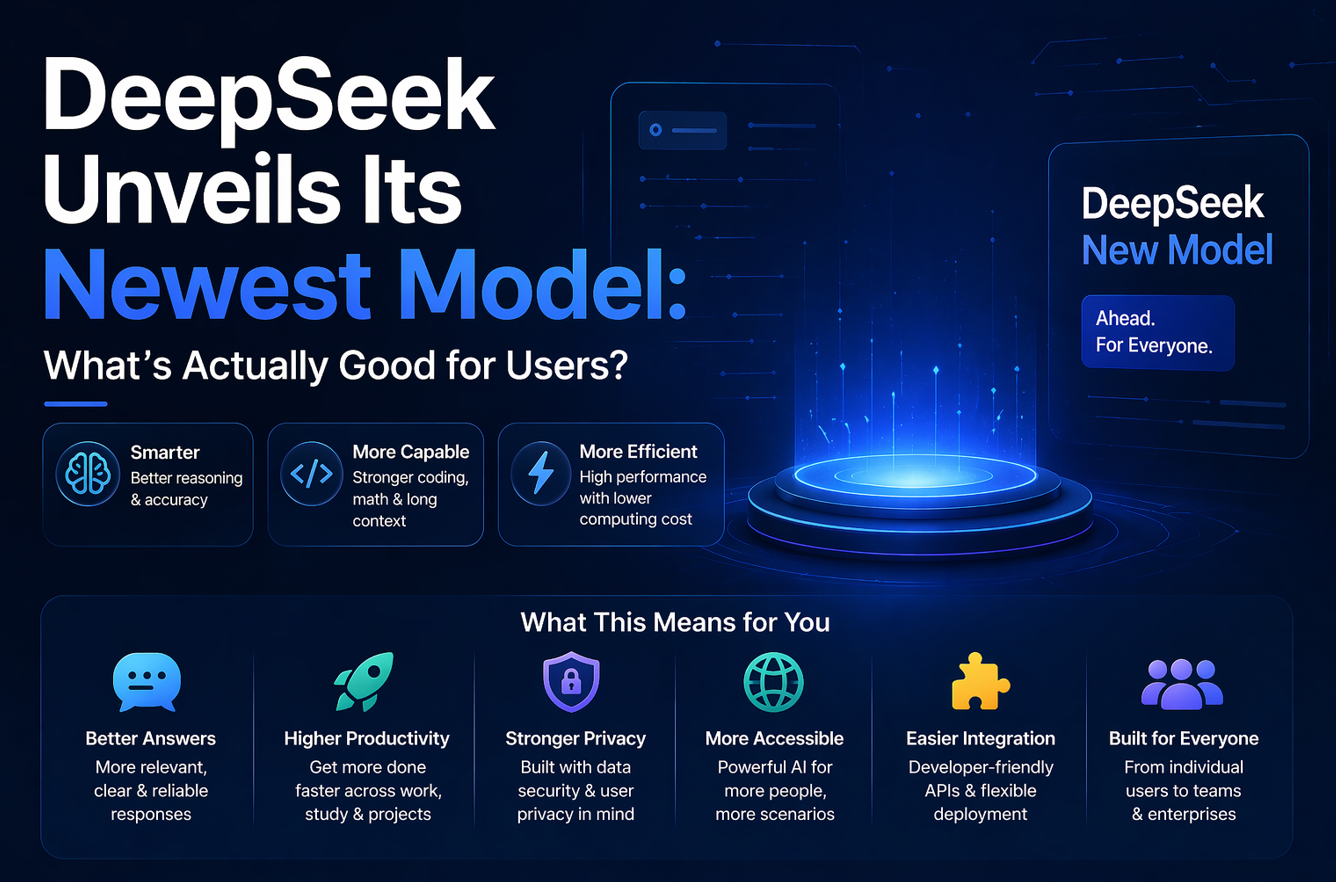
DeepSeek has unveiled its newest model lineup, and the update is getting attention across the AI world for one reason: it is trying to deliver stronger performance at lower cost. In a market where users are tired of expensive AI tools and confusing model choices, that promise matters.
The launch is centered on preview versions of DeepSeek V4 Pro and DeepSeek V4 Flash. According to reports and company claims, these models focus on better reasoning, larger context handling, and stronger coding capability. At the same time, DeepSeek appears to be keeping pricing aggressive versus many frontier alternatives.
For regular users, this is the key question: does this release improve your real work, or is it just another benchmark story? Let’s break that down in simple terms.
What DeepSeek Just Announced
Recent reports indicate DeepSeek has released preview versions of V4 in two tracks:
- V4 Pro: the higher-capability model for more complex tasks
- V4 Flash: the faster, lighter, and cheaper variant for broad usage
Coverage also highlights a very large context window claim (up to one million tokens), plus improvements in coding and reasoning benchmarks compared with previous DeepSeek generations. Some reports add that the new family is text-focused for now, rather than fully multimodal.
Important to note: most of these claims are currently in “launch stage” reporting. As with any new model release, real-world consistency over the next few weeks is what ultimately matters.
About DeepSeek and Its Competitors
Simple comparison of positioning, strengths, and practical usage fit
What Is Good for Users? The Practical Benefits
1) Better long-document handling
If large-context behavior is reliable, users can work with bigger inputs in one thread: long reports, contracts, code repositories, research notes, or multi-file product specs.
Why it helps: less copy-paste fragmentation, fewer “continue in next prompt” breaks, and better continuity in complex tasks.
2) More useful reasoning for work problems
DeepSeek is positioning V4 as stronger in reasoning-heavy tasks. For users, this can mean better multi-step outputs in planning, debugging, analysis, and problem solving.
Why it helps: clearer structured answers for tasks where simple autocomplete is not enough.
3) Stronger coding support at lower cost
Launch coverage places coding performance as a key focus area. If this holds up in daily usage, developers get a potentially cheaper alternative for test generation, refactoring suggestions, bug isolation, and architecture drafts.
Why it helps: teams can scale AI-assisted coding without spending frontier-model budgets on every request.
4) Cost pressure on the whole AI market
Even users who do not adopt DeepSeek directly can benefit if it pushes broader pricing competition.
Why it helps: when one model family lowers inference cost, other providers are often forced to improve value and packaging.
Who Benefits the Most Right Now
The biggest early advantage is likely for:
- startup engineering teams with limited AI budgets
- independent developers and freelancers
- research-heavy users who process long text and code context
- product teams that need many AI calls every day, not occasional use
- users in markets where cost-per-token is a real purchase barrier
For these groups, “good enough frontier-like capability at better price” is often more valuable than absolute top benchmark leadership.
Final Verdict: Is This Good for Users?
Yes, broadly. DeepSeek’s newest model release is good for users mainly because it adds pressure for better value in AI. The biggest upside is not a single benchmark score. The real upside is improved access to capable models for users who care about cost, coding help, and long-context workflows.
At the same time, this is still a preview-stage moment. The smartest move is to test before committing, measure quality in your own workflows, and avoid model loyalty based only on launch-day claims.
Discover more from Newskart
Subscribe to get the latest posts sent to your email.

Comments are closed.