

National Pension System – Can Retirees Create a Salary Like Monthly Income? Explained Simply


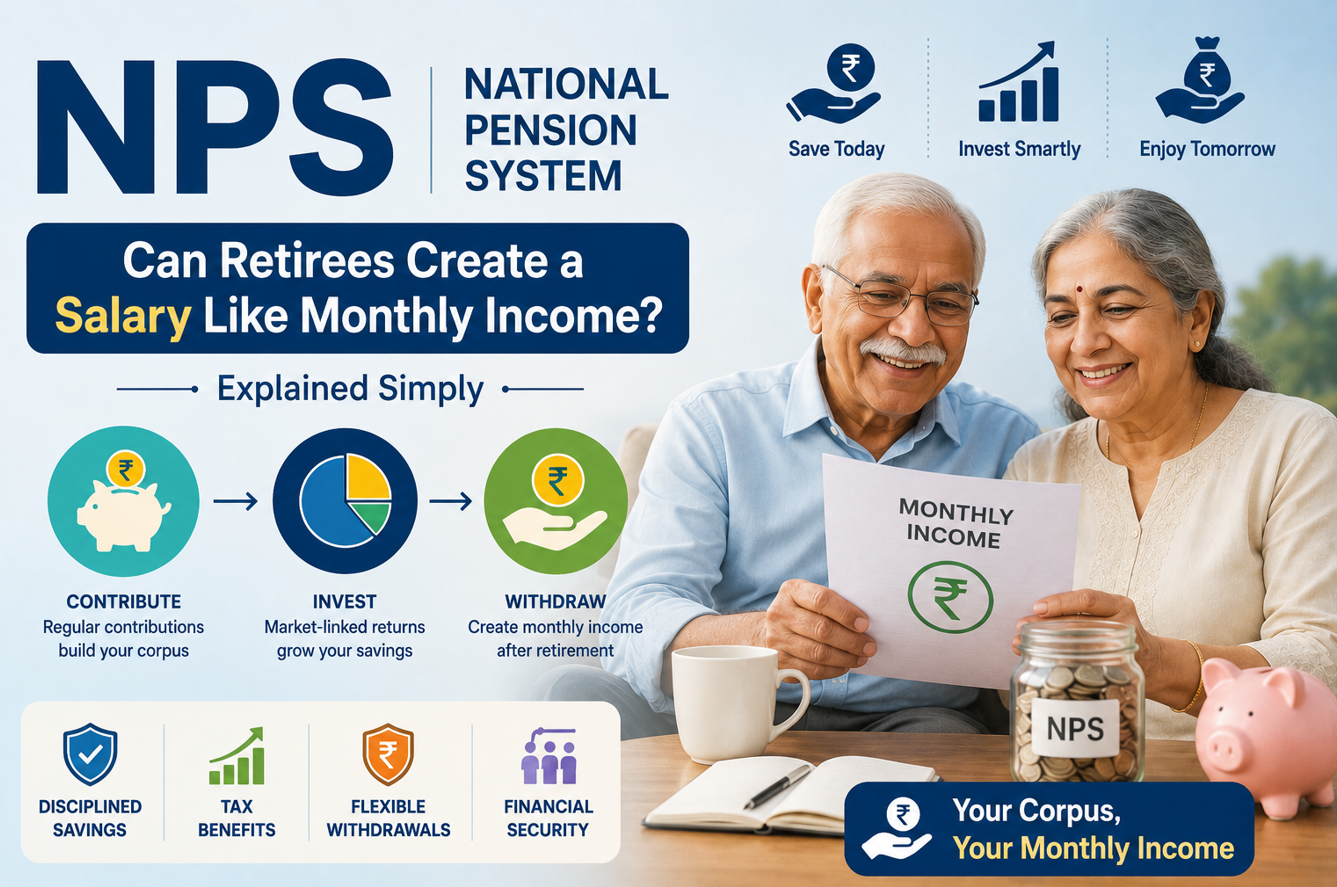
Retirement planning in India is changing fast. Earlier, many people depended only on family support, fixed deposits, or employer pension. Today, more workers use the National Pension System (NPS) as a long-term retirement tool. But one practical question comes up again and again which is that Can NPS create a salary-like monthly income after retirement?
The short answer is yes, but partially. NPS is designed to provide pension income through annuity, and with smart planning, retirees can structure their withdrawals to feel closer to a regular monthly paycheck. Still, it is important to understand how the system works before expecting a perfect “salary replacement.”
How NPS Pays You After Retirement
At retirement (normal exit), NPS does not usually give the entire corpus as free cash. A part of the corpus must be used to buy an annuity (pension product), and the remaining portion can be withdrawn as lump sum or in phased form as allowed by rules.
In simple terms-
- Annuity part gives periodic pension (monthly/quarterly/etc., depending on option).
- Lump sum part gives flexibility for one-time needs or planned drawdown.
This combination is why NPS can support a salary-like plan, but the monthly amount depends on your final corpus, annuity rates at exit, and how you manage the non-annuity portion.
Core Rule You Must Know
As per current PFRDA guidance for many standard exits in the All Citizen Model-
- A minimum 40% of corpus is typically used for annuity purchase.
- Up to 60% can be taken as lump sum (or managed through phased withdrawal options where applicable).
That means your “guaranteed pension stream” usually starts from the annuity chunk, not the full corpus.
Can It Feel Like a Monthly Salary? Yes, If You Plan It Correctly
To create salary-like income, retirees often combine two streams which are-
- Annuity pension (fixed core income)
This is the stable base. It is predictable but may not be very high if corpus is small. - Planned drawdown from lump sum (top-up income)
You can place the lump-sum portion in low-to-moderate risk instruments and withdraw a fixed monthly amount.
So instead of depending only on annuity, you build a “two-layer income model” where-
- Layer 1: fixed pension
- Layer 2: controlled monthly top-up
This structure can make cash flow feel closer to pre-retirement salary behavior.
Simple Example (Illustrative, Not Investment Advice)
Assume a retiree exits NPS with a ₹1 crore corpus.
- ₹40 lakh goes to annuity (minimum requirement case).
- ₹60 lakh remains as lump sum/managed corpus.
If annuity gives monthly pension based on chosen option and prevailing rates, that becomes the base cash flow. Then the retiree may withdraw a fixed amount monthly from the ₹60 lakh pool through a disciplined plan.
So the result would be combined monthly inflow which can be steadier and more “salary-like” than relying only on one component.
Who Should Consider This Strategy
This approach is useful for:
- Salaried professionals retiring without traditional defined-benefit pension
- Self-employed individuals who built retirement corpus through NPS
- Households that want predictable monthly cash flow rather than large idle lump sum
- Retirees who can follow a structured withdrawal discipline
Competitor Comparison – NPS vs Other Retirement Income Routes
Retirees often compare NPS with EPF/VPF corpus withdrawals, Senior Citizen Savings Scheme (SCSS), Monthly income plans and debt mutual fund SWP, Immediate annuity plans outside NPS, and Fixed deposits and post-office products. Behavior wise all are the different components and they all are designed for different different purposes.
Where NPS helps:
- long-term compounding during working years
- regulated structure
- mandatory pension-linked discipline via annuity component
Where others may help:
- simpler liquidity
- different risk-return profiles
- potentially easier income customization
In practice, many retirees use NPS + other instruments together which is a good combination.
Risks and Limits You Should Not Ignore
Even with good planning, NPS income is not a perfect salary clone because-
- Annuity payouts depend on market annuity rates at exit time
- Inflation can reduce real value of fixed pension over years
- Poor management of lump-sum portion can cause income gaps later
- Healthcare costs can rise faster than expected
So the goal should be “reliable retirement cash flow,” not exact salary replication.
5-Step Plan to Build Salary-Like Income from NPS
- Estimate monthly retirement expense realistically.
- Calculate expected annuity income from your projected corpus.
- Keep an emergency buffer separate from monthly drawdown pool.
- Design a conservative monthly withdrawal plan for lump-sum part.
- Review annually for inflation and medical cost adjustments.
This keeps your retirement income strategy practical and sustainable.
Conclusion – Yes, It Is Possible, But Strategy Matters
NPS can absolutely help retirees create a salary-like monthly income, but it works best when treated as a system, not a single payout tool. The annuity gives stability, while planned drawdown from the remaining corpus can improve monthly comfort. If you want retirement cash flow that feels predictable, combine discipline with flexibility: build a pension base, manage top-ups wisely, and review your plan each year. So the key takeaway is simple which is that NPS can support steady retirement income, but the final outcome depends on planning quality, not just contribution amount.
Discover more from Newskart
Subscribe to get the latest posts sent to your email.

Comments are closed.