

TCS Launches NVIDIA-Powered Industrial AI Lab in Bengaluru to Speed Up Real-World AI Adoption


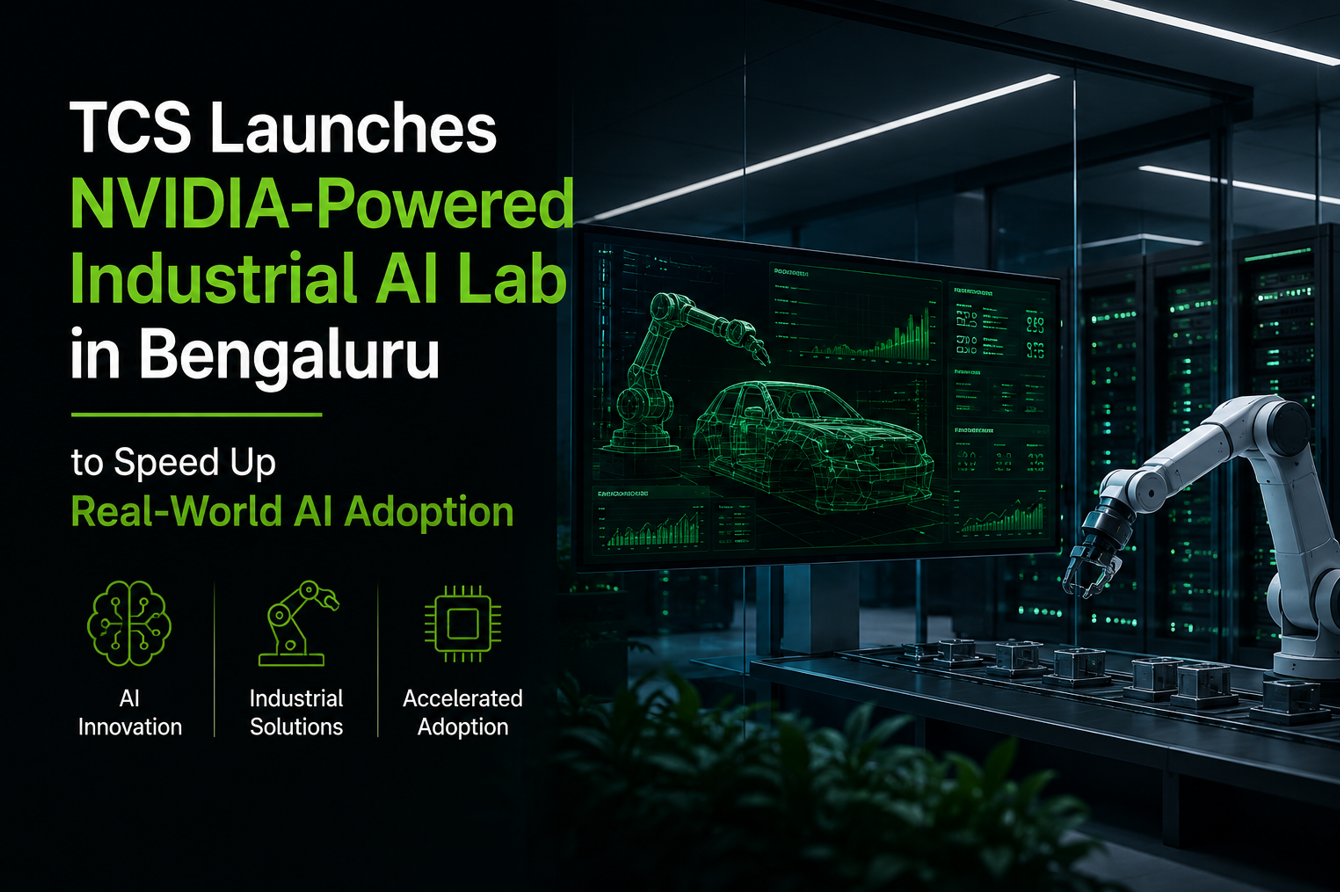
Tata Consultancy Services has launched a new Industrial AI-focused lab in Bengaluru, powered by NVIDIA’s AI infrastructure. The facility, called the TCS Autonomous Engineering Lab Powered by NVIDIA, is located at TCS’ Global Axis campus.
The launch is aimed at one problem many companies are facing right now. They are interested in AI, they run pilots, they test ideas, but moving from a small experiment to a real factory, vehicle platform or shop-floor system is still difficult.
TCS wants this lab to become a practical bridge between AI demos and actual industrial use. The focus is mainly on mobility, manufacturing, autonomous systems, smart plants and engineering-heavy businesses.
What TCS has launched
The new Bengaluru lab will work as a physical hub for Industrial AI innovation. It will help companies design, test, simulate and validate AI-led solutions before using them in real operations.
That last part matters. In manufacturing or mobility, a bad rollout can be expensive. If an AI system fails inside a plant, production may stop. If an autonomous mobility feature is not tested properly, safety becomes a concern. This is why simulation and controlled testing are important.
The lab will use NVIDIA AI infrastructure and TCS’ own industrial engineering experience to help customers build solutions faster and with lower deployment risk.
Why Bengaluru was chosen
Bengaluru is a natural place for such a lab. The city has a deep technology ecosystem, engineering talent, automotive software teams, startups, global capability centres and manufacturing-tech expertise.
For TCS, Bengaluru also gives access to clients, partners and skilled teams that understand both software and industrial engineering. That mix is important because Industrial AI is not only about writing code. It needs knowledge of machines, sensors, vehicles, plants, safety and operations.
What Industrial AI means
Industrial AI simply means using artificial intelligence in physical industries. It is AI for factories, machines, vehicles, supply chains, energy systems and field operations.
A normal office AI tool may summarize emails or write reports. Industrial AI may predict when a machine will fail, inspect product defects through cameras, improve factory output, help vehicles understand roads or simulate how a product will behave before it is built.
This is harder than basic chatbot AI because the system has to work with real-world data, machines, sensors and safety rules.
Key solutions inside the lab
TCS has highlighted several solution areas for the lab.
One is TCS DriveSphere, an AI-led mobility platform for software-defined vehicles. It uses digital twins, real-time data, predictive analytics and over-the-air lifecycle management.
In simple words, it can help vehicle makers manage cars that behave more like connected software platforms. This is becoming important as modern vehicles get more sensors, software updates and driver-assistance features.
The lab will also support AI-led mobility and autonomous systems, including ADAS, autonomous driving, perception systems and intelligent decision-making.
For manufacturing, it will work on physical AI and smart factory use cases such as predictive maintenance, automated quality inspection and real-time process improvement.
The lab will also cover agentic AI and vision AI. Agentic AI can take multi-step actions toward a goal, while vision AI can read images or video from cameras. In a factory, that could mean spotting defects on a production line. In service operations, it could mean helping teams understand problems faster.
Why NVIDIA is important here
NVIDIA is not only a chip company now. Its AI hardware and software stack is used widely for training, simulation, robotics, autonomous driving and industrial AI workloads.
Industrial AI needs heavy computing power. Simulating a vehicle, running vision models or testing a factory process digitally can require strong GPUs and specialized AI tools.
By using NVIDIA’s full-stack AI platform, TCS can offer customers a more serious testing environment. This can help companies try difficult AI use cases before spending money on full deployment.
What companies may gain
For enterprises, the lab can reduce guesswork.
A carmaker can test ADAS-related software in simulation before moving closer to road testing. A manufacturer can test whether vision AI can catch defects on a production line. A plant operator can see if predictive maintenance can actually reduce downtime.
This is useful because many AI projects fail after the pilot stage. They look impressive in a presentation, but struggle when connected to real machines, messy data and business deadlines.
The TCS lab is meant to shorten that distance.
Why this move matters for TCS
TCS is India’s largest IT services company and was founded in 1968 as part of the Tata Group. The company has been trying to deepen its AI services business as clients shift budgets toward automation, cloud, data and AI.
This lab gives TCS a more visible industrial AI asset. Instead of only telling clients that AI can help them, it can bring them into a lab, test use cases and show working prototypes.
That is important because IT services companies are under pressure to prove that AI is not just a consulting story. Clients want results, not slides.
Competitors and market context
TCS will compete with companies such as Infosys, Wipro, HCLTech, Tech Mahindra, LTIMindtree, Accenture, Capgemini and IBM in the industrial AI space.
Several of these firms are also building AI labs, industry clouds, automation platforms and partnerships with chip or cloud companies. The difference will come from execution – who can take AI from experiment to measurable business impact.
For manufacturing and mobility clients, the winners will be partners who understand both software and industrial reality. A factory floor is not a clean test environment. Neither is a road.
Challenges ahead
The biggest challenge is making AI reliable in real operations.
Industrial data is often incomplete, old or scattered across systems. Machines may be from different vendors. Plants may have legacy equipment. Safety checks can slow deployment. Workers also need training to trust and use AI tools.
Another challenge is cost. AI infrastructure is expensive, and companies will want proof that the investment saves money, improves quality or increases output.
TCS will need to show real examples where its lab helps clients move faster and avoid costly mistakes.
Conclusion – Key takeaways
TCS’ NVIDIA-powered Industrial AI lab in Bengaluru is a serious move toward practical AI adoption in mobility and manufacturing.
The lab will help companies prototype, simulate and validate AI solutions before full deployment. Its focus areas include software-defined vehicles, ADAS, autonomous systems, smart manufacturing, predictive maintenance, vision AI and digital twins.
For TCS, the lab strengthens its AI services story. For enterprises, it offers a safer place to test industrial AI before taking it to the real world.
Facts Input- TCS PressRelease
Discover more from Newskart
Subscribe to get the latest posts sent to your email.

Comments are closed.