

Cabinet Approves Rs. 62,500 Crore Mobile Phone Manufacturing Scheme to Boost Jobs and Exports


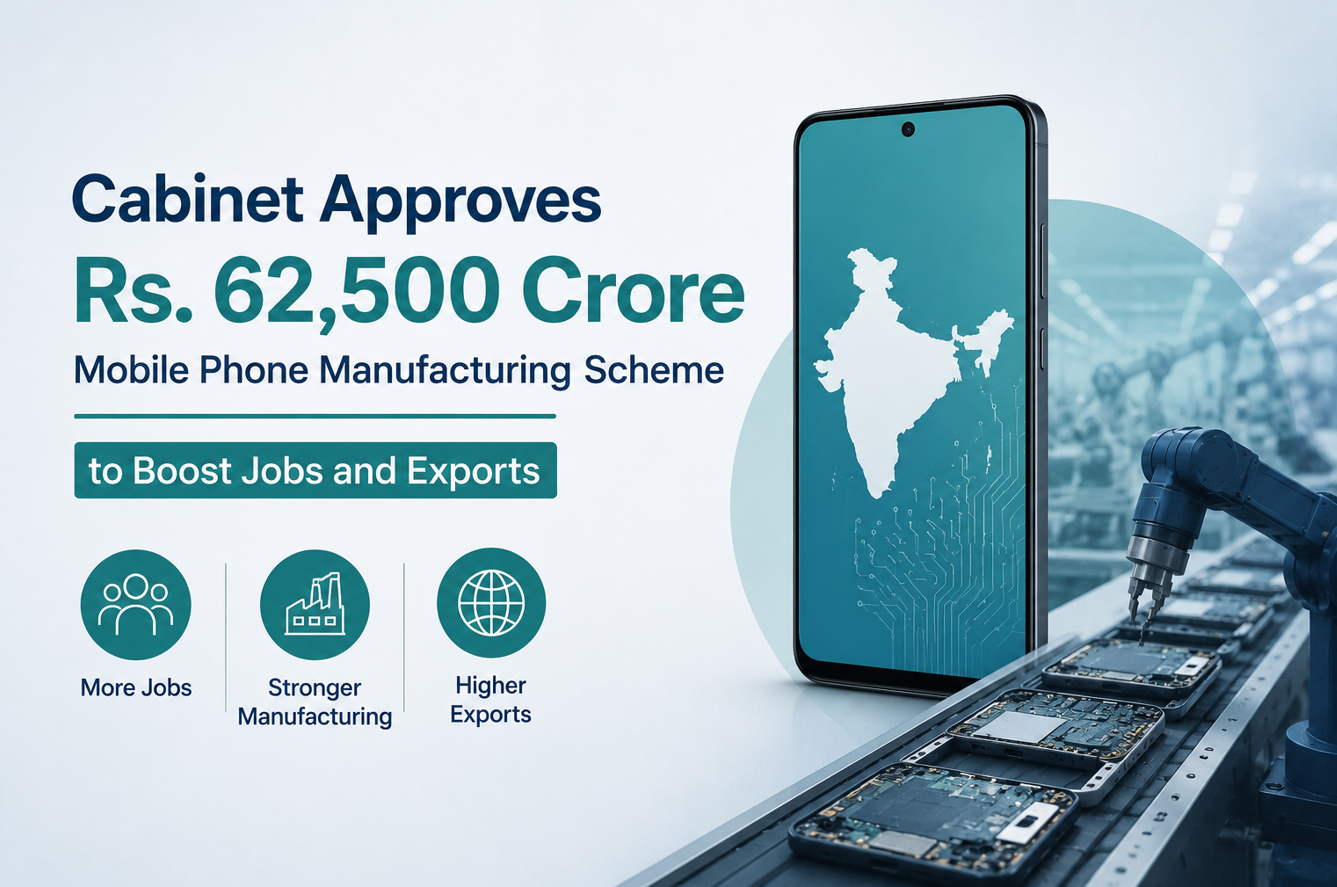
India’s mobile phone manufacturing story is getting another big push. The Union Cabinet has approved a Rs. 62,500 crore Mobile Phone Manufacturing Scheme, also called MPMS, to support phone production, exports and local supply chains over the next five years.
This is not just about assembling more phones. The government wants India to move deeper into the electronics value chain, where more parts, design work, testing, tooling and skilled jobs happen inside the country.
The timing is important. India is already one of the world’s largest mobile phone manufacturing hubs. But a large part of the value still comes from imported components. The new scheme is meant to change that gradually.
What is the Mobile Phone Manufacturing Scheme
The Mobile Phone Manufacturing Scheme is a new government support programme for India’s mobile manufacturing sector. It has an allocation of Rs. 62,500 crore over five years.
The scheme was approved along with the second phase of the India Semiconductor Mission, which has a much larger allocation of around Rs. 1.27 lakh crore. Together, both decisions show that the government wants to build a stronger electronics ecosystem, from chips to finished phones.
Administrative notifications for the new schemes are expected to be issued soon as per the reports on ET. Those notifications will give more clarity on eligibility, incentives, timelines and application rules.
Aim and purpose of the scheme
The purpose is simple – make India a bigger and stronger global mobile phone manufacturing base.
India has already become a major location for smartphone assembly. Companies such as Apple’s manufacturing partners, Samsung, Dixon Technologies, Tata Electronics and other electronics manufacturers have expanded local production.
But assembly is only the first stage. The real value comes when more components are also made locally. That includes camera modules, batteries, display parts, printed circuit boards, chargers, mechanical parts, connectors and other electronics.
The scheme aims to push India from “made in India” phones toward phones with higher Indian value addition.
How it can help growth
Mobile phones are a high-volume product. If India makes more phones for both local buyers and global exports, it can support factories, logistics, packaging, component suppliers, repair networks and testing labs.
This creates a wider growth chain. A phone factory does not work alone. It needs suppliers, transport, skilled workers, warehouses, machines, tools and service partners.
The scheme can also help India attract more global companies looking for a China-plus-one manufacturing base. Many brands now want to reduce dependence on one country for production. India wants to become one of the main alternatives.
How it can create jobs
Mobile phone manufacturing can create direct and indirect jobs.
- Direct jobs include assembly workers, engineers, quality testers, machine operators, production supervisors, warehouse staff and factory managers.
- Indirect jobs come through packaging, transport, canteens, security, maintenance, local vendors, component suppliers and repair services.
There is also a strong opportunity for women’s employment. Electronics assembly has already created many factory jobs for women in states like Tamil Nadu and Karnataka. If the scheme leads to more factories and component units, that trend can grow further.
Why components matter
A phone may be assembled in India, but if most parts are imported, India gets only a smaller share of the value.
That is why the government is now focusing more on deeper manufacturing. The next stage is not only putting parts together. It is making more of those parts inside India.
For example, if a smartphone brand imports the display, camera module, battery cell, chipset and casing, the Indian factory mainly handles assembly. But if local suppliers start making more modules and parts, jobs and profits spread across the ecosystem.
This is where MPMS can become important.
Who may benefit
Large electronics manufacturers are likely to benefit if they qualify under the scheme. Companies such as Dixon Technologies, Tata Electronics, Foxconn-linked units, Samsung’s Indian operations and other contract manufacturers may watch the final guidelines closely.
Component makers can also benefit if the scheme encourages phone brands to source more locally.
States with strong electronics clusters, such as Tamil Nadu, Uttar Pradesh, Karnataka, Andhra Pradesh and Telangana, may compete for new projects. Good land, power, labour availability, ports and logistics will matter.
Impact on smartphone prices
Buyers should not expect phone prices to fall immediately. Government schemes usually affect manufacturing capacity first. Price impact comes later, if local supply chains become stronger and costs reduce.
In the short term, the scheme may help companies invest more confidently. Over time, more local production can reduce import dependence and make supply more stable.
For consumers, the benefit may come through better availability, more models made in India and possibly more competitive pricing in some segments.
Export opportunity
Exports are a major part of this scheme’s logic. India does not want to make phones only for Indian buyers. It wants to ship more smartphones to the US, Europe, West Asia and other markets.
This matters because domestic demand alone may not support very large factories. Exports give manufacturers scale. Scale helps reduce cost. Lower cost makes India more attractive to global brands.
If India can become a trusted export base, mobile phone manufacturing can become one of the country’s strongest industrial stories.
Challenges ahead
The scheme is ambitious, but execution will decide the result.
India still needs stronger component manufacturing. Many advanced parts require high precision, deep supplier networks and years of process experience.
Logistics and customs speed will also matter. Global electronics supply chains run on tight timelines. A delay of even a few days can affect production schedules.
Skill training is another challenge. Factories need workers, but they also need trained technicians and engineers who understand quality systems, automation and electronics testing.
The government will also need to ensure that incentives reward real value addition, not only basic assembly.
Competition from other countries
India is not the only country trying to attract electronics manufacturing. Vietnam, Thailand, Malaysia and Mexico are also competing for global supply chain investments.
China remains the strongest player because of its huge supplier network, skilled workforce and manufacturing depth.
India’s advantage is its large domestic market, improving policy support, young workforce and rising export momentum. But it must keep improving speed, quality and predictability.
Conclusion – Key takeaways
The Rs. 62,500 crore Mobile Phone Manufacturing Scheme is a major step in India’s electronics manufacturing journey. Its purpose is to grow local production, increase exports, create jobs and bring more of the phone supply chain into India.
The scheme can help large manufacturers, component suppliers, factory workers and export-focused electronics clusters. It can also support India’s broader goal of becoming a serious global manufacturing hub.
The real test will come after the detailed guidelines are issued. If the scheme rewards deeper local value addition and not just assembly, it can create lasting growth and better jobs.
Facts Input- All other editorial, contextual interpretation, and analytical framing, perspective are added independently sourced from various online mediums/social media/publicly available platforms. Content synthesis and opinion contains original editorial input and all analysis are independently developed & authored.
Discover more from Newskart
Subscribe to get the latest posts sent to your email.

Comments are closed.