


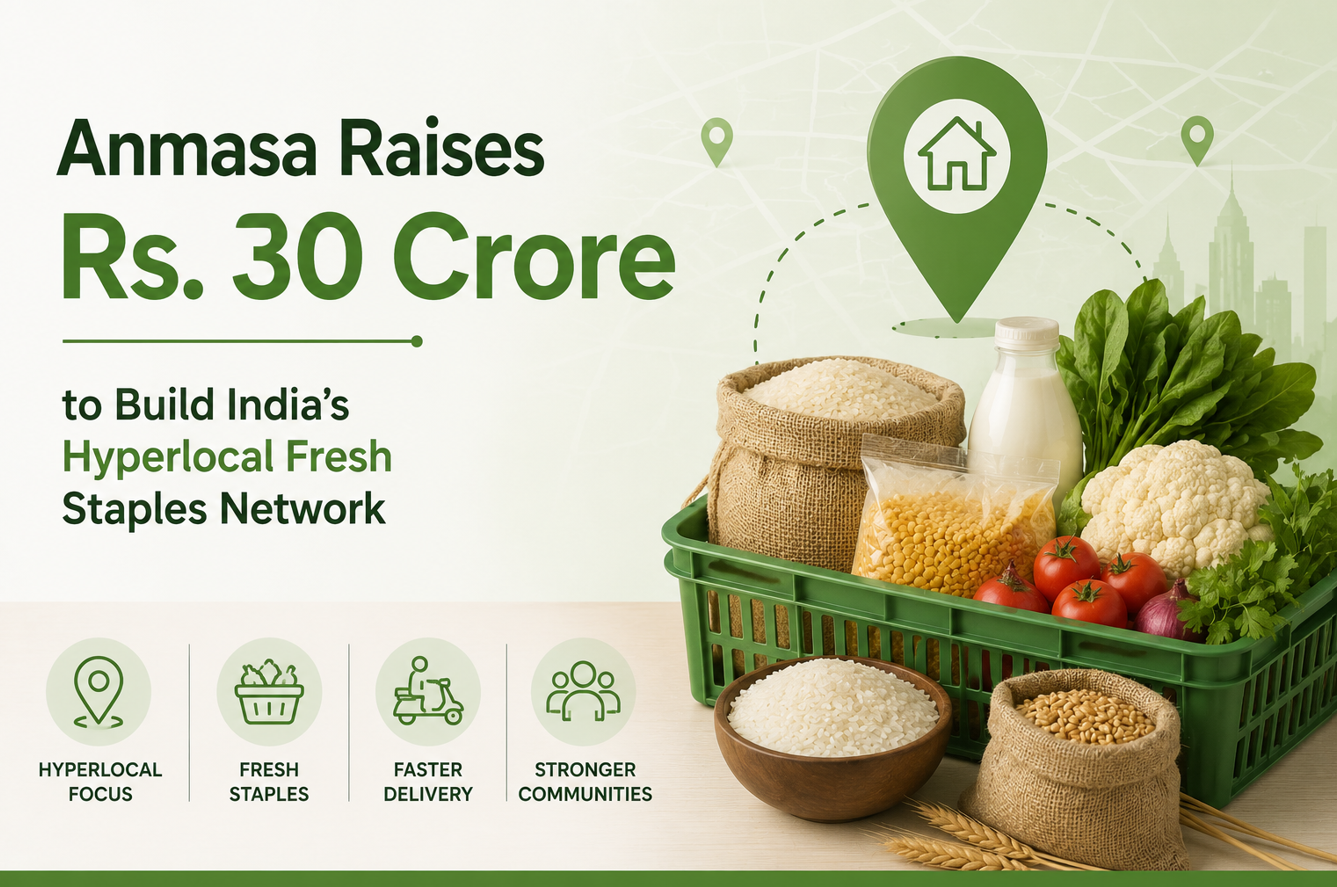
Anmasa has raised Rs. 30 crore in seed funding to scale its fresh staples business across India. The round was led by Fireside Ventures, with participation from Blume Ventures, existing investors and HNIs.
The startup is not trying to sell groceries in the usual packaged-food way. Its bet is more local and more personal. Anmasa runs neighbourhood micro-factories where staples like stone-ground flour, wood-pressed oils and freshly milled spices are prepared after an order is placed.
That is a very different approach from regular supermarket shelves, where flour and spices may sit in packets for weeks. Anmasa wants to bring back the old habit of freshly milled staples, but with the convenience of modern ordering and fast delivery.
What Anmasa does
Anmasa is a fresh staples startup focused on everyday kitchen essentials. It offers products across nine categories and more than 200 SKUs.
Its key products include fresh flour, pulses, wood-pressed oils, freshly milled spices and customized staples. Customers can choose multigrain blends, regional flour types and grind textures based on their food habits.
The company operates nine company-owned stores, with five in Gurugram and four in Noida. Each store also works like a local fulfilment point. Orders are prepared close to customers and delivered quickly, with reported delivery within 90 minutes.
Founder and background
Anmasa was founded by Yatish Talvadia and Shailendra Upadhyay.
Yatish Talvadia is the Founder and Chief Experience Officer of Anmasa. He earlier founded Milkbasket, a grocery delivery startup that was acquired by Reliance Retail. Shailendra Upadhyay previously founded Veggie India, which was acquired by Milkbasket in 2019.
The founding year of Anmasa was earlier reported as 2024 in public startup coverage.
Funding details
Anmasa has raised Rs. 30 crore in seed funding led by Fireside Ventures. Blume Ventures, existing investors and high-net-worth individuals also joined the round.
With this latest round, the company has raised Rs. 47 crore, or around $5 million, so far. Earlier to this, the startup raised $1.1 million in pre-seed funding in August, 2025.
The money will be used to deepen Anmasa’s presence in Delhi-NCR, enter Bengaluru, expand into more metro markets and strengthen its supply chain technology.
The startup plans to cross 15 outlets in the current financial year. Bengaluru is expected to launch by mid-September, with Hyderabad or Pune likely to follow after that.
Startup aim and purpose
Anmasa’s purpose is simple – make daily staples fresher, more customizable and closer to the consumer.
Most Indian homes use flour, oils, pulses and spices every day. These are not occasional products. They affect taste, health, cooking habits and family trust. Yet many consumers buy them from packets without knowing when they were milled, how long they have been stored, or whether the product suits their diet.
Anmasa is trying to solve that gap through local manufacturing. Its idea is that food should adapt to the consumer, not the other way around.
For example, one family may want coarse wheat flour for rotis. Another may want a special multigrain mix. Someone else may prefer a regional flour blend. Anmasa’s model allows that kind of personalization.
Why micro-factories matter
The most interesting part of Anmasa’s model is its neighbourhood micro-factory network.
A micro-factory is a small local production unit. Instead of making everything in one large factory and shipping packets across cities, Anmasa prepares staples closer to where customers live.
This matters because fresh flour has a shorter natural shelf life than regular packaged flour. If it is made close to the customer, the product can reach homes faster and feel fresher.
It also gives the brand more control over the customer journey, from sourcing and processing to fulfilment and delivery.
Business traction
Anmasa has reportedly grown 23 times over the past 12 months across Gurugram and Noida.
The company says 70 percent of its direct-to-consumer revenue comes from repeat customers. That is important in staples because repeat buying is the real test. A customer may try a new flour once, but if they return every month, the brand has entered the kitchen habit.
Its blended average order value is around Rs. 800. Around 85 percent of orders come online, while 15 percent come through store walk-ins.
All stores are reportedly EBITDA positive, and the company is targeting an exit ARR of Rs. 150 crore this financial year.
Why Anmasa is avoiding quick commerce
This is one of the more interesting choices. Despite the rise of quick commerce, Anmasa has no plan to list on those platforms for now.
That may sound surprising, because groceries sell well on quick commerce apps. But Anmasa wants to own the entire journey, from sourcing and manufacturing to delivery and personalzation.
The risk of quick commerce is that a brand can become just another item in a crowded app. Anmasa wants the customer to understand freshness, customization and local preparation. That story is easier to tell when the brand owns the channel.
Competitors
Anmasa competes with many different types of players.
In packaged staples, it competes with brands like Aashirvaad, Fortune, Pillsbury, Tata Sampann and regional flour and oil brands. In fresh and organic groceries, it competes with local mills, organic stores and D2C food brands. It also indirectly competes with quick commerce platforms that deliver staples instantly.
Its differentiation is freshness and customization. The challenge is whether enough customers will pay for that experience regularly.
Challenges ahead
Anmasa’s model is promising, but it is operationally demanding.
Running micro-factories across cities needs quality control, trained staff, supply chain discipline and consistent sourcing. Fresh products also leave less room for inventory mistakes.
The company must also keep pricing sensible. Staples are price-sensitive. A premium can work if customers clearly feel better taste, freshness or health value, but the gap cannot become too large.
Expansion will be another test. What works in Gurugram and Noida may need changes in Bengaluru, Hyderabad or Pune because food habits differ by city.
Conclusion – Key takeaways
Anmasa’s Rs. 30 crore seed funding led by Fireside Ventures gives the startup fresh capital to scale its hyperlocal staples model.
The company wants to make everyday staples fresher by preparing flour, oils and spices close to customers through neighbourhood micro-factories. It has raised Rs. 47 crore so far and plans to expand beyond Delhi-NCR into Bengaluru and other metros.
For Anmasa, the opportunity is large because staples are bought again and again. The challenge is equally real – freshness, quality, pricing and operations must stay consistent as the brand grows.
Facts Input- ETRetail
Discover more from Newskart
Subscribe to get the latest posts sent to your email.

Comments are closed.