


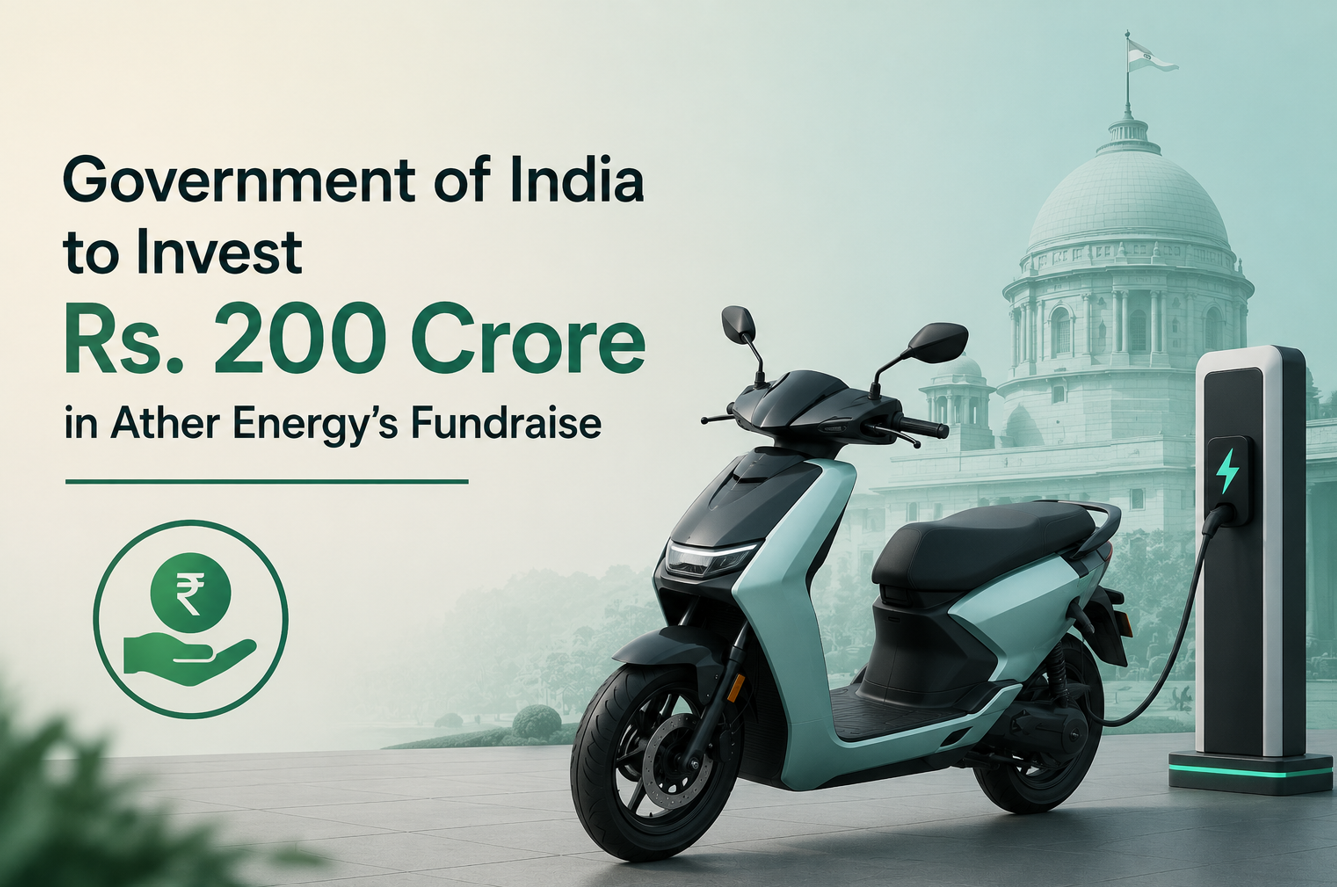
Ather Energy’s latest fundraise has brought an unusual but important name to the table – the Government of India. The electric two-wheeler maker will receive Rs. 200 crore from a government-backed fund as part of its Rs. 1,200 crore preferential issue.
The investment will be routed through the India-Japan Fund, a bilateral fund set up by the Government of India and the Japan Bank for International Cooperation. The fund is managed by NIIFL, which means this is not a direct ministry-style investment, but a structured investment through a sovereign-backed platform.
For Ather, the money comes at a critical time. India’s electric scooter market is growing, but the fight is getting tougher. Legacy players such as TVS and Bajaj are scaling fast, Ola Electric remains aggressive, and Hero MotoCorp is deepening its own bet on Ather.
Funding details
Ather Energy’s board has approved a Rs. 1,200 crore preferential issue. In this tranche, the India-Japan Fund will invest Rs. 200 crore through equity shares.
Hero MotoCorp will subscribe to convertible warrants worth Rs. 960 crore. Ather’s co-founders Tarun Mehta and Swapnil Jain will together invest Rs. 40 crore, with each committing Rs. 20 crore through convertible warrants.
This Rs. 1,200 crore issue is part of Ather’s wider Rs. 2,500 crore fundraising programme. The company had earlier approved a plan to raise up to Rs. 1,500 crore through QIP and the remaining amount through preferential issue, rights issue or other routes.
In simple words, Ather is raising capital in stages. This first big piece is coming from the India-Japan Fund, Hero MotoCorp and the founders.
What Ather Energy does
Ather Energy is a Bengaluru-based electric scooter company founded in 2013 by Tarun Mehta and Swapnil Jain.
The company is known for the Ather 450 series and the family-focused Rizta scooter. It also built Ather Grid, its fast-charging network. Ather has often positioned itself as a premium, technology-led EV brand, with connected features, over-the-air software updates and strong performance as key selling points.
The company listed on the stock exchanges in May 2025. Its latest fundraise is its first major capital raise after the IPO.
Why the government-backed investment matters
The Rs. 200 crore investment is small compared with Hero’s Rs. 960 crore commitment in this tranche, but it carries a different kind of weight.
When a government-backed fund invests in an EV company, it signals that electric mobility is still seen as a strategic sector for India. Electric two-wheelers can reduce fuel imports, cut urban emissions and support domestic manufacturing in batteries, electronics and vehicle assembly.
The India-Japan Fund angle is also interesting. Japan has deep experience in manufacturing, quality systems and mobility technology. India brings a large EV market and a growing manufacturing base. This fund is meant to support that kind of long-term industrial cooperation.
Why Ather needs fresh capital
The EV scooter business is expensive. Ather has to spend on product development, battery systems, manufacturing, software, charging, sales outlets and service networks.
It also needs money to compete better outside metro cities. Ather started with a premium urban image, but the next wave of EV buyers is coming from smaller cities and family scooter users. The Rizta was a step in that direction.
Fresh capital can help Ather expand faster, improve cost efficiency and support new products. It can also help the company handle competition from brands with larger distribution networks.
Hero MotoCorp’s role
Hero MotoCorp is already Ather’s largest shareholder and has now approved a fresh investment of up to Rs. 1,000 crore. In the approved preferential issue, Hero will subscribe to Rs. 960 crore worth of convertible warrants.
This is more than just a financial move. Hero has a long history in India’s two-wheeler market, while Ather has strong EV technology and brand recall among urban buyers.
Hero also has its own EV brand, Vida. That makes the relationship interesting. Hero is both an investor in Ather and a competitor in the wider electric scooter market.
For Ather, Hero’s continued backing adds confidence. For Hero, Ather gives exposure to a strong EV-first company.
What founders investing Rs. 40 crore signals
Founder participation is worth noticing. Tarun Mehta and Swapnil Jain are together putting in Rs. 40 crore through convertible warrants.
This sends a message to the market that the founders are still backing the company’s next phase with their own capital. In a listed company, founder participation often matters because investors look for alignment between promoters, major shareholders and public shareholders.
It does not remove business risk, but it does show commitment.
What this means for India’s EV market
Ather’s fundraise comes soon after Ola Electric raised around Rs. 780 crore through QIP. That tells us something about the sector. Electric two-wheeler companies need fresh capital to keep fighting.
The market is no longer only about who launches the flashiest scooter. Buyers now compare real-world range, battery life, service quality, charging access, resale value and price.
TVS and Bajaj have gained from trust and dealer reach. Ola has pushed scale and pricing. Ather has leaned on product quality, software and premium positioning. The next phase may reward companies that can combine all three – good products, strong service and sensible pricing.
Challenges ahead
The fundraise helps, but Ather still has hard work ahead.
The company needs to grow market share while keeping losses under control. It must make scooters that appeal beyond tech-savvy early adopters. It also has to keep service reliable as it expands into more cities.
Battery costs, subsidy changes and price competition can also affect margins. EV buyers are price-sensitive, and petrol scooters remain a tough benchmark.
The capital gives Ather more fuel. It still has to drive carefully.
Conclusion – Key takeaways
The Government of India-backed Rs. 200 crore investment in Ather Energy will come through the India-Japan Fund as part of Ather’s Rs. 1,200 crore preferential issue.
Hero MotoCorp will invest Rs. 960 crore through convertible warrants, while founders Tarun Mehta and Swapnil Jain will together invest Rs. 40 crore. This tranche forms part of Ather’s larger Rs. 2,500 crore fundraising plan.
For Ather, the funding can support expansion, R&D, manufacturing and competition in India’s electric scooter market. For India, it reinforces the policy direction toward clean mobility and domestic EV manufacturing.
Facts Input- MOneyCOntrol
Discover more from Newskart
Subscribe to get the latest posts sent to your email.

Comments are closed.