


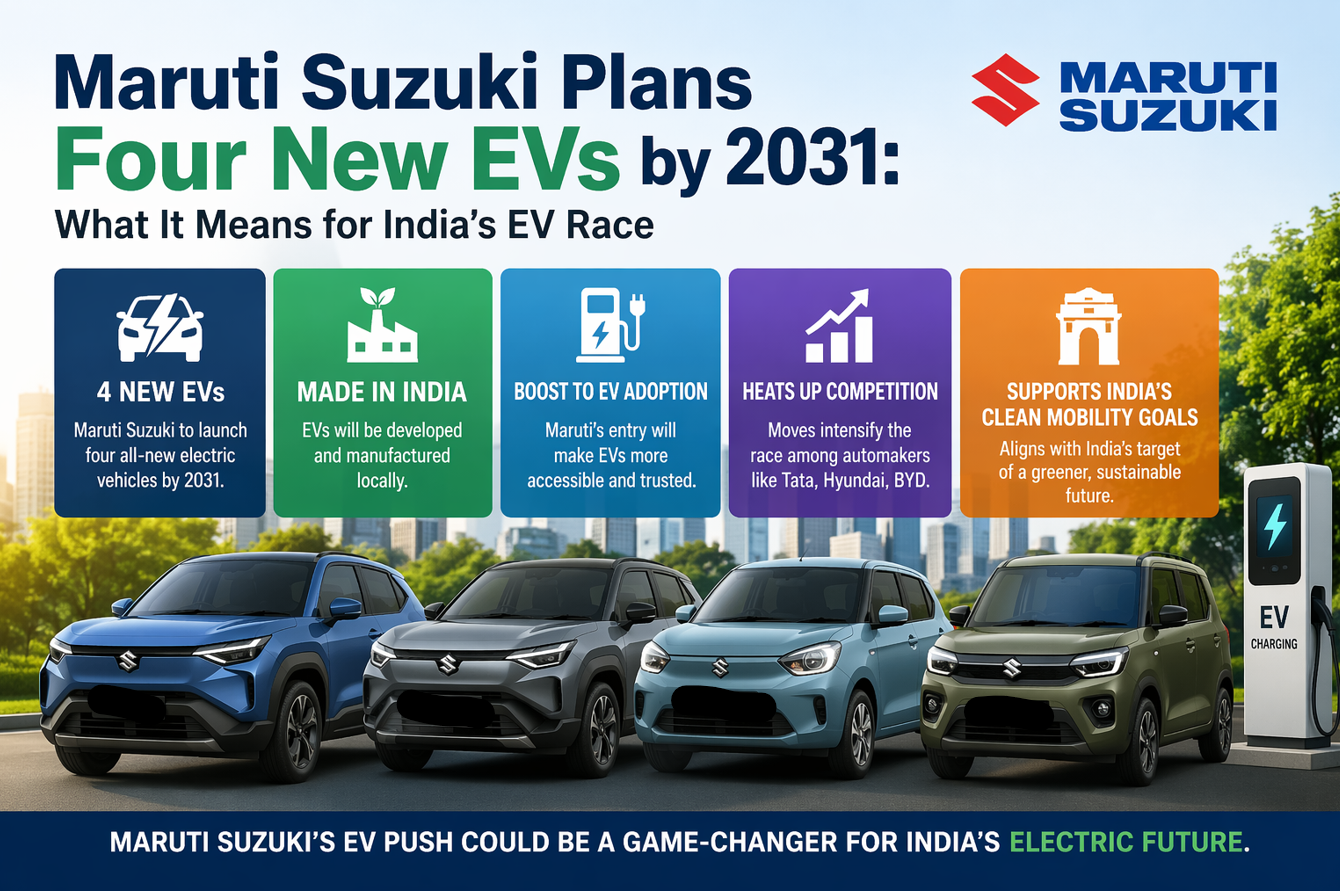
Maruti Suzuki plans four new EVs by 2031 is more than a corporate update. It signals how India’s largest carmaker is preparing for the next phase of electric mobility. If a brand with the scale of Maruti commits to multiple EV launches, it changes how buyers, rivals, and suppliers plan the next five years.
The statement was made by senior company leadership during an EV handover event, where Maruti delivered a large batch of its electric SUV, the e‑Vitara, in a single day. The company also linked this plan to its mid‑term EV strategy and its goal of competing across multiple segments. That combination—roadmap plus real deliveries—makes the announcement meaningful for the market.
This article explains what this plan actually means, who it affects, and what buyers should watch between now and 2031.
The core update in simple words
Maruti Suzuki says it will introduce four new electric vehicles by 2031. This is not one model and one price band. The company indicated it wants to “play across segments,” which suggests a wider product range rather than a single flagship EV.
It also highlighted its e‑Vitara deliveries as a milestone in its EV journey. So this is not just a future promise; the company is already moving EVs into customer hands and preparing its next lineup.
Why this announcement matters?
There are three big reasons:
-
Market impact
Maruti’s scale is enormous in India’s passenger car market. When it makes a long‑term commitment, the entire market adjusts. Suppliers, dealers, and even charging‑infra players take note. -
Customer confidence
Many buyers still hesitate about EVs because of long‑term support and service fears. A clear multi‑year roadmap from the country’s biggest carmaker improves trust and makes EV adoption feel safer. -
Competitive pressure
The moment Maruti expands EV offerings, rivals must react. This keeps prices, features, and service quality under pressure, which benefits customers.
What “four EVs by 2031” could look like
The company has not publicly revealed the exact models or timelines. But the phrase “across segments” is important. It likely means:
- An entry EV for first‑time buyers
- A family‑focused mid‑range EV
- A premium EV SUV or crossover
- A possible utility or high‑range EV offering
This is an educated inference based on how carmakers usually build portfolios, not an official product list. But the direction is clearly multi‑segment.
How the e‑Vitara fits into the plan
The e‑Vitara is currently Maruti’s key EV, and the company’s delivery milestone shows it is already active in the EV space. That matters because it gives the brand actual usage data, servicing experience, and consumer feedback to shape the next four models.
So this isn’t a “start from zero” plan. It’s a continuation—one model already in the field, and four more planned as the market grows.
Practical examples: what this means for buyers
Example 1: Budget buyer in 2027–2028
If Maruti launches a more affordable EV before 2030, many first‑time buyers may prefer that over premium EVs or hybrids. A lower starting price combined with Maruti’s service network can make EV adoption easier.
Example 2: Family buyer with range anxiety
A mid‑segment EV with strong range, service coverage, and financing support could be attractive for families who want an EV but fear charging hassles. Maruti’s network scale can reduce that fear.
Example 3: SUV buyer in 2029–2031
If the planned EV lineup includes larger or premium models, SUV‑focused buyers may see it as a direct alternative to current EV competitors.
Competitor check: where Maruti will face pressure
By the time four new EVs arrive, India’s EV market will already be busy. Maruti will be competing against:
A quick view of the key pressure points Maruti must handle as EV competition grows.
Rivals already have multiple EVs on the road and stronger usage data.
Competitors are pushing longer range at aggressive prices.
Some brands are bundling chargers and partner networks faster.
EV buyers now expect strong connected features and long‑term updates.
Luxury EV brands may set higher expectations for quality and tech.
Maruti must shift from value‑first to EV‑innovation perception.
- Established EV players with early market lead
- Brands with deeper premium EV experience
- Rivals offering aggressive pricing and long range
- Global players expanding India portfolios
Maruti’s strengths are scale, service network, and brand trust.
Its main challenge is catching up on EV experience and differentiating on tech.
If Maruti executes well, the four‑EV plan can help it stay competitive as the market matures.
The bigger industry context
India’s EV market is at a transition stage:
- Government policy is encouraging adoption
- Charging infrastructure is improving but still uneven
- Customers want lower upfront cost and longer range
- Manufacturers are now shifting from pilots to multi‑model plans
In that context, Maruti’s commitment tells the market that EVs are no longer experimental-they’re part of the long‑term mainstream plan.
What to watch next
If you are tracking this as a buyer or industry observer, keep these points in mind:
- Official model names and segment confirmation
- Pricing strategy: entry vs premium focus
- Charging and service ecosystem expansion
- Timeline details for the first of the four models
- Whether Maruti adopts battery subscription or other pricing innovations
These signals will define whether the plan is aggressive or conservative.
Conclusion
Maruti Suzuki’s new EVs is a big signal for India’s EV roadmap. It means the country’s largest carmaker is preparing a multi‑segment EV future, not a single‑model experiment. This increases competition, improves buyer confidence, and pushes the market forward. For buyers, the message is simple: EV choices will expand significantly by the end of this decade, and Maruti intends to be a major part of that future. If you are considering a long‑term shift to EVs, this roadmap is one of the clearest signs that the market is moving from early phase to mainstream scale.
Inputs- ToI
AI generated image for illustration purpose only
Discover more from Newskart
Subscribe to get the latest posts sent to your email.

Comments are closed.