

Ather Energy’s Rs. 1,300 Crore QIP Is More Than A Fundraise, It Is A Manufacturing Need?


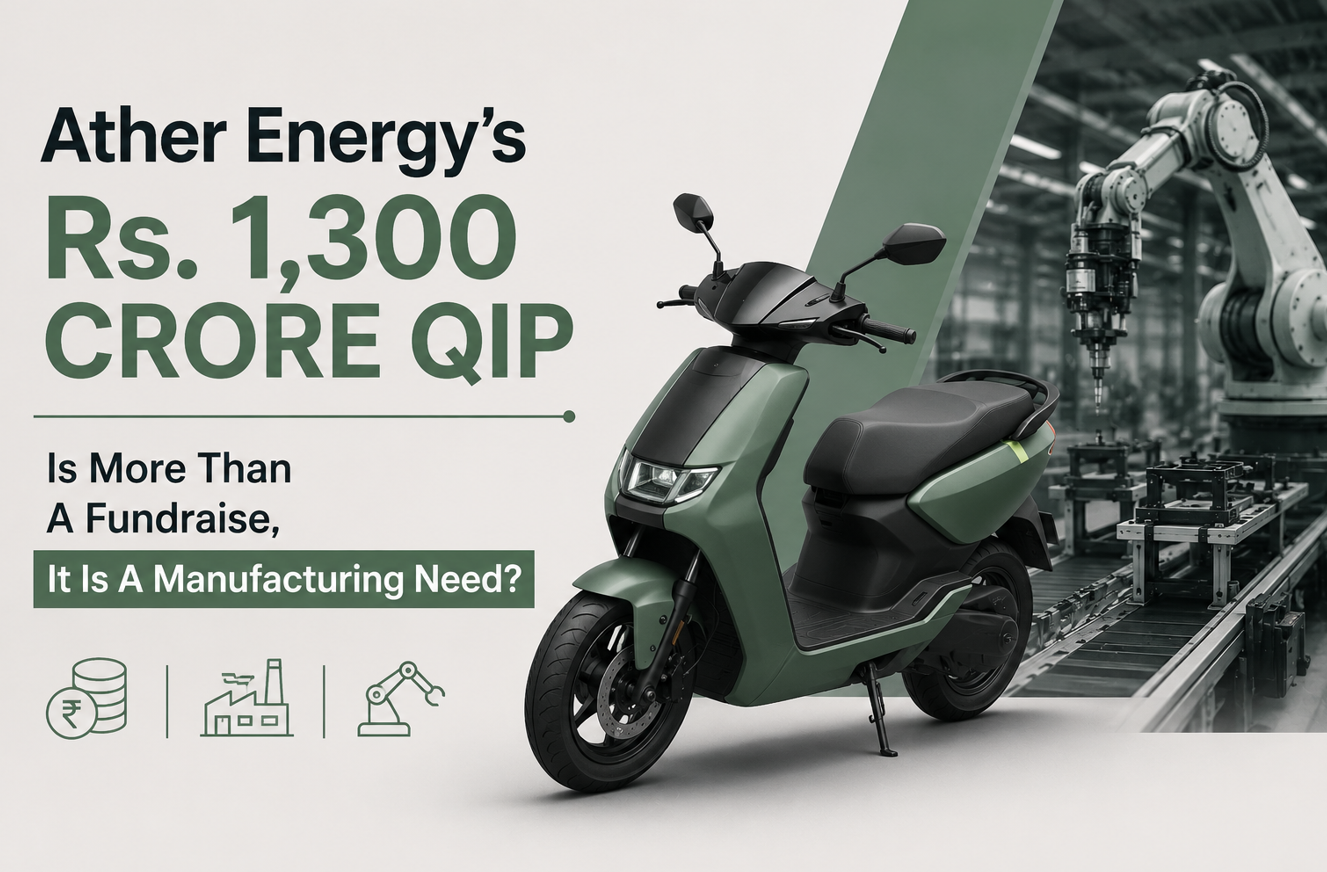
Ather Energy has raised around Rs. 1,300 crore through a Qualified Institutional Placement, or QIP, and the timing is interesting. It comes at a point when the electric (EV) two-wheeler market is growing fast, competition is getting sharper, and manufacturing scale is becoming more important than ever.
The issue was reportedly subscribed more than eight times, with institutional investors placing bids worth over Rs. 10,000 crore. Ather allotted over 1.08 crore equity shares at Rs. 1,202 per share, according to reports based on the company’s exchange filing.
For a normal buyer, this may sound like a stock market update. But for Ather, it is closely linked to a bigger question. Can the company build enough scooters, improve costs, and compete with large players like TVS, Bajaj, Hero MotoCorp and Ola Electric without losing its technology-first identity?
Why Ather Energy needed this money
Ather Energy was founded in 2013 by Tarun Mehta and Swapnil Jain. The Bengaluru-based company started as a premium electric scooter maker and slowly built its own ecosystem around vehicles, software, charging and battery technology.
That approach helped Ather build a strong brand, especially among urban buyers who wanted a refined electric scooter rather than just a low-cost option. But the EV market has changed. Electric scooters are no longer a niche product. Families, office commuters and first-time EV buyers are entering the market, and they care about price, range, service reach and reliability.
This is where manufacturing becomes important.
Ather already makes electric two-wheelers and battery packs at its Hosur facility in Tamil Nadu. Reports around its IPO documents said the Hosur facility had an annual installed capacity of about 4.2 lakh electric two-wheelers and nearly 3.8 lakh battery packs. The company has also been working on a larger Factory 3.0 project in Chhatrapati Sambhajinagar, Maharashtra, which is expected to increase its total production capacity significantly after completion.
In simple words, Ather needs money because growth in EVs is not cheap. A company has to spend before the benefits show up. New factories, tooling, automation, battery pack lines, supplier payments, testing, quality checks and dealer expansion all need capital.
What a QIP means in simple language
A QIP is a way for a listed company to raise money from large institutional investors such as mutual funds, banks, insurers and foreign funds. It is faster than many other fundraising routes and does not directly target small retail investors.
For Ather, this QIP gives it fresh capital without waiting for another large public issue. It also sends a signal that big investors are still interested in the company’s long-term EV story.
The oversubscription matters because it shows demand was much higher than the shares on offer. That does not guarantee future success, of course. But it does suggest that institutions see Ather as one of the serious players in India’s electric two-wheeler race.
The manufacturing angle is the real story
Ather’s funding need is not only about selling more scooters next month. It is about preparing for the next few years.
Electric two-wheeler companies face a practical challenge. If demand rises and factories cannot keep up, waiting periods increase and buyers may shift to competitors. If a company expands too early and demand is weak, factory costs become a burden. The balance is tricky.
Ather appears to be betting that the market will keep expanding and that it needs stronger manufacturing capacity to stay relevant. Its family scooter, Rizta, has helped the company move beyond performance-focused buyers. That is important because the family scooter market is much larger than the enthusiast segment.
For example, a buyer choosing a scooter for office runs, school drops and grocery trips may not care about sporty acceleration as much as comfort, boot space, service support and battery warranty. To serve such buyers at scale, Ather needs broader production, better cost control and a larger retail network.
Why scale can improve Ather’s business
Manufacturing scale can help an EV company in several ways.
- First, larger production can bring down per-unit costs. When a company buys more parts, negotiates with suppliers, improves automation and runs assembly lines more efficiently, each scooter can become cheaper to build.
- Second, scale can support more product launches. Ather has already built its name around the 450 series and Rizta. If it wants to enter more price points or categories, it will need capacity and working capital.
- Third, better manufacturing depth can improve quality control. In EVs, small issues in battery packs, electronics or software can hurt customer trust. Ather has usually positioned itself as a quality-focused brand, so expanding while keeping reliability intact will be a key test.
- Fourth, fresh funds can support the supply chain. EV makers need stable access to batteries, cells, electronics, chargers and other critical parts. Even when some components are sourced from suppliers, the company still needs money to manage inventory and production cycles.
Competition is now tougher than before
Ather is not operating in an empty lane. TVS Motor has grown strongly with the iQube range. Bajaj Auto has pushed its Chetak electric scooter aggressively. Hero MotoCorp is building its Vida electric mobility business. Ola Electric, despite losing share from earlier highs, remains a known EV brand with wide public visibility.
Recent market reports show that India’s electric two-wheeler growth is being captured mainly by a few large names. TVS, Bajaj, Hero and Ather have gained as buyers look for scale, service networks and dependable products.
This makes Ather’s position interesting. It is still an EV-first company, unlike TVS, Bajaj and Hero, which already have large traditional two-wheeler businesses. That gives Ather a focused EV identity, but it also means it must fund its expansion carefully.
Legacy companies can use their existing dealer networks, supplier relationships and manufacturing experience. Ather has to keep building those strengths while also spending on technology, software and product design.
Why investors may be interested
Institutional investors may be looking at three things.
- One, India’s electric two-wheeler market still has room to grow. Petrol scooters remain widely used, and EV adoption can rise as charging improves and running costs stay attractive.
- Two, Ather has a clear brand. It is not seen as a random scooter assembler. It has built products, software and user experience with a premium image.
- Three, the company is entering a stage where manufacturing scale could improve its financial performance. If volumes rise and costs reduce, the business can become healthier over time.
But there are risks too. EV demand can be affected by subsidies, battery costs, pricing pressure and service issues. Competition can also force companies to offer discounts, which hurts margins. For Ather, the big task is to grow without becoming just another price-war player.
What this means for customers
For customers, this fundraise may not change showroom prices overnight. But over time, it can matter.
If Ather uses the money well, buyers may see better availability, more models, wider service coverage and possibly more competitive pricing. A stronger factory setup can also help the company reduce delivery delays during high-demand periods.
The bigger benefit may come in trust. In EVs, people want to know whether a brand will be around for the long run. Fresh institutional capital can help strengthen that confidence, especially for buyers making their first EV purchase.
Conclusion with key takeaways
Ather Energy’s Rs. 1,300 crore QIP is not just a financial move. It is a signal that the company is preparing for a larger manufacturing and market battle.
The money is needed because EV growth requires heavy spending on factories, battery capacity, supply chains, product development and retail expansion. Ather has a strong brand, but it now has to prove that it can scale like a serious mass-market two-wheeler company.
Key takeaways
- Ather Energy raised around Rs. 1,300 crore through a QIP.
- The issue was reportedly oversubscribed more than eight times.
- The company was founded in 2013 by Tarun Mehta and Swapnil Jain.
- Manufacturing expansion is a major reason behind the fresh capital need.
- Ather faces strong competition from TVS, Bajaj, Hero Vida and Ola Electric.
- The next challenge is clear. Ather must turn investor confidence into factory output, better availability and stronger customer trust.
Facts Input- ET, ET, WEF, BS, Upstox
Discover more from Newskart
Subscribe to get the latest posts sent to your email.

[…] to Rs. 1.5 lakh range, depending on variant, city, benefits and market conditions. It competes with Ather 450 series, TVS iQube, Bajaj Chetak, Hero Vida, Ola Electric scooters and Simple Energy […]
[…] Ather Energy’s Rs. 1,300 Crore QIP Is More Than A Fundraise, It Is A Manufacturing Need? […]