

Uber, Eternal and Porter Leave Karnataka Gig Workers Welfare Board, What It Means for App Workers


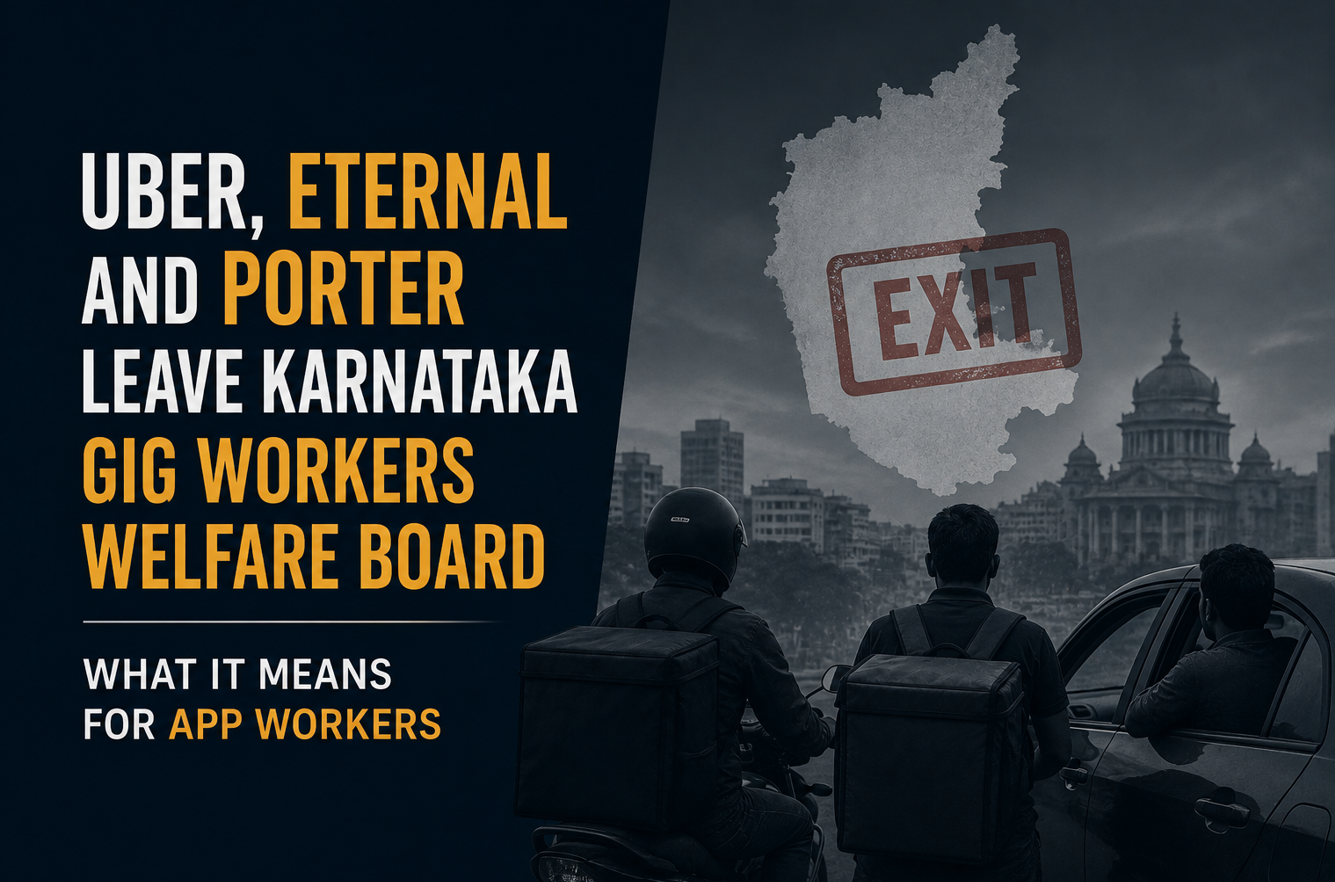
Uber, Eternal, the parent company of Zomato, and Porter have stepped away from Karnataka’s Gig Workers Welfare Board. The move has brought fresh attention to a larger debate in India’s platform economy which is that how should app-based workers be protected, and who should pay for that protection?
The issue is important because lakhs of delivery partners, cab drivers, logistics workers and service providers now depend on digital platforms for daily income. Karnataka wants to build a welfare system for them. Several companies, however, believe the state law creates extra costs and overlaps with national social security rules.
What is Karnataka Gig Workers Welfare Board
The Karnataka Platform-Based Gig Workers Welfare Board was created under the Karnataka Platform-Based Gig Workers Social Security and Welfare Act, 2025.
Its aim is to support gig workers with social security benefits. These may include life and accident insurance, disability support, medical help, maternity benefits, old-age protection and a grievance system.
In simple words, the board is meant to act like a safety net for people who work through apps but do not enjoy the same benefits as regular salaried employees.
For example, if a delivery partner meets with an accident while working, a welfare system can help provide financial support. If a driver is suddenly removed from an app without clear explanation, a grievance mechanism can give that worker a formal way to raise the issue.
Why Uber, Eternal and Porter exited
Uber, Eternal and Porter left the board because they are challenging the Karnataka gig worker law in the Karnataka High Court.
Their position is that they do not want to remain part of a statutory board created under a law whose validity they are questioning in court. This is less about rejecting worker welfare in public language, and more about disagreeing with the legal and financial structure of the state’s system.
The companies and industry bodies have raised concerns that Karnataka’s law may overlap with the Centre’s Code on Social Security, 2020. They also worry about extra compliance, reporting rules and welfare payments.
The welfare fee dispute
A key point of disagreement is the welfare fee. Karnataka has fixed a fee linked to platform transactions, with category-wise caps.
Reports say the fee is meant to fund worker benefits. For food and grocery delivery, the fee is capped at 50 paise per transaction. For ride-hailing, the cap is 50 paise for two-wheelers, 75 paise for three-wheelers and Re. 1 for four-wheelers.
The Karnataka High Court has not stayed the law, but it has given interim protection from coercive action to some petitioners. It also directed platforms to deposit welfare fee amounts with the court registry while the case continues.
Who can benefit from the board
The main beneficiaries are platform-based gig workers in Karnataka. This includes food delivery partners, grocery delivery riders, cab drivers, bike taxi workers, logistics workers and other app-linked service providers.
The board can also help the government create a clearer database of workers, platforms and welfare needs. So far, only 15 platform companies have registered with the board, reportedly representing around seven lakh gig workers.
After the exits, the state is looking to bring in other platform representatives. Delhivery, Namma Yatri and Yulu have reportedly agreed to join the board, while Amazon India has stayed on.
Wider industry impact
This issue affects many platform companies, not just Uber, Eternal and Porter. Swiggy, Zepto, Urban Company, Meesho, Amazon, Delhivery, Namma Yatri and Yulu are also part of the wider gig economy discussion in Karnataka.
If Karnataka’s model survives legal challenge, other states may study similar welfare laws. If courts find overlaps with central law, the framework may need changes. Either way, this case could shape how India treats gig worker welfare in the coming years.
Conclusion – Key takeaways
Uber, Eternal and Porter exiting Karnataka’s Gig Workers Welfare Board shows the growing tension between worker protection and platform compliance costs.
The board’s aim is to give gig workers a stronger safety net. The companies’ concern is that the law may create overlapping rules and extra financial burden.
For workers, the final outcome matters deeply. A good welfare system can offer insurance, grievance support and basic protection. But it must also be clear, practical and easy to implement so that companies, workers and the government can all work with it.
Facts Input- ET, Inc42, MC, FE
Discover more from Newskart
Subscribe to get the latest posts sent to your email.

Comments are closed.