

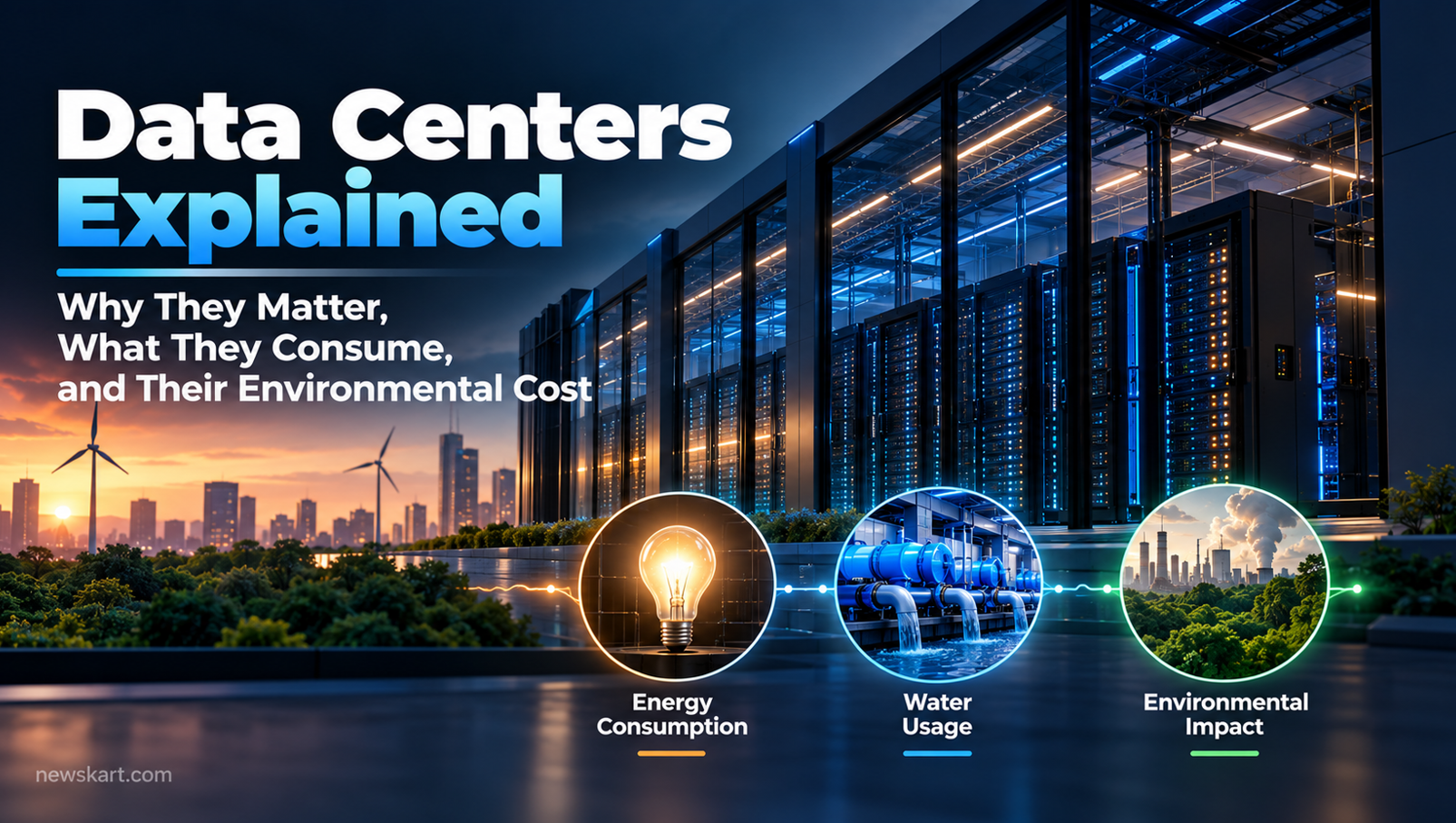
Data Centers Explained – Why They Matter, What They Consume, and Their Environmental Cost


Every photo stored in the cloud, online payment, video call, AI prompt, streaming show, and mobile app depends on physical machines somewhere. Those machines sit inside data centers.
A data center is often described as “the cloud,” but there is nothing weightless about it. It needs land, buildings, power lines, backup systems, cooling equipment, water in some designs, and thousands of pieces of hardware. As demand for AI, digital payments, e-commerce, and connected vehicles rises, data centers are becoming an important part of modern infrastructure. They are also raising serious questions about electricity, water, and emissions.
What is a data center and why is it built
A data center is a secure facility that stores, processes, and sends digital information. It may support a bank’s mobile app, a hospital’s records, an automobile company’s connected-car platform, or an AI service.
Companies build or rent data-center space to keep services available around the clock. The facility protects equipment from outages, overheating, cyber risks, fire, and physical damage. It also helps businesses handle large numbers of users without their website or app slowing down.
Cloud companies such as Amazon Web Services, Microsoft Azure, and Google Cloud compete to offer this computing capacity. Telecom firms, banks, startups, government departments, and large manufacturers also operate their own facilities or lease space from specialist operators.
The main parts inside a data center
The servers do the actual computing. They run websites, databases, apps, AI models, and business software. Storage systems keep files, videos, backups, and customer records. Networking equipment, including switches and routers, moves data between servers and out to users.
But the equipment around the servers is just as important. A data center needs uninterrupted power supply systems, batteries, transformers, backup generators, cables, fire-suppression systems, security controls, and cooling equipment.
Land matters because a large campus needs room for the building, power substation, diesel generators, cooling systems, water infrastructure, access roads, and future expansion. Reliable electricity is usually the first deciding factor when choosing a location.
Cooling is essential because servers release heat continuously. Depending on the design, a facility may use air cooling, chilled water, cooling towers, outside air, or direct liquid cooling. Water use can be low in an air-cooled site and much higher in a facility using evaporative cooling towers.
A 1 MW data center – the basic calculation
To keep the example clear, assume the data center has a 1 MW IT load. In simple terms, its servers, storage, and networking equipment use 1 MW of electricity.
Now assume a Power Usage Effectiveness, or PUE, of 1.50. PUE measures total facility energy divided by IT-equipment energy. A PUE of 1.50 means that for every 1 kWh used by computers, another 0.5 kWh is used by cooling, power conversion, lighting, and other building systems.
The global average PUE reported by Uptime Institute was 1.56 in 2024, while newer large facilities can do better than older sites as per Uptime Institute.
With a PUE of 1.50, the 1 MW IT load becomes a 1.5 MW total facility load.
| Period | Estimated electricity use |
| Per hour | 1,500 kWh |
| Per day | 36,000 kWh |
| Per 30-day month | 1.08 million kWh |
| Per year | 13.14 million kWh or 13.14 GWh |
If electricity costs Rs. 8 per kWh, the energy bill alone works out to roughly:
| Period | Estimated electricity cost |
| Per hour | Rs. 12,000 |
| Per day | Rs. 2.88 lakh |
| Per 30-day month | Rs. 86.4 lakh |
| Per year | Rs. 10.51 crore |
This does not include land, construction, generators, equipment replacement, employees, network connectivity, taxes, water treatment, or maintenance.
How many servers can 1 MW support
There is no fixed answer because a basic business server may use a few hundred watts, while a powerful AI server can use several kilowatts or more.
For a simple illustration, if each compute server uses an average of 2 kW, 1 MW could power about 500 servers if all IT capacity went to those servers. In reality, some power must also go to storage and networking, so the actual number could be lower.
If those 500 servers each had two 64-core processors, the facility could contain around 64,000 physical CPU cores. That is not the same as a fixed level of performance. AI workloads depend heavily on GPUs and accelerators, while website hosting may depend more on memory, storage speed, and network capacity.
The US Department of Energy notes that server power varies widely, from mainstream systems to mid-range and high-end machines using roughly 2 kW and 12 kW respectively.
Water use and carbon emissions
Water use depends heavily on local weather and cooling technology. Using a planning estimate of 1.8 litres per kWh of total facility energy, a 1 MW IT data center with a 1.50 PUE could use about 23.65 million litres of water annually at the site. This is an estimate, not a universal figure. An air-cooled facility may use much less on-site water, while a cooling-tower design in a hot climate may use more as per US Department of Energy.
For carbon, assume the Indian grid factor of 0.716 kg CO2 per kWh, based on the Central Electricity Authority’s FY 2022-23 figure that includes renewable energy. The 1 MW example would produce about 9,408 tonnes of CO2 annually from electricity use, unless the operator matches or replaces grid power with cleaner energy.
What changes at 10 MW, 50 MW, and 100 MW
The same formula scales quickly. The table below assumes the same 1.50 PUE, Rs. 8 per kWh electricity cost, 1.8 litres per kWh water estimate, and 0.716 kg CO2 per kWh grid factor.
| IT capacity | Total facility load | Annual electricity use | Annual energy cost | Estimated annual water use | Estimated annual CO2 emissions |
| 1 MW | 1.5 MW | 13.14 GWh | Rs. 10.51 crore | 23.65 million litres | 9,408 tonnes |
| 10 MW | 15 MW | 131.4 GWh | Rs. 105.12 crore | 236.52 million litres | 94,082 tonnes |
| 50 MW | 75 MW | 657.0 GWh | Rs. 525.60 crore | 1.18 billion litres | 470,412 tonnes |
| 100 MW | 150 MW | 1.314 TWh | Rs. 1051.20 crore | 2.37 billion litres | 940,824 tonnes |
Larger data centers may achieve better PUE because they can invest in efficient cooling and power systems. Still, better efficiency does not automatically mean lower total consumption. A huge, efficient facility can use more electricity overall than a smaller, less efficient one.
Are data centers a threat to the environment
They can be, especially when rapid construction depends on coal-heavy electricity, scarce water, or poorly planned land use.
Electricity is the biggest concern. The International Energy Agency estimates that data centers used around 415 TWh globally in 2024, or about 1.5 percent of worldwide electricity demand. If that electricity comes from fossil fuels, emissions rise.
Water is another local issue. A data center may be manageable in a water-rich area but controversial in a drought-prone district. The choice between water-saving cooling and energy-saving cooling can involve difficult trade-offs.
Land use also matters. A large campus can replace open land, affect drainage, add noise from generators and cooling equipment, and disturb nearby biodiversity if site selection is weak. Then there is electronic waste. Servers, batteries, networking equipment, and cooling parts must be repaired, reused, refurbished, or recycled responsibly instead of being discarded early.
Local power supply can become strained when several large facilities seek grid connections in the same area. This can require new substations, transmission lines, and generation capacity.
Why data centers still matter
Data centers support digital payments, emergency services, research, cloud software, online education, connected vehicles, manufacturing systems, and startups that cannot afford to build their own IT infrastructure. The answer is not to stop building them. It is to build and operate them more carefully.
Renewable power purchase agreements, on-site solar where practical, wind power, battery storage, waste-heat reuse, efficient chips, server virtualization, better software, and direct liquid cooling can reduce the impact. Operators can also use reclaimed water, select water-stable locations, extend hardware life, and publish clear data on electricity, water, and emissions.
Key takeaways
Data centers are essential digital infrastructure, but they are resource-intensive physical facilities.
A 1 MW IT data center operating at a PUE of 1.50 uses about 13.14 GWh of electricity each year. At Rs. 8 per kWh, that is roughly Rs. 10.51 crore in annual electricity cost.
As capacity rises from 1 MW to 100 MW, electricity use, water demand, operating costs, and emissions grow enormously. Efficient design helps, but clean electricity, responsible water planning, durable hardware, and transparent reporting matter just as much.
Disclaimer
The calculations in this article are illustrative estimates based on stated assumptions for PUE, electricity tariffs, grid emission factors, and water use. Actual data-center costs, power consumption, water needs, server capacity, and carbon emissions can vary by location, climate, hardware, cooling design, workload, electricity source, and local regulations. Readers should obtain site-specific technical, financial, and environmental assessments before making business, investment, or infrastructure decisions.
Discover more from Newskart
Subscribe to get the latest posts sent to your email.
