

Top 28 Agile and Scrum Interview Questions with Detailed Answers (Beginner to Advanced)


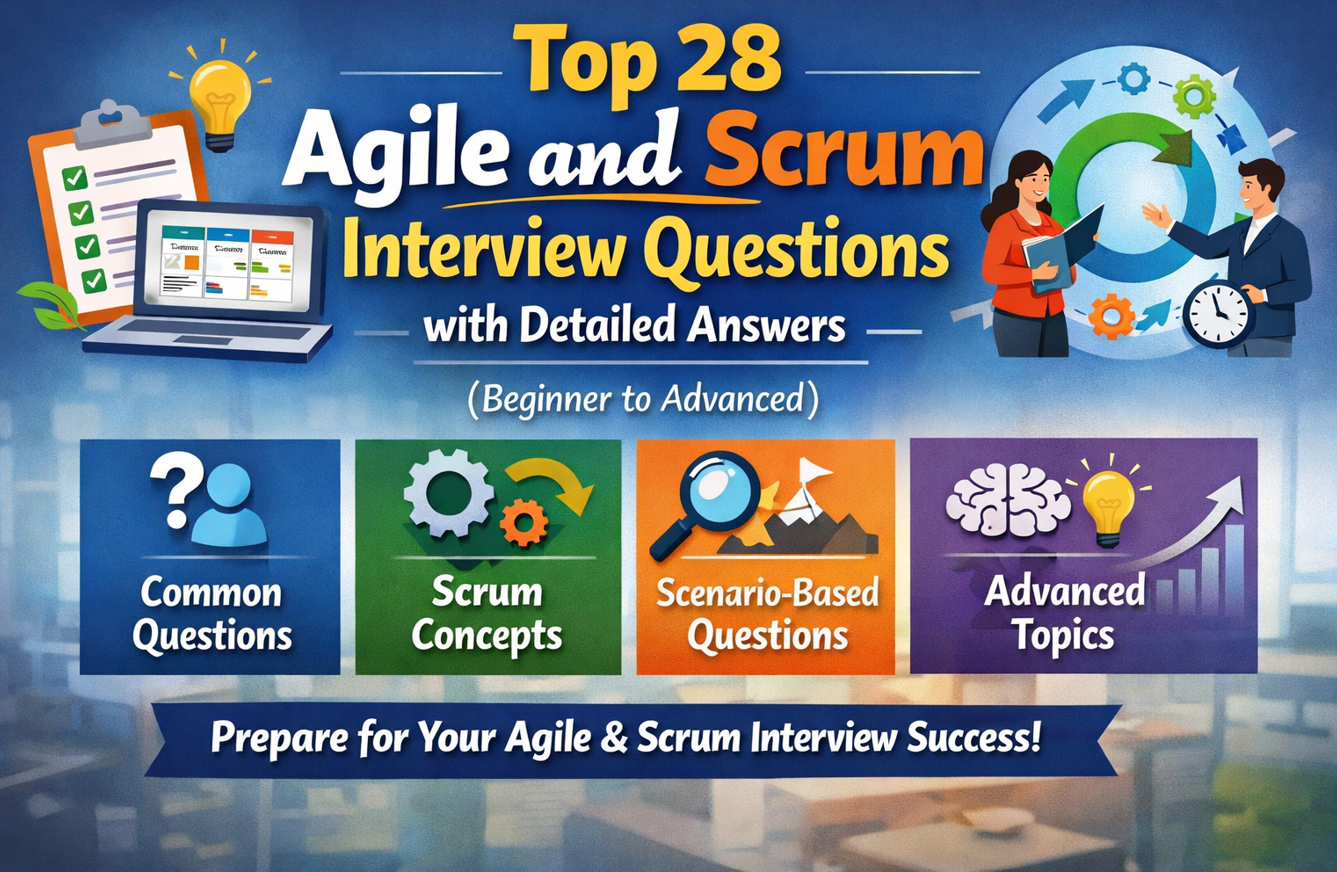
If you’re preparing for Agile and Scrum master interviews, the smartest approach is to understand concepts in simple, practical language, not just memorize definitions. Interviewers usually look for how clearly you can explain real team situations like sprint planning, role responsibilities, handling changing priorities, and improving delivery quality over time. But in this article, you can review the basic definitions of Agile and Scrum concepts in simple language.
1. What is Agile in simple terms?
Agile is a way of working where teams deliver in small steps, learn quickly, and improve continuously instead of waiting for one big final release. The core idea is adaptability. Teams plan, build, review, and adjust in short cycles. In simple terms, Agile is not just speed; it is speed with feedback and learning.
2. What is Scrum, and how is it related to Agile?
Scrum is one popular framework used to apply Agile principles. Agile is the mindset; Scrum is a structured way to practice that mindset. Scrum gives clear roles, events, and artifacts so teams can work with focus and predictability. If asked in interview, say: “Agile is the philosophy, Scrum is one practical framework to implement it.”
Agile vs Scrum
A simple and practical comparison to understand what Agile and Scrum really mean.
Agile
Mindset / Philosophy
- Focuses on flexibility, feedback, and continuous improvement
- Encourages small, frequent delivery of value
- Helps teams adapt quickly to changing requirements
- Includes many frameworks (Scrum, Kanban, XP, etc.)
Scrum
Framework within Agile
- Provides a structured way to practice Agile
- Uses fixed-length sprints (1–4 weeks)
- Defines roles: Product Owner, Scrum Master, Developers
- Defines events: Sprint Planning, Daily Scrum, Review, Retrospective
Quick Difference Table
| Point | Agile | Scrum |
|---|---|---|
| What it is | A mindset and set of principles | A process framework under Agile |
| Structure level | Broad and flexible | Specific roles, events, and artifacts |
| Use case | Guides overall product and team behavior | Runs day-to-day execution in timeboxed sprints |
| Examples | Scrum, Kanban, XP | Sprint Planning, Daily Scrum, Sprint Review, Sprint Retrospective |
Easy way to remember:
Agile = Why and mindset | Scrum = How and framework
3. What are Agile values, and why do they matter?
The Agile values are the core ideas from the Agile Manifesto that guide how modern teams build products. They are simple, practical, and focused on delivering value faster while staying flexible when things change.
- Individuals and interactions over processes and tools: Great teamwork and communication solve problems faster than rigid rules alone.
- Working software over comprehensive documentation: Useful, working outcomes matter more than large documents that may become outdated.
- Customer collaboration over contract negotiation: Regular customer feedback helps teams build the right product, not just follow initial assumptions.
- Responding to change over following a plan: Plans are important, but teams should adapt quickly when priorities or user needs change.
These values do not reject planning, tools, or documentation. They simply say that in real projects, people, outcomes, collaboration, and adaptability should come first.
4. What are Scrum’s three roles?
Scrum has Product Owner, Scrum Master, and Developers. Product Owner owns business priorities and backlog value. Scrum Master supports process health and team effectiveness. Developers build, test, and deliver increments. As far as accountability is concerned: each role has a purpose, and overlap without clarity creates confusion.
5. What does a Product Owner actually do day to day?
A Product Owner continuously manages backlog priority, clarifies requirements, aligns stakeholders, and ensures the team works on high-value outcomes. They are not just writing user stories. Their real job is value optimization. PO is responsible for maximizing product value, not micromanaging tasks.
6. What does a Scrum Master do, and what does a Scrum Master not do?
Scrum Master facilitates Scrum events, removes process blockers, coaches the team, and helps create a healthy delivery environment. They do not assign tasks like a traditional project manager. Their role is to serve leadership.
Scrum Master Role
A Scrum Master is a servant leader who helps the team follow Scrum effectively, improve delivery flow, and remove process-level blockers.
Core Responsibility
- Coach the team on Scrum values and practices
- Facilitate Sprint events (Planning, Daily Scrum, Review, Retrospective)
- Help team stay focused on Sprint Goal
How Scrum Master Supports Team
- Removes blockers that slow delivery
- Protects team from unnecessary interruptions
- Encourages healthy collaboration and ownership
Support to Product Owner
- Improves backlog management flow
- Helps in value-focused prioritization discussions
- Supports stakeholder communication rhythm
What a Scrum Master is Not
- Not a traditional project manager assigning daily tasks
- Not a people manager controlling team members
- Not a status collector for leadership dashboards only
Success Signals of a Good Scrum Master
- Clear Sprint Goals and realistic commitments
- Fewer recurring blockers and smoother sprint flow
- Stronger retrospective actions and visible improvements
- Higher team confidence, ownership, and delivery consistency
Simple definition: A Scrum Master makes Scrum work in real life, not just on paper.
7. Who are Developers in Scrum?
Developers are everyone who contributes directly to creating the product increment, such as engineers, testers, designers, and other specialists. In Scrum, they are one self-managing team. The key point is shared accountability for delivery, not isolated role silos.
8. What is a Sprint?
A Sprint is a fixed-length cycle (usually 1–4 weeks) where the team works toward a Sprint Goal and produces a usable increment. The fixed timebox creates rhythm and focus. If asked why sprints matter, explain that they reduce planning risk and increase learning frequency.
9. What happens in Sprint Planning?
Sprint Planning defines what the team will deliver and how they will approach it. The team agrees on a Sprint Goal, selects backlog items, and builds an initial execution plan. Strong Sprint Planning creates clarity before work starts and reduces mid-sprint confusion.
10. What is a Daily Scrum?
Daily Scrum is a short daily meeting where developers inspect progress toward the Sprint Goal and adjust their plan for the next 24 hours. It is not a status update for managers. It is a coordination tool for the team to stay aligned and proactive.
11. What is Sprint Review?
Sprint Review is where the team demonstrates completed work to stakeholders, collects feedback, and discusses next priorities. It is a product-focused conversation, not just a demo ritual. A good answer highlights that review closes the feedback loop between team and business.
12. What is Sprint Retrospective?
Retrospective is an internal team session to reflect on process, collaboration, and quality, then decide concrete improvements for the next sprint. It is not blame time. It is a structured learning mechanism. Teams that take retrospectives seriously improve consistently over time.
13. What is Product Backlog?
Product Backlog is an ordered list of all work ideas, fixes, features, and improvements for the product. It evolves continuously based on business goals and feedback. The key is “ordered by value,” not simply a random task list.
14. What is Sprint Backlog?
Sprint Backlog is the selected set of backlog items plus the team’s plan to deliver them in the current sprint. It belongs to developers. It can be adjusted during the sprint as long as Sprint Goal remains protected.
15. What is “Increment” in Scrum?
Increment is the completed, usable product outcome at the end of a sprint that meets the Definition of Done. It should be potentially releasable. This means “done” work must be real and testable, not partial progress hidden behind percentages.
16. What is Definition of Done?
Definition of Done is a shared quality checklist that defines when work is truly complete. It may include coding, testing, security checks, review, documentation, and deployment readiness. Without this, teams overestimate completion and quality suffers.
17. What is Definition of Ready?
Definition of Ready is a team-agreed checklist that tells whether a backlog item is clear enough to be pulled into a sprint. It is optional in Scrum Guide but useful in practice. It prevents planning with vague requirements and reduces rework.
18. How is Agile different from Waterfall?
Waterfall is sequential and plan-heavy upfront; Agile is iterative and feedback-driven. In Waterfall, change is often expensive late in the cycle. In Agile, change is expected and managed in short loops. Good interview answers avoid saying one is always better; they explain context fit.
19. How does Scrum handle changing requirements?
Scrum handles change through short sprints, frequent reviews, and backlog reprioritization. Teams avoid random mid-sprint scope changes unless critical. This gives both flexibility and focus. The balance is important: adaptability without chaos.
20. What is velocity, and should teams chase higher velocity?
Velocity is the average amount of work completed per sprint, often in story points. It helps forecasting. Teams should not chase velocity as a target because that can reduce quality and encourage bad estimation. Velocity is a planning signal, not a performance score.
Velocity in Agile
Velocity is the average amount of work a team completes in one sprint. It helps in planning realistic future sprints.
What Velocity Means
- Usually measured in story points
- Calculated from completed work only (not partially done work)
- Represents team capacity trend, not team speed competition
Simple Example
If a team completed 28, 32, and 30 points in last 3 sprints, average velocity is:
(28 + 32 + 30) / 3 = 30 points
Where It Helps
- Sprint planning (realistic commitment)
- Release forecasting (rough timeline)
- Capacity discussion with stakeholders
Best Practices
- Use velocity as a planning guide, not a performance target
- Compare a team only with its own past data
- Include team capacity changes (holidays, support load, new members)
- Keep estimation approach consistent sprint to sprint
Common Mistakes to Avoid
- Using velocity to rank teams
- Forcing higher velocity every sprint
- Counting incomplete stories as done
- Ignoring quality just to increase points
Quick takeaway: Velocity is for better planning, not for pressure.
Healthy teams use it to improve predictability while protecting quality.
21. What is burndown chart, and how is it useful?
A burndown chart shows remaining work versus sprint days. It helps identify if work is on track and highlights delays early. It is useful for transparency but should be read along with context like blockers and quality status.
Burndown Chart vs Burnup Chart
Both charts track Agile progress, but they tell the story in different ways.
Burndown Chart
Shows work remaining over time
- Y-axis = remaining work (story points/tasks)
- X-axis = sprint days or time
- Line moves downward as work gets completed
- Best for sprint-level tracking and early delay detection
Burnup Chart
Shows work completed vs total scope
- One line = completed work (moves up)
- Second line = total scope (can move up/down)
- Great for tracking scope changes clearly
- Useful for release-level planning and stakeholder visibility
Quick Comparison
| Point | Burndown | Burnup |
|---|---|---|
| Tracks | Remaining work | Completed work + total scope |
| Direction | Downward trend | Upward completion trend |
| Scope change visibility | Less clear | Very clear |
| Best use | Sprint tracking | Release tracking |
| Stakeholder communication | Simple status view | Better story for progress vs changing scope |
Easy rule: Use Burndown when sprint focus is on remaining work.
Use Burnup when scope changes often and you need clearer progress visibility.
22. What are common reasons Scrum fails in teams?
Common reasons include unclear role ownership, weak Product Owner involvement, poor backlog quality, skipping retrospectives, overcommitment, and treating Scrum events as formalities. Scrum fails when mindset is missing, even if ceremonies are present.
23. How do you prioritize backlog items effectively?
Prioritization should consider user value, business impact, urgency, risk reduction, dependencies, and effort. Many teams use methods like MoSCoW, WSJF, or simple value-effort discussion. The best approach is transparent and aligned with product goals.
24. What should a team do when it cannot finish committed sprint work?
First, inspect root causes honestly: unclear stories, dependencies, overcommitment, or interruptions. Then adapt next sprint planning using better capacity checks and story slicing. Incomplete items go back to backlog for re-prioritization, not automatic carryover.
25. How do Agile and Scrum improve product quality?
Quality improves through short feedback cycles, early testing, continuous integration, shared Definition of Done, and frequent review. Problems are detected earlier, so correction cost is lower. Quality is treated as part of delivery, not a separate final phase.
26. What are scrum or agile ceremonies?
Agile/Scrum ceremonies are regular team meetings used to plan, track, review, and improve work. In Scrum, the main ceremonies are:
-
Sprint Planning – Decide sprint goal, what to build, and how to do it.
-
Daily Scrum (Stand-up) – 15-minute daily sync to track progress and blockers.
-
Sprint Review – Demo completed work to stakeholders and collect feedback.
-
Sprint Retrospective – Team reflects on what went well, what didn’t, and what to improve next sprint.
Many teams also do Backlog Refinement regularly (not an official Scrum event, but very common) to prepare upcoming work.
27. Is Scrum suitable for every team and project?
Not always. Scrum works best when work can be delivered incrementally and feedback is valuable. For highly rigid, low-change, or compliance-heavy projects, teams may need a hybrid approach. Good interviewers appreciate balanced thinking over one-size-fits-all claims.
28. What is the biggest mindset shift Agile requires?
Moving from “follow plan at all costs” to “deliver value through learning and adaptation.” Teams must accept transparency, shared ownership, and continuous improvement. This mindset shift is harder than changing tools or meeting names, and it is often the true success factor.
Conclusion
Agile and Scrum questions become easy when you connect each concept to real project behavior: who decides priorities, how teams commit realistically, how quality is protected, and how continuous improvement actually works in day-to-day execution. If you focus on clarity, practical examples, and value-driven thinking, your answers will sound natural, confident, and interview-ready.
Discover more from Newskart
Subscribe to get the latest posts sent to your email.

Comments are closed.