

Recently Introduced Meta Muse Spark 1.1 Agentic Model – What It Can Do and Why It Matters


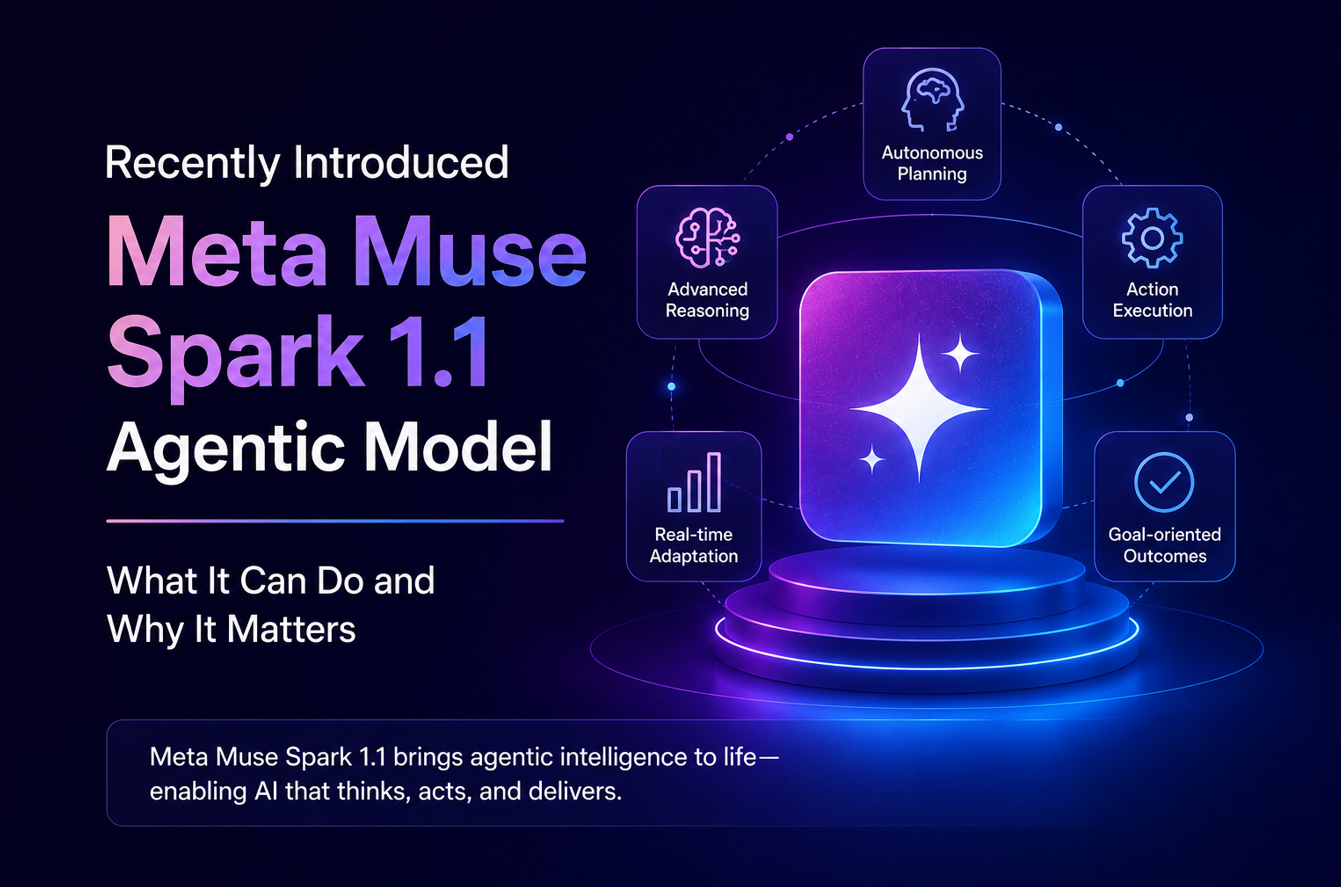
Meta is trying to make a louder entry into the serious AI model race with Muse Spark 1.1, its updated agentic AI model built for coding, tool use and multimodal work.
The timing is interesting. OpenAI, Anthropic and Google have already built strong developer ecosystems around their models. Meta, known for Llama and consumer AI features inside Instagram, WhatsApp and Facebook, now wants developers to take its own in-house model more seriously.
Muse Spark 1.1 is not just another chatbot update. It is being positioned as a model that can help with longer tasks, coding problems, multi-step workflows and inputs like images, videos and documents.
What is Meta Muse Spark 1.1 Agentic Model
Meta Muse Spark 1.1 is the newer version of Meta’s Muse Spark AI model. It is designed for more “agentic” work, which means it can do more than answer a question and stop.
An agentic model can plan steps, use tools, check information, work across apps and continue toward a goal. For example, instead of only explaining a bug in code, it may help identify the problem, suggest a fix and support a larger coding workflow.
Meta has made Muse Spark 1.1 available in Thinking mode through the Meta AI app and website. It is also being opened to developers through the Meta Model API, which is in public preview for developers in the US.
Why this launch matters
Meta has millions of users across WhatsApp, Instagram, Facebook and its smart glasses ecosystem. If it can place a stronger AI model inside those products, AI may become part of daily social, shopping, messaging and work habits.
For developers, the bigger news is API access. Meta is no longer only using its AI inside its own products. It wants outside developers to build apps and tools using Muse Spark 1.1.
That puts Meta in direct competition with OpenAI, Anthropic, Google and xAI, especially in coding and agent workflows.
The pricing angle also matters. Reports say Meta is using aggressive pricing to attract developers. That could put pressure on rivals if the model performs well enough for real production use.
Main capabilities of Muse Spark 1.1
Muse Spark 1.1 is focused on three useful areas – coding, agentic workflows and multimodal understanding.
- In coding, Meta says the model can help detect and fix complex bugs. That is useful because developers do not only need code suggestions. They need help understanding why something broke.
- In agentic work, the model is expected to support end-to-end workflows across apps, including multi-agent systems. Multi-agent systems are setups where more than one AI agent works on different parts of a task.
- In multimodal work, the model can understand images, videos and documents. This can help with tasks like reading a screenshot, checking a file, reviewing a product image or understanding a video-based input.
Coding use cases –
The clearest use case for Muse Spark 1.1 is software development.
A developer could use it to inspect code, explain errors, suggest patches or help with repetitive coding tasks. A startup could connect it to an internal coding tool and use it for bug triage, test writing or documentation.
For example, if a team has a payment bug, the model may help compare logs, read the code path and suggest where the problem could be. A human developer still has to review the final fix, but the model can reduce the time spent searching.
That is the appeal. Good AI coding tools do not replace engineers overnight. They remove some of the slower parts of engineering work.
Multimodal use cases –
Muse Spark 1.1’s ability to understand different input types could make it useful beyond coding.
A product manager may upload a screenshot and ask what is confusing in the user interface. A marketing team may ask it to analyse a video script or a campaign document. A support team may use it to read customer-uploaded images and draft a response.
If Meta connects these abilities deeply with Instagram, WhatsApp and its smart glasses, the model could become more personal and practical. A user wearing smart glasses may ask about something they are seeing. A seller on Instagram may ask AI to create better product replies. A creator may ask for content ideas based on a video.
This is where Meta has an advantage. It already owns the platforms where people communicate, shop, post and create.
Meta Model API and developer push
The Meta Model API is important because it gives developers a way to build with Muse Spark 1.1 outside Meta’s own apps.
Reports say new Meta Model API accounts are getting $20 in free credits. That is a small but useful push to make developers test the model.
If developers like the quality and price, Meta could build a new business line around AI model access. That would be different from its usual ad-heavy business model.
But developer trust takes time. OpenAI, Anthropic and Google already have strong API users. Meta will need reliable performance, clear documentation, stable pricing and good support if it wants developers to stay.
How it compares with rivals
Muse Spark 1.1 will be compared with OpenAI’s GPT models, Anthropic’s Claude models, Google’s Gemini models and xAI’s Grok models.
OpenAI is strong in developer tools and general-purpose AI. Anthropic is known for long-context work, coding and enterprise use. Google has Gemini and deep cloud integration. Meta’s edge may come from lower pricing, social product reach and its ability to place AI inside apps people already use every day.
Still, Meta has to prove the model is not only cheap, but dependable. In business use, a weak answer can cost more than a higher API bill.
Limitations and concerns
There are still open questions.
- First, availability is limited because the API public preview is for US developers.
- Second, detailed official documentation and independent testing will matter before companies trust it for critical work.
- Third, Meta’s AI work often raises privacy questions because of the company’s large social data ecosystem. Users and developers will want clarity on what data is used, how prompts are handled and what control they have.
There is also the safety angle. Meta’s earlier Muse Spark safety report discussed safeguards around high-risk areas such as cybersecurity and chemical or biological misuse. As models become more capable, these controls become more important.
Who should try Muse Spark 1.1
Developers working on coding tools, AI agents, automation products and multimodal apps may find Muse Spark 1.1 worth testing.
Startups with tight budgets may also be interested if Meta’s pricing remains competitive. A cheaper model that performs well can make AI features more affordable at scale.
For normal users, the model may show up through Meta AI, WhatsApp, Instagram or smart glasses features over time. They may not care about the model name, but they will notice if the assistant becomes better at planning, explaining, seeing and helping.
Conclusion – Key takeaways
Meta Muse Spark 1.1 Agentic Model is Meta’s attempt to move from consumer AI features into a more serious developer and enterprise AI race.
Its main strengths are coding support, agentic workflows, multimodal understanding and lower-cost API access. The model could help developers build AI tools, support app-based automation and improve Meta AI across consumer platforms.
The real test will be trust. If Muse Spark 1.1 is fast, affordable and reliable, Meta can become a stronger challenger to OpenAI, Anthropic and Google. If it is only cheap, developers may test it once and move back to models they already trust.
Facts Input- Meta, EvaluationReport
Discover more from Newskart
Subscribe to get the latest posts sent to your email.

Comments are closed.