


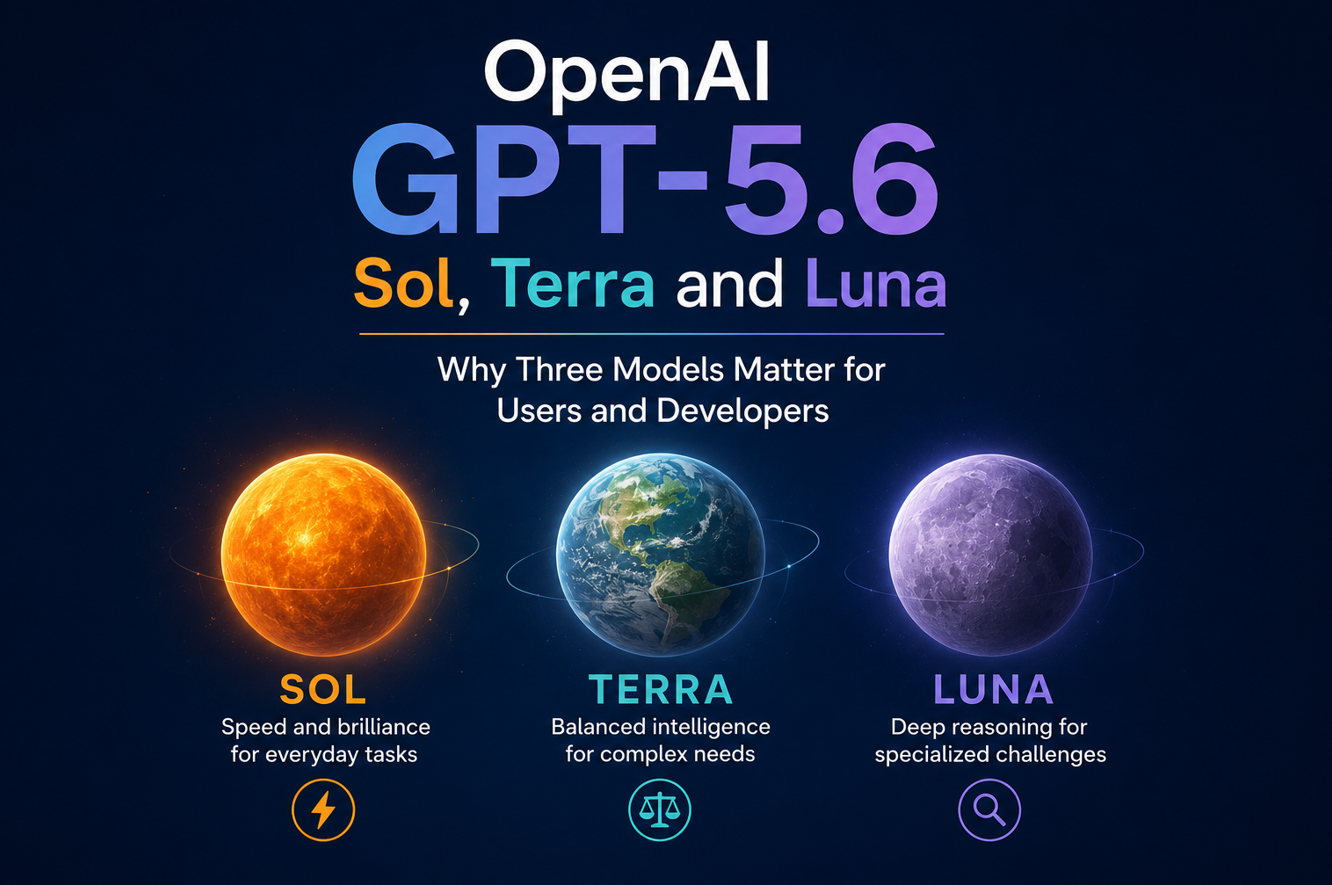
OpenAI has introduced the GPT-5.6 model family with three choices – Sol, Terra and Luna. Instead of pushing one model for every task, OpenAI is now giving users and developers a clearer way to pick between power, price and speed.
That may sound like a small naming change, but it matters. AI is now used for many different jobs. A startup may need cheap, fast replies for customer support. A developer may need deeper reasoning for code review. A designer may want better layout ideas. A large company may want a model that can handle long, tool-heavy workflows without wasting tokens.
This is where GPT-5.6 Sol, Terra and Luna come in. Each model is meant for a different kind of work.
What is GPT-5.6
GPT-5.6 is OpenAI’s newer model family for production workflows, coding, reasoning, tool use and design-heavy tasks. OpenAI says it is more token-efficient and better at areas such as frontend design, layout, visual hierarchy and understanding user intent.
In simple words, token efficiency means the model can often do useful work with fewer words or smaller output. For businesses using the API, that can matter because AI cost is usually linked to input and output tokens.
GPT-5.6 also supports features such as programmatic tool calling, multi-agent workflows in beta, prompt caching, persisted reasoning, max reasoning effort and pro mode. These are mostly developer-facing features, but the idea behind them is simple – make AI more useful for serious work, not just quick chat.
Sol – the flagship model
Sol is the most capable model in the GPT-5.6 family. OpenAI’s model alias gpt-5.6 routes to gpt-5.6-sol, which tells us Sol is the default flagship option.
This is the model for harder work. Think complex coding, long planning, technical analysis, product design, multi-step research, detailed debugging or tasks where a weak answer can waste time.
For example, if a software team wants AI to review a complicated codebase, Sol would make more sense than a cheaper lightweight model. If a product team wants help designing a full dashboard interface with clean layout decisions, Sol may be the better pick.
Sol costs more than the other two models, but that is expected. The point is not to use it for every tiny request. The smarter move is to reserve it for work where quality matters more than speed or cost.
Terra – the balanced option
Terra is the middle model. It is made for users who want strong performance but do not want to pay Sol-level pricing for every task.
This could become the practical daily model for many teams. Writing, summarizing, planning, code assistance, document review, customer support drafts and normal business analysis may fit well here.
A small business, for example, may use Terra to summarize sales calls, draft customer emails, prepare reports and support internal knowledge search. These jobs need quality, but not always the deepest reasoning.
Terra is also useful when companies are moving from GPT-5.5 or GPT-5.4 and want a better balance between output quality and cost.
Luna – the fast and affordable model
Luna is the low-cost, high-volume model in the GPT-5.6 family. It is meant for tasks where speed and scale matter.
This can include short summaries, simple rewrites, classification, basic customer replies, data labelling, quick Q&A and high-volume app features.
A shopping app may not need Sol to answer “Where is my order?” A helpdesk tool may not need the most powerful model to classify a ticket as billing, delivery or refund. Luna is designed for these lighter jobs where cost control is important.
For developers, Luna can be a smart choice when millions of small requests are involved. Even a small cost difference can become large at scale.
Why OpenAI created three choices
The main purpose is flexibility. One AI model cannot be perfect for every user, every budget and every workload.
Earlier, many people picked the strongest model by default. That worked for quality, but it often increased cost. Others picked cheaper models and accepted weaker answers. GPT-5.6 makes the choice more structured.
Use Sol when the task is difficult. Use Terra for balanced everyday work. Use Luna when speed and cost matter most.
This is similar to choosing a vehicle. You do not use a luxury SUV for every small delivery, and you do not use a basic city car for a mountain expedition. Different jobs need different tools.
What changes for developers
Developers get more control with GPT-5.6. They can choose the model, set reasoning effort, use pro mode for harder tasks and test prompt caching to control cost.
OpenAI’s guidance suggests that teams moving from GPT-5.5 or GPT-5.4 should not blindly increase settings. They should test the same reasoning level and one level lower on real tasks. That is sensible because a newer model may give similar or better results with fewer tokens.
The pricing also shows the difference clearly. In standard short-context API pricing, Sol is listed at $5 input and $30 output per 1 million tokens. Terra is $2.50 input and $15 output. Luna is $1 input and $6 output. Long-context pricing is higher.
For a company building AI into its product, this makes planning easier. Expensive tasks can go to Sol. Routine tasks can go to Terra or Luna.
Competitors and market context
OpenAI is not alone in giving users more model choices. Anthropic, Google, Meta and Mistral also offer different models for different use cases.
Anthropic has Claude models for reasoning and business use. Google has Gemini models across different speed and capability levels. Meta’s Llama models are important for open-source and self-hosted AI use cases. Mistral also competes strongly in efficient models.
The GPT-5.6 family shows where the market is going. AI companies are no longer selling only “the best model.” They are selling the right model for the job.
What users should keep in mind
More choice is useful, but it can also confuse people. The best way to choose is to test models on real work.
If you are writing a short email, Luna may be enough. If you are preparing a research memo, Terra may be better. If you are debugging a difficult app or building a complex workflow, Sol is the safer choice.
Do not judge only by price. A cheaper model that gives weak answers may cost more in rework. A powerful model used for simple tasks may waste money. The right choice sits between quality, speed and cost.
Conclusion – Key takeaways
OpenAI’s GPT-5.6 family gives users three clearer AI choices. Sol is the flagship model for hard work. Terra is the balanced option for everyday productivity. Luna is the faster, cheaper model for high-volume tasks.
The purpose is simple – help people stop using one model for everything. Developers, startups and companies can now match the model to the job more carefully.
For regular users, this means better flexibility. For businesses, it means better cost control. For OpenAI, it is a way to serve both advanced users and high-volume applications without forcing everyone into the same lane.
Facts Input- Model Guidance, OpenAI
Discover more from Newskart
Subscribe to get the latest posts sent to your email.

[…] OpenAI GPT-5.6 Sol, Terra and Luna – Why Three Models Matter for Users and Developers […]
[…] OpenAI GPT-5.6 Sol, Terra and Luna – Why Three Models Matter for Users and Developers […]