

RBI Keeps Repo Rate Unchanged at 5.25%: What It Means for EMIs, Businesses, and the Indian Economy?


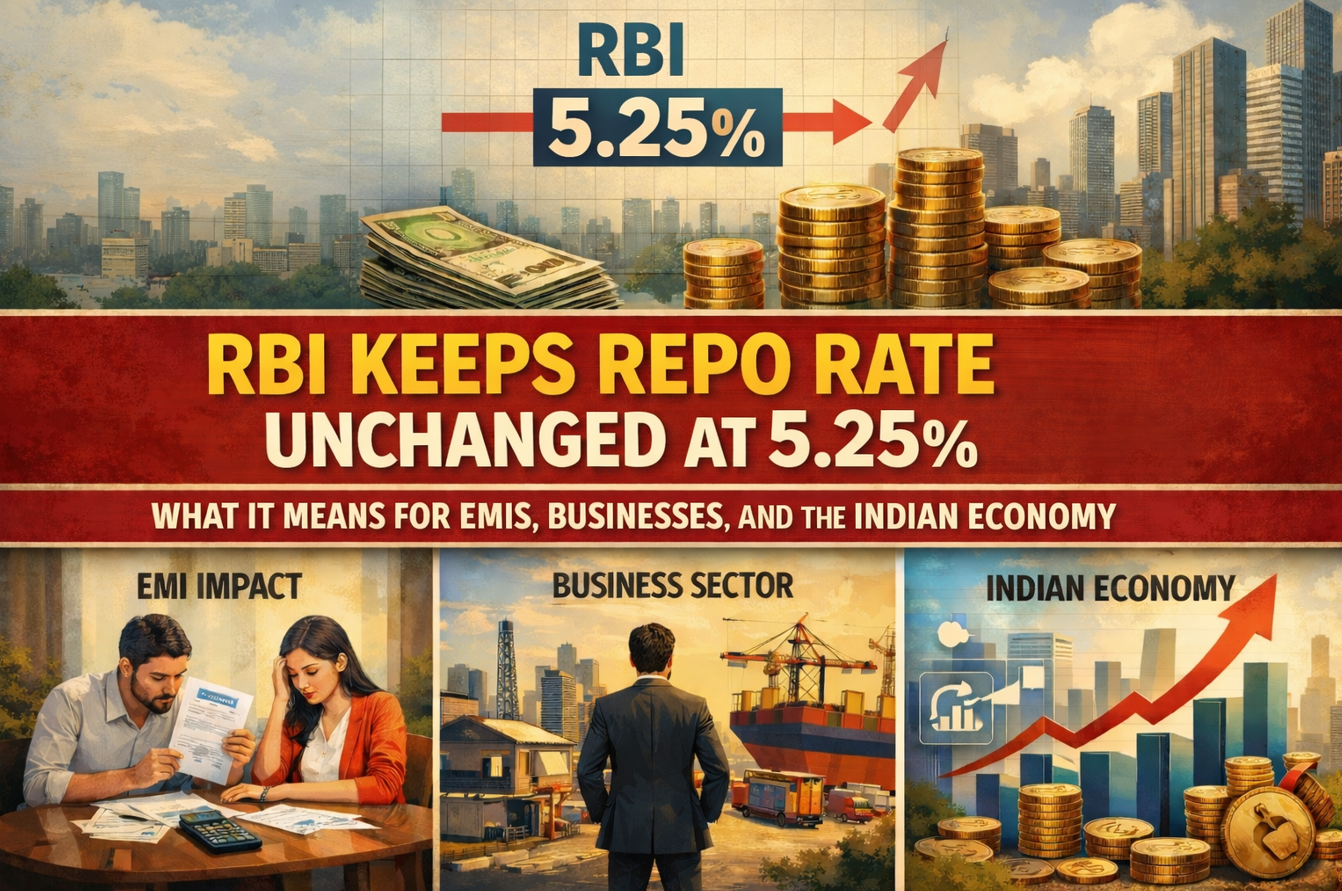
On 8 April 2026, the Reserve Bank of India (RBI) kept the repo rate unchanged at 5.25%. For many people, we’ll explain the technical aspect of this thing over our loan EMIs, businesses and Indian economy. This single decision affects your loan cost, market sentiment, and business borrowing mood etc.
If you are paying a floating-rate home loan, planning a personal loan, or tracking investments, this policy matters directly. Even if your EMI does not change immediately, the RBI’s message tells us where borrowing conditions may go next.
In this article, we break the update in plain language, explain practical impact, compare India’s stance with global central bank trends, and share what borrowers and investors should watch now.
What Exactly Did RBI Announce?
The Monetary Policy Committee (MPC) decided to keep the policy repo rate at 5.25%. Reports also indicate the stance remains neutral, meaning RBI is keeping flexibility instead of clearly signaling only hikes or only cuts. So, in plain terms, RBI is saying:
- We are not changing rates right now.
- We want more clarity on inflation and global risks.
- & Future moves will be data-driven.
That “wait and watch” approach is common when global uncertainty is high and domestic conditions are mixed.
Why RBI Likely Chose a Pause
A pause usually means the central bank is balancing two goals:
- Keep inflation under control.
- Avoid hurting growth with premature tightening.
Recent coverage points to global geopolitical stress, commodity volatility, and external uncertainty as major risk factors. At the same time, India’s domestic growth base remains relatively resilient compared with many economies. So RBI’s hold decision appears to be a calculated middle path: no sudden shock to borrowers, but no aggressive easing signal either.
Impact on Home Loan and Other EMIs
This is the first question most people ask: “Will my EMI go up or down?”
If your loan is linked to repo (or external benchmark), an unchanged repo rate generally means no immediate rate reset from this policy alone. Your EMI may stay the same unless your bank changes spread or other internal pricing components later.
1. Practical example
If you have a floating home loan and expected a rate cut today, your EMI may not reduce now. But the rate also has not increased, which is still a relief for borrowers who feared tightening.
2. What borrowers should do
- Check your current loan benchmark type (repo/ECLR/MCLR).
- Compare refinance options if your effective rate is high.
- Use prepayment on principal when possible to reduce total interest burden.
Impact on Businesses and MSMEs
For businesses, especially MSMEs, stable policy rates usually improve planning confidence. A pause helps companies estimate borrowing cost better for working capital, inventory, and expansion decisions. However, stable policy rate does not automatically mean cheap credit. Final lending rates still depend on bank risk appetite, sector conditions, and borrower profile.
Practical example
A small manufacturer planning machine upgrades may still proceed, because the policy did not become stricter. But they may negotiate harder with lenders for better terms instead of assuming automatic reduction.
Market Reaction: Why Stocks and Bonds Care
Monetary policy decisions often shape market mood quickly.
- Equity markets generally prefer policy predictability.
- Bond markets read policy tone for future rate path clues.
- Currency traders watch growth-inflation-risk balance.
When RBI holds and signals caution, markets often focus less on the current rate and more on forward guidance. In short, investors ask: “What is likely in the next one or two meetings?”
RBI’s latest move is best read as a stability-first decision in an uncertain global environment. For households and businesses, the smart response is financial discipline, informed comparisons, and readiness for multiple rate scenarios.
Facts Input- RBI
Discover more from Newskart
Subscribe to get the latest posts sent to your email.

Comments are closed.