

PM Modi’s Rs. 1 Lakh Crore Innovation Fund – What Startups Should Know About The Big Announcement


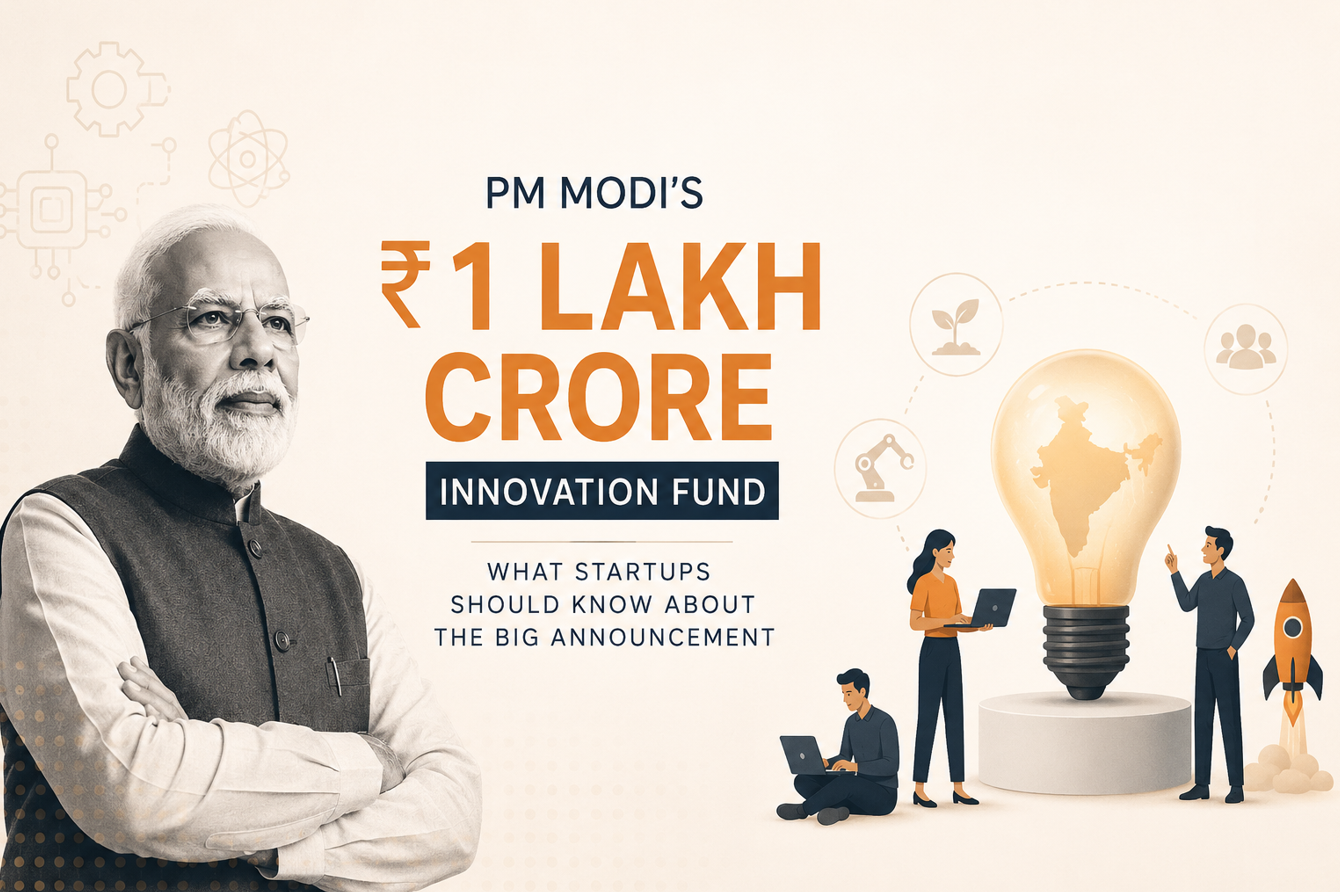
Prime Minister Narendra Modi used his Independence Day 2026 speech from the Red Fort to put startups, young entrepreneurs and innovation at the centre of India’s growth story. According to an India Today report published on August 15, 2026, the Prime Minister announced a Rs. 1 lakh crore innovation fund to support young people with ideas and help them turn those ideas into businesses.
The announcement is important because startup funding in India is no longer only about food delivery apps, fintech products or quick consumer platforms. The next phase is expected to be more about deep technology, manufacturing, artificial intelligence, clean energy, semiconductors, biotech, space and advanced research.
For founders, the message is simple. If India wants to build world-class technology at home, promising ideas will need longer-term financial support. That is exactly where the Rs. 1 lakh crore innovation fund fits in.
What PM Modi announced
During his Independence Day address on August 15, 2026, PM Modi said the government had created a Rs. 1 lakh crore mechanism to support ideas, innovation and capability. The larger message was aimed at young entrepreneurs who may have strong ideas but lack the capital to develop them.
India Today reported that the announcement was part of a broader youth-focused push. The Prime Minister also spoke about AI training for one crore young people, free online coaching for competitive exam aspirants, and opportunities linked to Digital India, Skill India, the drone sector and the opening up of space.
This is why the fund should not be seen as a standalone headline. It sits inside a wider policy direction where the government wants Indian youth to build, research, manufacture and create jobs.
Is this a new fund or linked to the RDI Fund
The announcement is closely linked to the government’s Research, Development and Innovation Fund, commonly called the RDI Fund. Official records show that the Union Cabinet approved the Rs. 1 lakh crore RDI Scheme on July 1, 2025. It was formally launched by the Prime Minister on November 3, 2025.
So, the Independence Day 2026 announcement should be understood as a strong public push for the same innovation financing framework, especially for startups and young entrepreneurs.
The RDI Fund is planned over six years. It is designed to support private sector research, deep-tech startups and companies working on high-impact technologies. The fund is not meant only for small grants. It is meant to provide long-term capital for difficult technologies that may take years to become commercially ready.
Why this matters for Indian startups
Most startups need money. But deep-tech startups need a different kind of money.
A regular consumer startup may be able to launch a product, test it with users, change features quickly and show early revenue. A deep-tech startup works differently. It may need a lab, testing equipment, researchers, patents, safety approvals, pilots with large companies and manufacturing partners.
Take an electric vehicle battery startup as an example. It cannot simply build an app and launch it in a few weeks. It has to test battery chemistry, safety, charging performance, lifecycle, heat management and cost. That takes time and patient funding.
The same is true for startups building medical devices, drones, robotics, semiconductor tools, clean energy equipment or space technology. These areas are expensive, but they can also create serious long-term value for the country.
That is why the PM Modi Rs. 1 lakh crore innovation fund could matter. It can reduce the funding gap between an early idea and a product that is ready for the market.
Which sectors can benefit
The official RDI Fund framework focuses on sunrise and strategic sectors. These include artificial intelligence, quantum computing, robotics, space technology, biotechnology, biomanufacturing, pharmaceuticals, medical devices, energy transition, climate action and the digital economy.
AI in agriculture, health and education is also part of the focus area. This is important because India has many large public problems where technology can make a difference.
For example, an AI tool that helps farmers detect crop disease early can improve income and reduce waste. A low-cost medical device can help smaller hospitals. A robotics startup can support factories. A clean energy startup can help industries reduce fuel costs.
The automobile sector may also benefit indirectly. EV batteries, charging systems, vehicle electronics, lightweight materials and hydrogen technology all need research-led innovation. If the funding reaches strong companies in these areas, it can support India’s manufacturing ambitions.
How the process may work
The Rs. 1 lakh crore innovation fund is not expected to work like a simple online cash scheme where any founder can directly claim money.
As per official RDI Fund details, the structure works through the Anusandhan National Research Foundation, or ANRF. The Department of Science and Technology is the nodal ministry for implementation.
The fund uses a two-level model. Money is first routed to approved Second-Level Fund Managers, called SLFMs. These fund managers then support eligible startups, companies and research-led projects.
The Technology Development Board and the Biotechnology Industry Research Assistance Council have already been approved as SLFMs. In simple language, TDB may support wider technology commercialization, while BIRAC is more focused on biotechnology and life sciences.
This means founders should not only watch government announcements. They should track official calls from TDB, BIRAC, ANRF and future approved fund managers.
What founders should prepare
A startup that wants to apply should first check whether its product has a strong research or technology component. The fund is more suitable for serious innovation than for ordinary trading, resale, content or basic service businesses.
Founders should prepare a clear problem statement. They should explain what they are building, why it is different, what stage the technology has reached and how it can become commercially useful.
They should also keep technical proof ready. This may include prototypes, lab results, pilot data, patent filings, customer letters, testing reports or partnerships with research institutions.
Financial planning will be equally important. A founder should be able to explain how much funding is needed, where the money will go, what milestones will be achieved and how the company plans to earn revenue later.
A practical example would be a startup building an Indian-made medical sensor. A strong application would not only say “we are building a sensor”. It would show test results, target hospitals, expected price, regulatory path, manufacturing plan and why the product is better or cheaper than existing options.
Latest implementation status
The RDI Fund has already started moving from announcement to execution. A PIB update from July 2026 said TDB and BIRAC had each been sanctioned Rs. 1,000 crore under the RDI Fund.
The same update said Rs. 500 crore was disbursed to TDB in March 2026 for investment in eligible technology entities. TDB had approved 22 projects with total project cost of Rs. 4,744 crore, including RDI Fund support of Rs. 2,192 crore. BIRAC had shortlisted eight projects involving support of Rs. 390.35 crore.
This is a useful detail because it shows that the fund is not just a speech point. The funding machinery has started, though founders still need to follow formal calls and eligibility rules.
Conclusion with key takeaways
PM Modi’s Rs. 1 lakh crore innovation fund announcement on Independence Day 2026 gives India’s startup ecosystem a strong policy signal. The government wants more young entrepreneurs to build serious technology, not just quick digital products.
Key takeaways –
- PM Modi announced the Rs. 1 lakh crore innovation fund during his Independence Day 2026 speech.
- The announcement is linked to India’s wider RDI Fund framework for research, development and innovation.
- The fund is focused on deep-tech, AI, biotech, space, robotics, clean energy, medical devices and strategic technology areas.
- Startups may access support through approved fund managers such as TDB and BIRAC.
- Founders should prepare technical proof, clear milestones, funding plans and market use cases before applying.
Discover more from Newskart
Subscribe to get the latest posts sent to your email.

Comments are closed.