


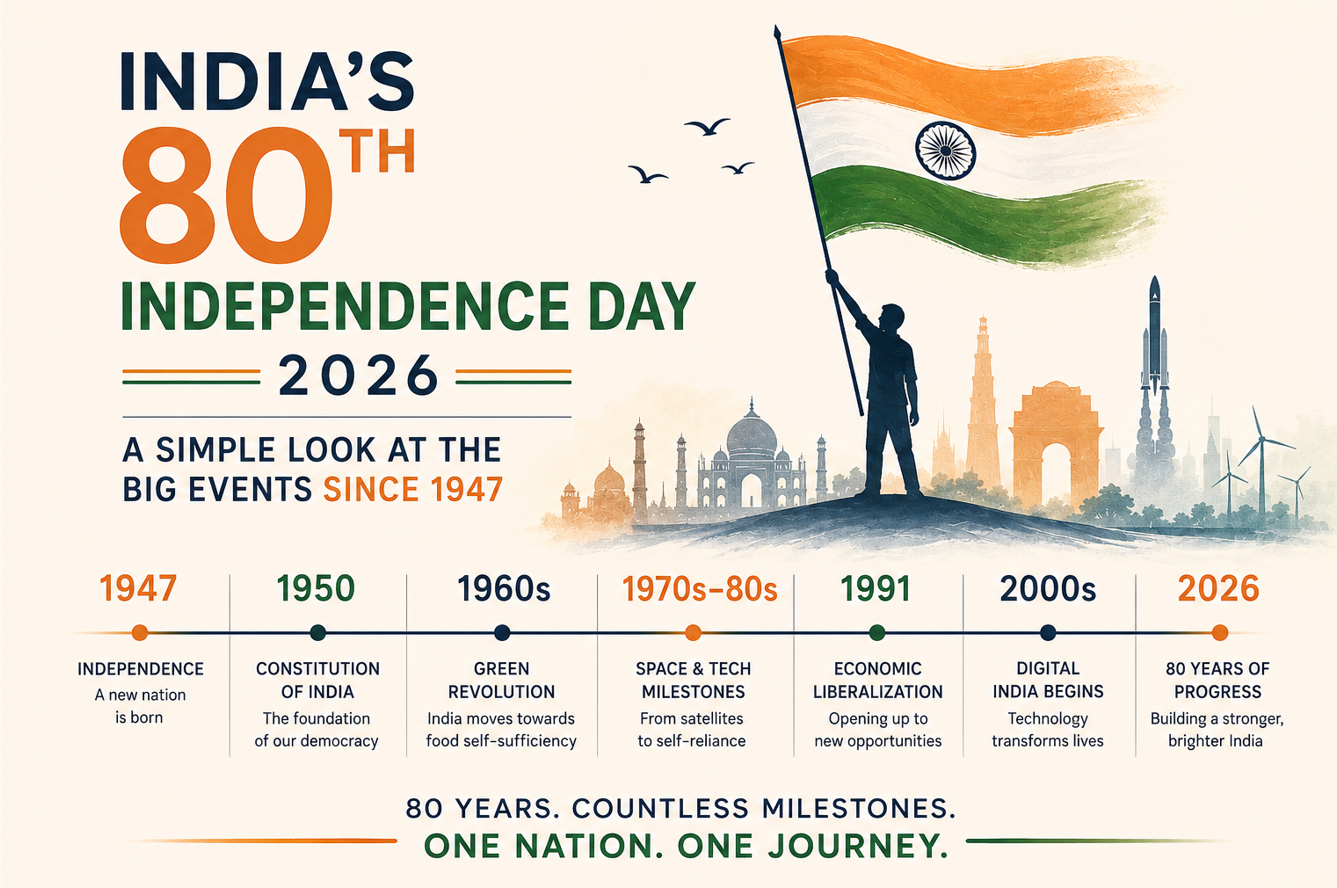
India is celebrating its 80th Independence Day on August 15, 2026. Many people get confused by the number, and that is understandable. India became free on August 15, 1947. So, by August 15, 2026, the country completes 79 years of independence. But because the first Independence Day was celebrated in 1947 itself, 2026 is counted as the 80th Independence Day.
This day is not only about flag hoisting, school functions, speeches and patriotic songs. It is also a moment to look back at how far the country has travelled. India began its modern journey with deep poverty, Partition pain, food shortages and the difficult task of building one democratic nation out of many regions, languages and communities.
Today, the story is much bigger. India is a major economy, a large digital market, a growing startup hub, a key automobile market, a telecom giant and a space power. The journey has not been perfect, and many challenges remain. But the change since 1947 is massive.
Why August 15 matters so much
August 15 is the date India became independent from British rule in 1947. It marked the end of colonial control and the start of self-rule. Every year, the Prime Minister hoists the national flag at the Red Fort in Delhi and addresses the country.
The Red Fort speech has become more than a ceremony. It often reflects the mood of the country. In different decades, the focus has shifted from food security and national unity to economic reforms, technology, startups, women’s participation, defence strength and the idea of Viksit Bharat by 2047.
The 2026 Independence Day is special because it comes when India is moving toward the 100th year of independence in 2047. That gives the day a forward-looking meaning. It is not only about remembering the past. It is also about asking what kind of country India wants to become in the next 21 years.
From freedom to a republic
The first big step after independence was building the Constitution. India became free in 1947, but the Constitution came into force on January 26, 1950. That is when India formally became a sovereign democratic republic.
This was a huge achievement. Many newly independent countries struggled to keep democracy alive. India chose universal adult franchise, which meant every adult citizen had the right to vote. For a country with high poverty and low literacy at the time, this was a bold decision.
The early years were also about building institutions. Parliament, the Election Commission, the courts, public sector companies, universities, dams and scientific institutions became part of the new national framework. The idea was simple. Political freedom had to be supported by economic and social development.
Food, industry and self-reliance
In the years after 1947, India faced serious food shortages. The country had to depend on imports at different points. The Green Revolution later helped improve foodgrain production, especially in states such as Punjab, Haryana and western Uttar Pradesh.
Industrial growth was also shaped by planning and public sector investment. India built steel plants, heavy engineering companies, power projects and research institutions. This model had limits, but it created the base for future growth.
For an ordinary family, the change was visible slowly. More schools opened. Electricity reached more towns and villages. Roads improved. Banking expanded. Public services became part of daily life, even if access remained uneven.
The 1991 turning point
One of the biggest changes after independence came in 1991. India faced a serious economic crisis and then began major reforms. The government reduced many controls on industry, eased import restrictions and opened more space for private companies.
This changed Indian business. Competition increased. Consumers got more choice. Indian companies had to become sharper. Sectors such as automobiles, telecom, software, finance and retail began changing faster.
For example, before liberalization, buying a car or getting a telephone connection could mean long waiting periods. Over time, competition brought more brands, better products and lower entry barriers. This is why 1991 remains one of the most important years in India’s post-independence economic story.
The automobile shift
India’s automobile journey is a good way to understand the country’s wider economic change. For many years, the market was small and choice was limited. Later, with policy changes and competition, India became a major market for two-wheelers, cars, commercial vehicles and auto parts.
The auto sector also created a large supplier network. A car is not only made by one company. It needs tyres, seats, electronics, batteries, glass, software, logistics and thousands of workers across the supply chain.
Now the sector is changing again because of electric vehicles, battery technology, connected cars and cleaner fuel rules. This is where India’s future manufacturing story may be written. If India can build strong EV supply chains, charging networks and battery capacity, the auto sector can become even more important for jobs and exports.
The telecom and mobile revolution
Telecom may be the clearest example of how India changed in everyday life. A mobile phone was once a luxury. Today, it is a basic tool for payments, education, shopping, work, entertainment and government services.
TRAI data shows how large the telecom base has become. By March 2026, India had over 1 billion internet subscribers and more than 1.2 billion wireless subscribers, according to TRAI dashboard figures. These numbers explain why mobile-first businesses work so well in India.
A vegetable seller accepting UPI, a student watching classes on a phone, a small shop taking orders on WhatsApp and a driver using navigation are all part of this change. The mobile phone has become India’s pocket-sized development tool.
Digital India, UPI and startups
Digital India was launched in 2015 to improve digital services, connectivity and citizen access. Around the same period, India’s startup story also became much stronger. Startup India was launched in January 2016 to support entrepreneurship and innovation.
UPI, launched in 2016, became one of India’s most visible digital success stories. It made instant bank-to-bank payments simple for ordinary users. By FY 2025-26, official data said UPI had crossed 24,000 crore annual transactions and handled value above Rs. 314 lakh crore.
This matters because digital payments are not just about convenience. They help small businesses record transactions, reduce cash handling and serve more customers. A roadside tea stall and a large online marketplace can both use the same payment rail. That is a powerful idea.
India’s startup ecosystem also grew across fintech, edtech, healthtech, mobility, software, agritech and consumer brands. Not every startup succeeds, but the culture of building new companies has become stronger than it was a decade ago.
Space, science and national confidence
India’s science journey has also become a source of national pride. ISRO’s Chandrayaan-3 successfully soft-landed on the Moon on August 23, 2023. It was a major moment for Indian space technology and inspired millions of students.
Such achievements matter beyond headlines. Space missions improve scientific capability, engineering confidence and public interest in research. They also support real-world sectors such as weather forecasting, navigation, agriculture, communication and disaster management.
The road to 2047
The 80th Independence Day is a good time to look at both pride and responsibility. India has made strong progress since 1947, but the next phase will require better jobs, cleaner cities, stronger manufacturing, quality education, affordable healthcare, safer roads and more inclusive growth.
The big question is not whether India has changed. It clearly has. The real question is whether that change can reach every household more fairly.
For a young Indian in 2026, independence is not only a memory from history books. It is the freedom to study, start a business, use technology, move across the country for work, vote, speak, build and dream. That is what makes August 15 feel alive even after eight decades.
Conclusion with key takeaways
India’s 80th Independence Day in 2026 is a moment to remember the journey from 1947 and think seriously about the road to 2047.
Key takeaways –
- India completes 79 years of freedom on August 15, 2026, but celebrates its 80th Independence Day because the first one was in 1947.
- The Constitution coming into force in 1950 turned India into a democratic republic.
- The 1991 reforms changed the direction of Indian business and opened the economy to more competition.
- Telecom, mobile internet, Digital India, UPI and startups have reshaped daily life in the last decade.
- India’s future growth will depend on jobs, manufacturing, technology, inclusion and stronger public services.
Facts Input- Incredible India – Independence Day, PIB – Journey of India as a Republic, PIB – Economic reforms and 1991 liberalization, PIB – Digital India programme, NPCI – UPI overview,
PIB – UPI completes 10 years, Startup India – About Startup India, PIB – GST roll-out, TRAI – Telecom dashboard and subscription reports, ISRO – Chandrayaan-3 mission updates
Discover more from Newskart
Subscribe to get the latest posts sent to your email.

Comments are closed.