

MG ADAPT Platform Unveiled in India – What It Means for Future EVs, Hybrids and PHEVs


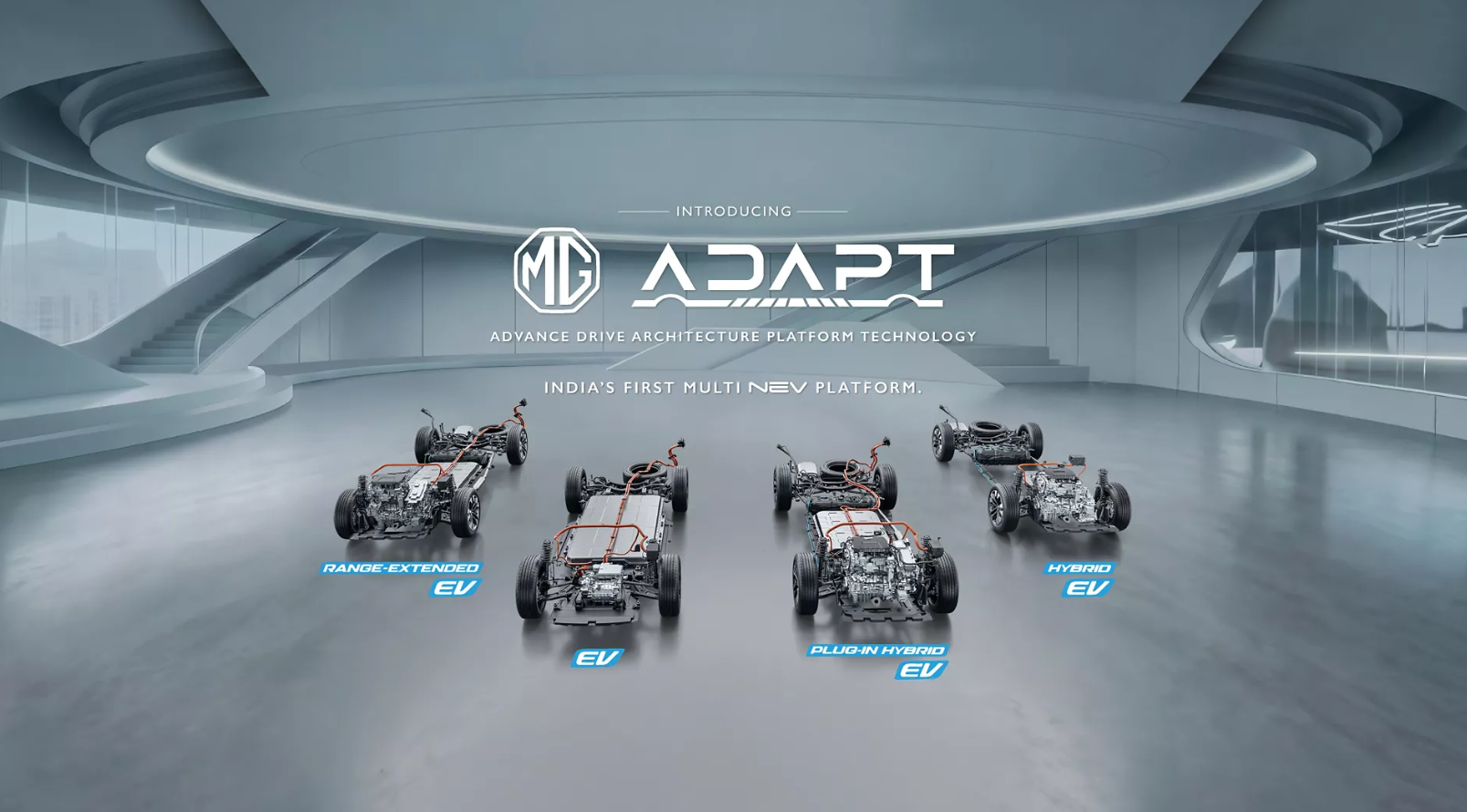
JSW MG Motor India has unveiled ADAPT, a new vehicle platform that can support different kinds of electrified cars on one base. The full name is Advance Drive Architecture Platform Technology, but buyers will care more about what it can do.
In simple words, MG ADAPT can be used for electric vehicles, strong hybrids, plug-in hybrids and range-extender electric vehicles. That gives MG more freedom to launch different types of new energy vehicles in India without building a separate platform for every powertrain.
The first products based on this platform are expected by FY2026-27. MG has confirmed that one EV and one plug-in hybrid model will come on ADAPT, which means the platform is not just a concept slide. It is going into real cars.
What is MG ADAPT
MG ADAPT is a modular platform for New Energy Vehicles, also called NEVs.
A platform is the base structure of a vehicle. It decides where the battery, motor, engine, suspension and key electronics can sit. If the platform is flexible, the carmaker can build different models on it more easily.
ADAPT is designed to support four powertrain types –
- Electric Vehicle or EV
- Hybrid Electric Vehicle or HEV
- Plug-in Hybrid Electric Vehicle or PHEV
- Range Extender Electric Vehicle or REEV
This matters because India is not moving to electric cars in one straight line. Some buyers are ready for EVs. Some want hybrids. Some want petrol backup with electric driving. MG is trying to cover all these stages with one architecture.
Why MG built a multi-powertrain platform
India’s car market is complicated. Charging infrastructure is improving, but range anxiety is still real for many families. Fuel prices matter. City buyers may like EVs, while highway users may still want petrol backup.
A single-powertrain strategy can miss many customers. ADAPT gives MG more room to respond.
For example, a city-focused buyer may choose a pure EV. A family that does long highway trips may prefer a PHEV. Someone who wants an EV-like drive but longer range may look at an REEV.
This is the practical purpose of ADAPT. It gives buyers more choices while helping MG reduce development time and cost.
EV, HEV, PHEV and REEV explained simply
- An EV runs only on battery power. You charge it from a charger, and there is no petrol engine.
- A strong hybrid uses petrol and electric power together. It does not need external charging. The system manages the battery on its own.
- A plug-in hybrid has a bigger battery than a normal hybrid and can be charged from outside. It can drive some distance in electric mode and then use the petrol engine when needed.
- A range extender electric vehicle is slightly different. The wheels are driven by the electric motor, while the petrol engine works mainly as a generator to charge the battery. So the driving feel remains more EV-like, but the engine reduces range worry.
For Indian buyers, REEVs and PHEVs could become interesting because they offer a middle path between full EVs and regular petrol cars.
Key technology inside ADAPT
MG says the platform has a hybrid-focused technology ecosystem. It includes a dedicated hybrid petrol engine, a battery system, a 10-in-1 Intelligent Electric Drive Unit and an Electromagnetic Dedicated Hybrid Transmission.
That sounds technical, but the goal is easy to understand – better efficiency, smoother power delivery and smarter packaging.
The 10-in-1 drive unit combines multiple functions into one compact unit. This can reduce complexity and save space. The dedicated hybrid transmission is meant to make the switch between electric and petrol power smoother.
MG has also highlighted battery safety. Its ADAPT page mentions 2,000+ bench tests, 490+ vehicle validations and 24×7 battery monitoring through a Battery Management System.
Driving modes on MG ADAPT
ADAPT supports different drive modes depending on speed, battery level and driving condition.
- In Pure EV Mode, the car runs only on electric power, mainly useful for city driving.
- In Hybrid Series Mode, the engine generates electricity while the motor drives the wheels.
- In Parallel Mode, the engine and motor work together for better performance.
- In Engine Direct Drive, the petrol engine directly powers the wheels, mainly useful for efficient highway driving.
The driver may not need to think about all this every day. The system is meant to choose the best mode automatically.
Benefits for buyers
- The biggest benefit is choice. Not every buyer is ready for a full EV, and not every buyer wants a regular petrol car. ADAPT can help MG offer multiple options.
- The second benefit is lower range anxiety. PHEVs and REEVs can give electric driving for daily use while keeping petrol support for longer trips.
- The third benefit is efficiency. Hybrids and PHEVs can reduce fuel use, especially in city driving.
- The fourth benefit is faster product rollout. Since MG can use one flexible base, it may bring more new models to India without long delays.
For buyers, that can mean more options in SUVs, family cars and premium electrified vehicles.
Benefits for MG
For MG, ADAPT is more than a technology announcement. It is a product strategy.
The company can use the platform to launch different models for different buyers. It can localize parts over time, reduce engineering duplication and react faster if market demand changes.
If EV demand rises quickly, MG can push more EVs. If hybrid demand grows, it can bring more HEVs and PHEVs. If customers want range-extender options, ADAPT is ready for that too.
This flexibility could help MG compete better with Tata, Mahindra, Hyundai, Kia, Toyota and Maruti Suzuki in India’s next phase of cleaner mobility.
Competitors and market context
India’s new energy vehicle market is becoming crowded.
Tata Motors is strong in EVs. Mahindra is pushing electric SUVs. Toyota and Maruti are betting on hybrids. Hyundai and Kia are preparing more EVs and hybrids. BYD is active in premium EVs.
MG already sells EVs like the Comet EV and ZS EV, and it has been building a more premium EV image with products like the Windsor EV. ADAPT can help the company move beyond only pure EVs and cover hybrid buyers too.
That is important because hybrids are gaining attention again in India, especially among buyers who want better mileage but are not fully ready for charging-led ownership.
What to watch next
The big question is which cars will come first.
MG has said one EV and one PHEV based on ADAPT will arrive by FY2026-27. Reports suggest these may be SUVs, which makes sense because SUVs remain the strongest body style in India.
Price will decide a lot. If MG can price its upcoming PHEV and EV smartly, ADAPT could become a serious advantage. If the cars are too expensive, the technology may interest enthusiasts but not regular buyers.
Conclusion – Key takeaways
MG ADAPT is India’s first multi-powertrain NEV platform, built to support EVs, hybrids, plug-in hybrids and range-extender EVs.
Its purpose is simple – give MG one flexible base for different cleaner powertrains and give customers more choices as India moves toward electrified mobility.
For buyers, the main benefits are better range confidence, more fuel-efficient options and future-ready technology. For MG, it can speed up product development and help the brand compete in multiple new-energy categories.
Facts Input- MG, India Today, Autocar, Business Standard
Image Credit- MG
Discover more from Newskart
Subscribe to get the latest posts sent to your email.

Comments are closed.