

How to File Income Tax Return 2026 in India – Simple Step-by-Step Guide for Individuals and Firms


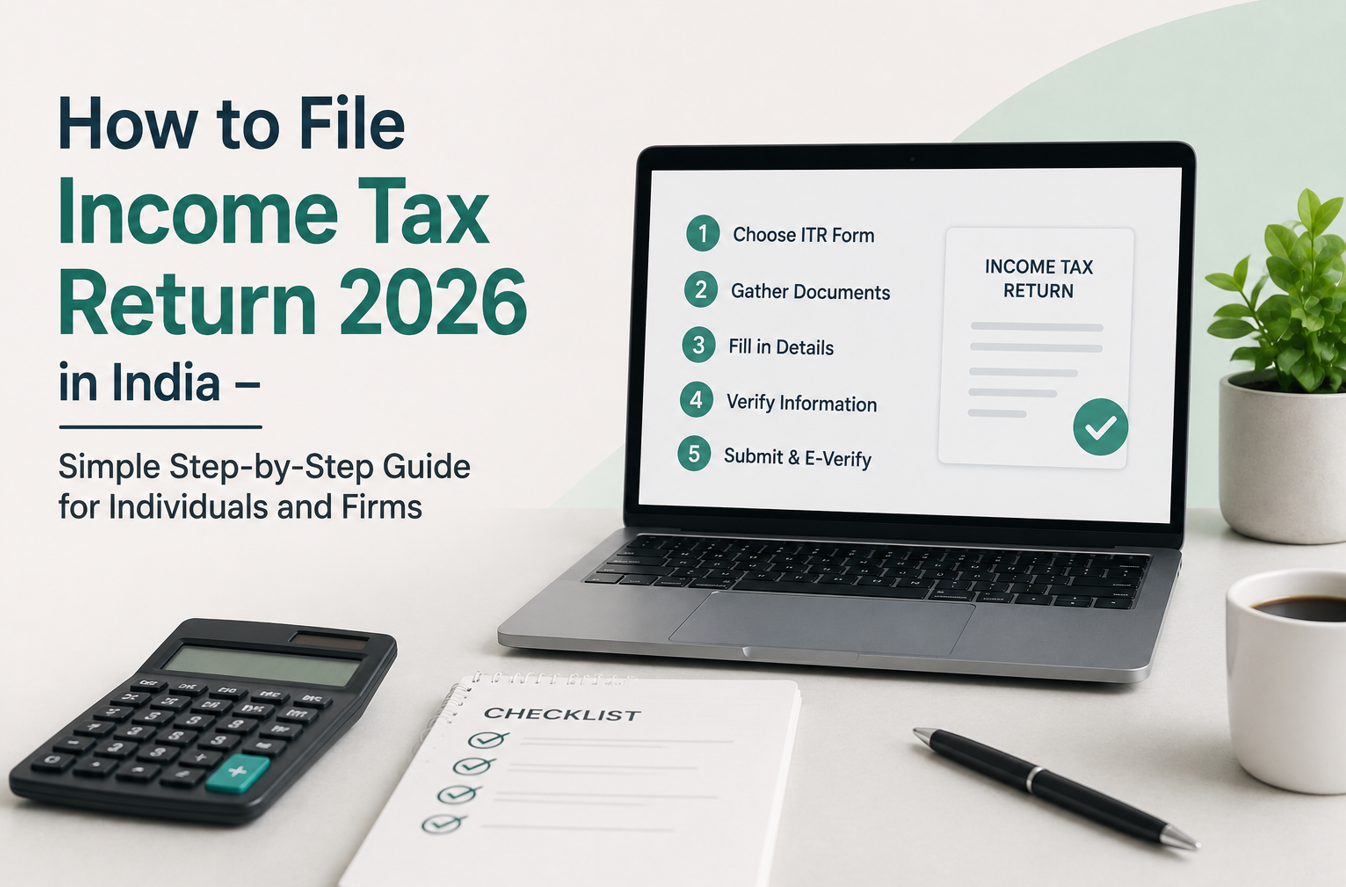
Filing an Income Tax Return can feel confusing when you see words like AIS, Form 26AS, ITR-3, ITR-5, tax audit and e-verification on the same screen. But the basic idea is simple. You report your income, claim the deductions allowed to you, pay any pending tax, and submit the return to the Income Tax Department.
This guide explains how to file Income Tax Return 2026 in India for individuals and firms in a plain, step-by-step way. For 2026 filing, most people are filing for Financial Year 2025-26 and Assessment Year 2026-27.
The rules may look technical, but if your documents are ready and you choose the right ITR form, the process becomes much easier.
Who needs to file ITR in 2026
You should file an Income Tax Return if your income is above the basic exemption limit, if tax has been deducted and you want a refund, if you want to carry forward losses, or if you have certain high-value transactions, foreign assets, business income, capital gains, or professional income.
Firms generally need to file their return even if there is a loss. For businesses, ITR is also useful for loan applications, tenders, investor checks, visa work, and keeping clean financial records.
For example, if a salaried person earned Rs. 8 lakh and TDS was deducted by the employer, filing ITR helps confirm the final tax position. If extra TDS was deducted, the person can claim a refund. Similarly, a small partnership firm with Rs. 35 lakh turnover under presumptive taxation may need to file ITR-4 if it meets the conditions.
Important due dates for ITR 2026
For Assessment Year 2026-27, the common due date for individuals and non-audit cases is 31 July 2026, unless the government extends it.
For taxpayers whose accounts need audit, the usual due date is 31 October 2026. For cases involving transfer pricing reports, the due date is generally 30 November 2026.
Do not wait for the last day. The portal may work fine, but mistakes happen when you rush. Also, late filing may bring fees, interest, delayed refunds, and loss of some benefits such as carrying forward certain losses.
Choose the right ITR form
This is where many people make mistakes. The form depends on your income type, not just your job title.
- ITR-1 is usually for resident individuals with income up to Rs. 50 lakh from salary or pension, one house property, other sources such as interest, and agricultural income up to Rs. 5,000.
- ITR-2 is for individuals and HUFs who are not eligible for ITR-1 and do not have business or professional income. It is commonly used when there are capital gains, more than one house property, foreign assets, or income above Rs. 50 lakh.
- ITR-3 is for individuals and HUFs with income from business or profession.
- ITR-4 is for eligible individuals, HUFs and firms, excluding LLPs, using presumptive taxation and having total income up to Rs. 50 lakh.
- ITR-5 is generally used by firms, LLPs, AOPs, BOIs and similar entities.
- Companies usually file ITR-6, unless they fall under a special exempt category.
A simple example helps. A freelance designer earning professional income may need ITR-3 or ITR-4, depending on whether presumptive taxation is used. A salaried employee who also sold shares and made capital gains will usually need ITR-2, not ITR-1.
Documents to keep ready
Before logging in, collect your papers. It saves time and reduces errors.
Keep PAN, Aadhaar, bank account details, Form 16, Form 16A if applicable, salary slips, rent receipts, home loan interest certificate, insurance and investment proofs, donation receipts, capital gains statements, bank interest certificates, GST details if applicable, books of accounts, audit report if needed, and loan statements.
Also download and check AIS, TIS and Form 26AS from the income tax portal. These statements show details such as TDS, TCS, interest income, dividends, securities transactions, tax payments and other reported financial activity.
Do not blindly trust pre-filled data. It is helpful, but it can be incomplete or mismatched. If your bank FD interest is missing or your broker capital gains statement differs from AIS, check the numbers before filing.
Step-by-step process to file ITR online
- First, visit the official income tax e-filing portal at incometax.gov.in and log in with your PAN or Aadhaar. If you are a new user, register first and link the required details.
- Next, go to the income tax return filing section and select the correct assessment year. For income earned in FY 2025-26, choose AY 2026-27.
- Now select filing mode. Many simple returns can be filed online. For more detailed returns, offline utilities may be used and then uploaded.
- Choose the right ITR form. Read the eligibility carefully. If you choose the wrong form, your return may become defective and you may have to correct it later.
- Check personal details such as name, PAN, Aadhaar, address, mobile number, email and bank account. Make sure your refund bank account is validated.
- Then review income details. For individuals, this may include salary, house property, capital gains, interest, dividends, freelance income or business income. For firms, this may include sales, expenses, partner details, profit distribution, depreciation, loans and balance sheet information.
- After that, enter deductions and exemptions only if you are eligible. Under the old tax regime, common deductions may include Section 80C, 80D, 80G and home loan-related claims. Under the new tax regime, many old deductions are not available, so compare both before choosing.
- Now calculate tax. If tax is still payable, pay it as self-assessment tax through the portal and enter the challan details. If the return shows a refund, check your bank details again.
- Before submitting, preview the return. Match income with AIS, TIS, Form 26AS, Form 16 and your own records. Small items like savings account interest are easy to miss.
- Finally, submit the return and e-verify it. Filing is not complete unless the return is verified. You can usually e-verify through Aadhaar OTP, net banking, bank account, demat account or Digital Signature Certificate. Firms and audit cases may need DSC depending on the category.
For firms and small businesses
Firms should be more careful with books, partner details, capital accounts, loans, GST turnover, TDS, depreciation and audit requirements. A small firm using presumptive taxation may have a simpler return, but an LLP or audited partnership will need more detailed reporting.
If the firm has GST registration, match sales with GST returns. If TDS has been deducted by clients, match it with Form 26AS. If the firm has paid contractors, rent, commission or professional fees, check whether TDS compliance is required.
For example, if a partnership firm receives Rs. 48 lakh from consulting work and chooses presumptive taxation, ITR-4 may apply if all conditions are met. But if it is an LLP, ITR-4 will not apply and ITR-5 is generally used.
Official portal or private tax filing platforms
The official income tax portal is the main place to file returns. It is free and directly connected to the department.
Private platforms such as ClearTax, TaxBuddy, Quicko and other tax filing services can help with guided filing, capital gains calculations, CA-assisted filing and business returns. They are useful if your return is not simple, but the responsibility for correct information remains with the taxpayer.
For a simple salary return, the official portal may be enough. For business income, capital gains, F&O trading, foreign assets, LLPs or tax audit cases, professional help is often worth the fee.
Common mistakes to avoid
- Do not pick ITR-1 just because it looks simple. If you have capital gains or business income, it may not be the right form.
- Do not ignore AIS mismatches. If AIS shows interest, dividend or securities transactions, check and report the correct figures.
- Do not forget to e-verify after submitting. An unverified return is like an unfinished job.
- Do not inflate deductions to get a bigger refund. Wrong claims can lead to notices and stress later.
- Do not file too early if your Form 16, AIS or broker statements are not updated. A few extra days of checking can save weeks of correction.
Conclusion – Key takeaways
Filing Income Tax Return 2026 in India is not difficult if you follow the process calmly. Start with the right assessment year, choose the correct ITR form, match your income with AIS and Form 26AS, pay any pending tax, submit the return, and complete e-verification.
Individuals should focus on salary, capital gains, interest, deductions and tax regime selection. Firms should pay extra attention to books of accounts, audit rules, GST data, TDS and the correct ITR form.
The best practical advice is simple – keep records ready, file before the due date, and do not guess where tax rules are unclear. A clean return is always better than a rushed refund claim.
Facts Input- IT Dept
Discover more from Newskart
Subscribe to get the latest posts sent to your email.

Comments are closed.