


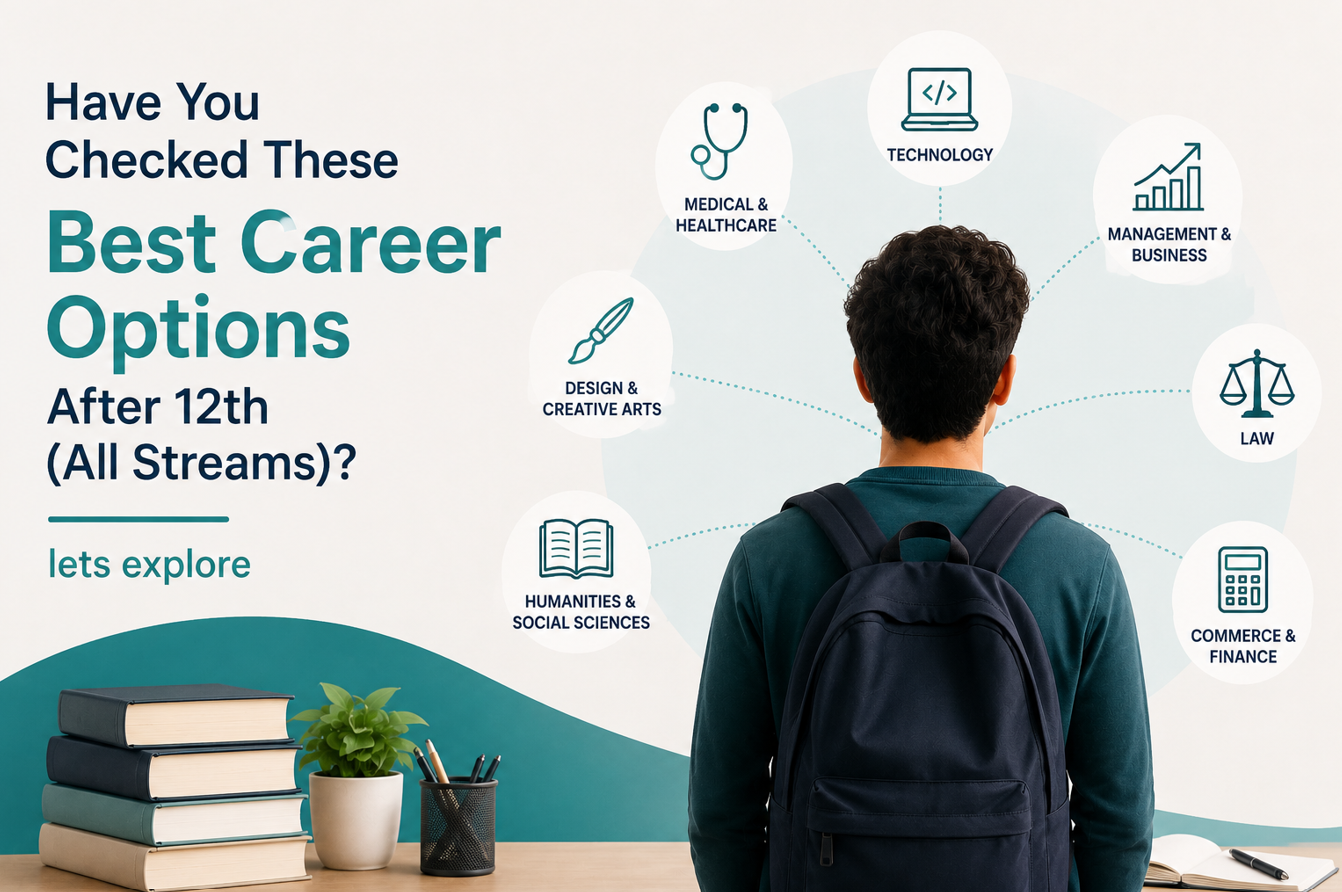
Choosing a career after Class 12 can feel like standing at a busy crossing. Everyone has advice. Parents may suggest one thing, friends may choose another, and social media keeps showing new careers every week.
The good news is that there is no single “best” career for every student. The right option depends on your subject, interest, marks, budget, entrance exam plan, family situation and long-term goal.
This guide on the best career options after 12th is written for students from all streams – Science, Commerce and Arts. The aim is simple while writing the article which is to help you understand real options without fear, confusion or pressure.
How to choose the right career after 12th
Before selecting a course, ask yourself a few honest questions. Which subject do you enjoy even when it gets difficult? Do you like numbers, people, machines, writing, design, law, business, health, technology or public service? Do you want a job quickly or are you ready for long study?
Also check the cost of the course, college quality, entrance exam rules, placement record and future scope. A famous course from a weak college may not help much. A practical course from a good institute can open better doors.
Do not choose a career only because your friend picked it. Your friend’s strength may not be your strength.
Career options after 12th Science
Science students usually have many choices because they can move into engineering, medicine, research, technology, defence, design, management and even commerce or arts-related fields.
If you studied PCM, engineering is still a popular route. Students can explore Computer Science, Electronics, Mechanical, Civil, Electrical, AI-related courses, Data Science and other branches. JEE Main and JEE Advanced are important for many engineering admissions, while several private and state universities conduct their own entrance exams.
If you studied PCB, medical and healthcare careers are major options. MBBS, BDS, BAMS, BHMS, BPT, Nursing, Pharmacy, Medical Lab Technology, Radiology and other allied health courses can be considered. NEET-UG is required for many major medical courses in India.
Science students who do not want engineering or medicine can explore B.Sc. in Physics, Chemistry, Maths, Biology, Biotechnology, Microbiology, Environmental Science, Statistics or Computer Science. These can lead to research, teaching, analytics, lab work, government exams or higher studies.
A practical example – if a student likes biology but does not want to repeat NEET for years, options like B.Pharm, BPT, Nursing, Biotechnology or Medical Lab Technology may be worth checking.
Career options after 12th Commerce
Commerce is a strong stream for students interested in business, money, markets, accounts, banking and management.
B.Com is one of the most common degrees after 12th Commerce. It can be paired with professional courses, internships, accounting tools and finance certifications. Students can later move into accounting, taxation, banking, audit, finance, insurance, business operations or higher studies.
Chartered Accountancy is a respected path for students who are strong in accounts and taxation. Company Secretary, Cost and Management Accounting, CFA-style finance routes, banking exams and financial planning are also popular choices.
Students interested in business can choose BBA, BMS or similar management degrees. These courses can help in marketing, sales, HR, operations, entrepreneurship and later MBA preparation.
A student who enjoys numbers but does not want CA can consider B.Com with data analytics, banking, financial markets, taxation or investment-related courses. Commerce is no longer limited to traditional accounting jobs.
Career options after 12th Arts and Humanities
Arts students have a wide range of choices, especially in areas that need communication, creativity, social understanding, research and public service preparation.
BA courses are available in subjects like English, Hindi, History, Political Science, Psychology, Sociology, Economics, Geography, Philosophy and Public Administration. These subjects can lead to teaching, civil services, research, writing, policy work, NGOs, media and corporate roles.
Law is another strong option. Students can take integrated courses like BA LL.B, BBA LL.B or B.Com LL.B after Class 12, depending on the college and entrance exam. CLAT and other law entrance tests are common routes for many law schools.
Arts students can also enter media, journalism, mass communication, design, hotel management, social work, foreign languages, event management, liberal arts and education.
For example, a student who likes writing and current affairs can explore journalism, digital media, public relations or content strategy. A student who enjoys understanding people can look at psychology, counselling-related study paths or social work.
Career options open to all streams
Some careers are open to students from Science, Commerce and Arts, though eligibility may differ by college.
These include law, hotel management, fashion design, graphic design, animation, digital marketing, journalism, mass communication, foreign languages, event management, travel and tourism, defence services, government exams, entrepreneurship and skill-based careers.
CUET-UG is also used by many universities for undergraduate admissions, so students should check the official admission rules of the colleges they want.
Design is a good example of an all-stream career. Students can explore fashion design, product design, communication design, UI/UX design, animation or interior design. But a good portfolio and practical skill matter a lot.
Skill-based and job-ready courses
Not every student wants a long academic route. Some want to start earning early or build a practical skill along with college.
Good skill options include coding, web development, digital marketing, video editing, graphic design, data analytics, accounting software, GST basics, stock market basics, spoken English, sales, photography, beauty and wellness, hospitality, hardware networking and mobile repair.
Short courses can help, but students should avoid random certificates with no real training. Always check whether the course gives practical projects, internship support and useful skills.
A smart approach is to combine a degree with one job-ready skill. For example, a B.Com student can learn Excel, GST filing and accounting software. A BA student can learn content writing and digital marketing. A B.Sc. student can learn Python or data tools.
Government job route after 12th
Many students also prepare for government jobs after Class 12. Options may include defence exams, SSC CHSL, railway recruitment, police constable exams, state-level clerical jobs and other posts, depending on eligibility.
This path needs discipline. Students should read official notifications, check age limits, understand the syllabus and practise previous-year papers. Do not depend only on coaching ads or social media posts.
If you plan for government jobs, it is still wise to continue graduation. A degree keeps more options open for future exams and private jobs.
New-age careers students should not ignore
Careers are changing fast. Mobile apps, electric vehicles, finance technology, online shopping, AI tools, digital content, gaming and clean energy are creating new job roles.
Students can explore fields like data analytics, cybersecurity, app development, EV technology, drone technology, financial technology, digital finance, product management, UI/UX design, content creation and online business.
But do not get carried away by buzzwords. A career is not good just because it sounds modern. Check the learning path, job roles, salary reality, competition and your interest.
College matters, but skills matter too
A good college can help with teachers, peer group, internships and placements. But college name alone is not enough.
Students should build communication skills, computer skills, internships, projects and a clean resume from the first year itself. Join clubs, attend workshops, learn basic email writing, improve English or Hindi communication, and try small real projects.
Employers like students who can do the work, not just talk about marks.
Conclusion – Key takeaways
The best career options after 12th are different for every student. Science students can explore engineering, medicine, research, healthcare, technology and design. Commerce students can move into accounts, finance, management, banking, taxation and business. Arts students have strong options in law, media, psychology, civil services, design, education and public policy.
All streams can explore skill-based careers, digital careers, government exams and entrepreneurship.
Take time, compare courses, check official websites, speak to seniors, and understand your own interest. A career decision should not be made in panic. It should be made with clear information and honest self-awareness.
Disclaimer –
This article is for general career guidance only. Admission rules, eligibility, entrance exams, fees and course availability can change by college, state and year. Students should always check official websites and speak to qualified counsellors before making final decisions.
Discover more from Newskart
Subscribe to get the latest posts sent to your email.

Comments are closed.