


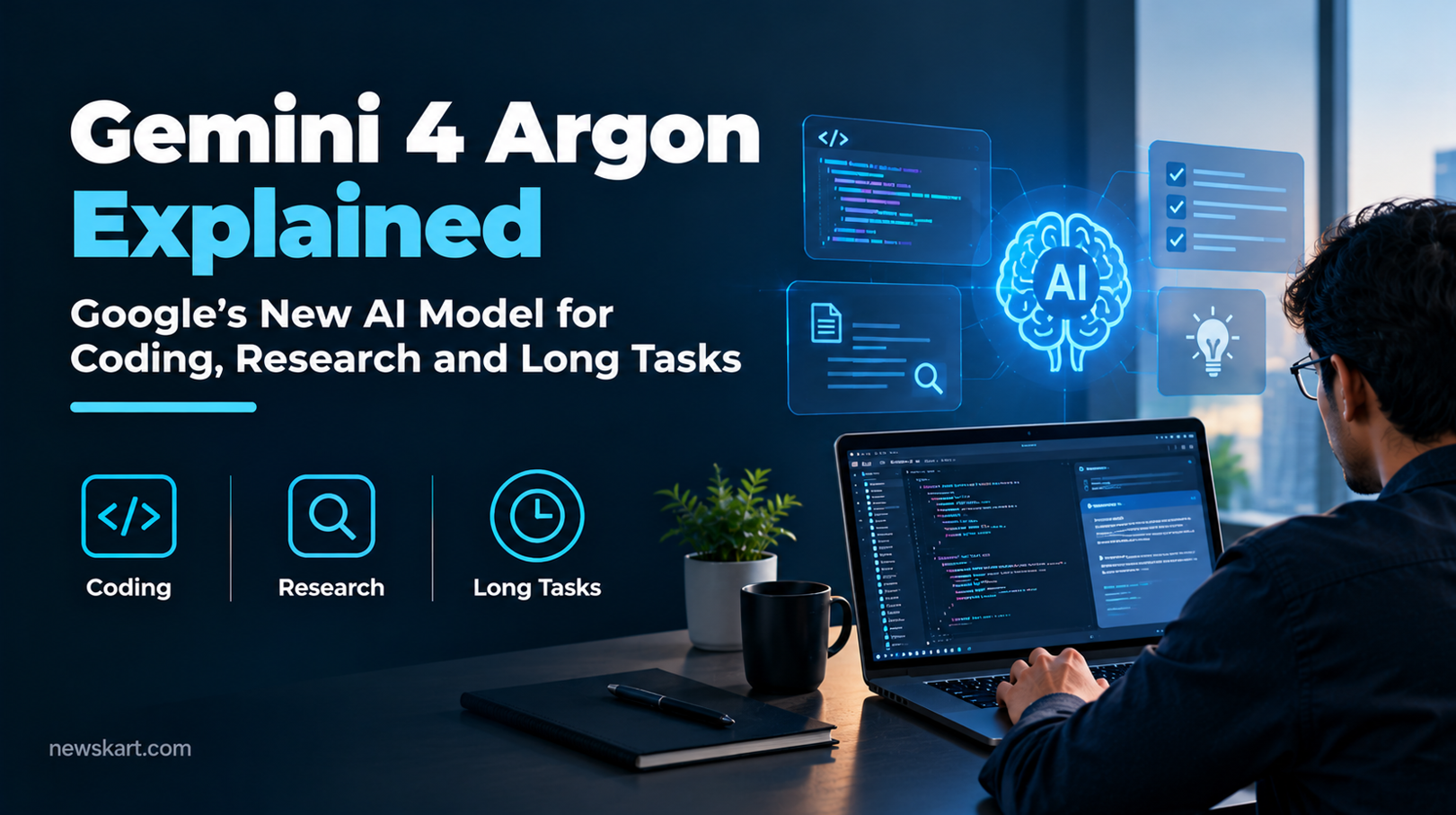
Google has introduced Gemini 4 Argon, its new flagship AI model for difficult tasks that need more than a quick answer. It is designed for software engineering, mathematics, science, cybersecurity and long-running AI agents.
For everyday users, Gemini 4 Argon is available in the Gemini app and AI Mode in Search through eligible Google AI Pro and Ultra subscriptions. For developers and companies, it is available through the Gemini API, Google AI Studio and Google Cloud’s Gemini platform.
What is Gemini 4 Argon?
Gemini 4 Argon is a reasoning model from Google DeepMind. A reasoning model is designed to spend more time working through complicated problems before answering.
It is not simply a chatbot for writing emails or summarizing a short article. Google positions Argon for situations such as understanding a large codebase, reviewing long legal or financial documents, analyzing scientific material and completing tasks that require several connected steps.
The model identifier for developers is gemini-4-argon.
Major capabilities and specifications
Gemini 4 Argon accepts text, images, video, audio and PDF files as input. Its output is text. This means it can study a video, document or image and explain what it finds, but it does not generate images or audio itself.
Its biggest technical feature is a unified context window of up to 1,048,576 tokens. In plain language, it can work with a very large amount of material in one task. A developer could provide a large set of technical documents, while a legal team could ask it to compare multiple lengthy agreements.
Google also allows a long-response mode, called long decode, which can produce up to one million tokens through background execution. This is aimed at complex jobs such as generating extensive code, detailed research output or long technical explanations.
Other supported tools include code execution, function calling, file search, structured outputs, Google Search grounding, Google Maps grounding and URL context. Computer use is available in preview.
How people can use Gemini 4 Argon
For developers, Argon may be useful for debugging software, planning a multi-step coding project or reviewing a large repository. A practical example would be asking the model to examine a payment system’s retry process, identify possible errors and suggest safer code changes.
For researchers and professionals, it can help organise long reports, inspect data, compare contracts and create structured summaries. It should still be treated as an assistant, not a final decision-maker. Important legal, financial, medical and security work needs human review.
Argon offers three reasoning settings: low, medium and high. Lower settings are intended for quicker and less expensive tasks. High reasoning may help with hard mathematics, science and coding, but it can take longer and use more tokens.
Pricing and availability
Gemini 4 Argon is not available through Google’s free API tier. Until November 30, 2026, Google lists introductory API pricing of $2 per million input tokens and $10 per million output tokens. From December 1, the listed price rises to $4 per million input tokens and $20 per million output tokens.
Google AI Pro and Ultra subscribers can access the model in the Gemini app, while developers can use it through paid API access. Availability and usage limits may vary by product, subscription and region.
Gemini 4 Argon rivals
Gemini 4 Argon enters a competitive market led by OpenAI’s GPT-6 family, Anthropic’s Claude models, Meta Muse Spark and xAI’s Grok models. All are competing for demanding business work such as coding, research, agent workflows and document analysis.
Argon’s main strengths are Google’s claimed focus on very long context, multimodal inputs and deep integration with Google Search, Maps and the Gemini ecosystem. However, there is no single AI model that is best for every task.
A company choosing between Gemini, GPT, Claude or Grok should test each model using its own documents, coding tasks, costs, privacy requirements and response-quality standards.
Key takeaways
Gemini 4 Argon is Google’s flagship reasoning model for complex work. It supports text, image, video, audio and PDF inputs, offers a one-million-token context window and can use tools such as code execution and web grounding. It is most relevant for developers, researchers and businesses handling large or difficult tasks, rather than users looking for a basic free chatbot.
Discover more from Newskart
Subscribe to get the latest posts sent to your email.
