


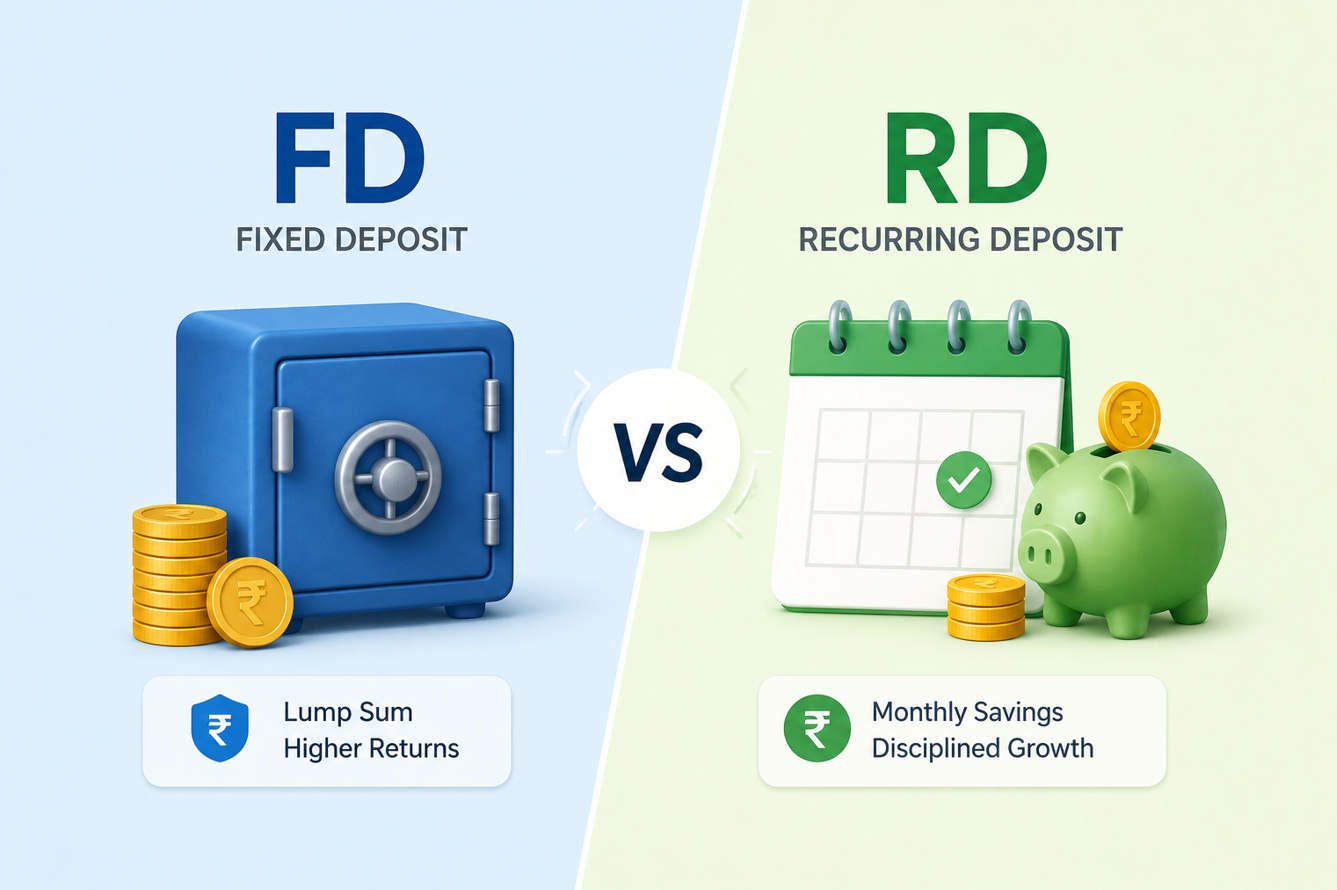
When people want safe and secure savings, the first two saving options they usually compare are Fixed Deposit (FD) and Recurring Deposit (RD). Both are popular, low-risk, and easy to start through banks. But the right choice depends on one simple thing which is – do you already have a lump sum, or are you saving gradually every month?
That is why the FD vs RD comparison has no single winner. Each product solves a different money problem. Once you understand how they work, choosing becomes much easier and more practical.
Fixed Deposit (FD) vs Recurring Deposit (RD) – Core difference
A Fixed Deposit (FD) is good when you already have a lump sum amount available. You deposit it once for a chosen tenure, and the bank pays interest as per applicable rates and payout type (cumulative or periodic). Because the full amount is invested from day one, compounding can work on the entire principal from the start.
A Recurring Deposit (RD) is fine for disciplined monthly saving. You need to deposit a fixed amount every month for a selected period of time say 3 years or 5 years. For every deposits and your previous deposits monthly compounded interest is calculated and added in your RD account and after the tenure you get lumpsum. It is useful for salaried people, students, and new earners who cannot invest a large lump sum immediately but want to build big corpus steadily.
In many banks, RD interest rates are linked to term deposit rates for similar tenures, but the final maturity amount still differs from FD because money enters in parts over time, not all at once. This is why an FD often generates a higher maturity value than an RD for the same total amount and tenure, if that total amount is available upfront.
Which is better for your goals?
You can choose FD if your goal is capital preservation with predictable returns from a one-time surplus, bonus, maturity amount, or emergency fund bucket you do not need immediately. It can also suit retirees who prefer periodic interest income (if they choose non-cumulative payout options).
& You can choose RD if your goal is habit-building and planned corpus creation. It works well for goals like annual fees, travel, gadget purchase, or festival expenses where you want to save month by month instead of borrowing later.
You should also compare flexibility of both the options. FDs and RDs both allow premature closure in many cases, but usually with conditions or penalties. RDs may also have penalties for missed installments, depending on bank rules. So if your income is irregular, review terms carefully before committing to a strict monthly RD contribution.
One more practical point is which should be considered that is safety. Deposits in insured banks are covered by DICGC up to Rs. 5 lakh per depositor per bank. This gives both FD and RD a trust advantage for conservative savers.
The DICGC or Deposit Insurance and Credit Guarantee Corporation is a wholly-owned subsidiary of Reserve Bank of India (RBI) which was formed to protects bank depositors by insuring deposits up to ₹5 lakh per depositor per bank (covering principal + interest).
Applicable Taxes on FD and RD in India
Both RD and FD are taxable in India and here’s a simple India-specific tax view for FD and RD (current as of FY 2026-27)-
- FD and RD interest is taxed as “Income from Other Sources” at your slab rate (old/new regime as applicable).
- TDS on interest (Section 194A)
(i) Banks/co-operative banks/post office generally deduct TDS at 10% (if PAN is available).
(ii) If PAN is not provided, then TDS can be 20%. - TDS applies only after annual threshold is crossed which is ₹50,000 (for non-senior citizens) and ₹1,00,000 (for senior citizens)
- It is important to know that TDS is not final tax,
(i) If your slab rate is higher than 10%, you may need to pay extra tax while filing ITR.
(ii) If your total tax liability is lower, you can claim refund of excess TDS. - You can avoid TDS, you can submit Form 15G / 15H (or the currently notified equivalent declaration format) if your total taxable income is below taxable limit and conditions/eligibility are met.
- You should know the deductions related to FD/RD
(i) Tax-saving FD (5-year lock-in) principal qualifies under Section 80C (old regime only).
(ii) Regular FD/RD principal does not get 80C benefit.
(iii) Interest is still taxable even for tax-saving FD.
(iv) Senior citizens may claim deduction on interest under Section 80TTB (subject to limit and regime conditions).
Overall, the better option is the one that matches your cash-flow pattern. If you have lump sum money now, FD is generally more efficient. If you need a disciplined monthly route, RD is usually better. Many smart savers use both i.e. RD for ongoing goals and FD for parked surplus. Instead of choosing by popularity, you can choose any of them but by purpose, tenure, and liquidity need.
Discover more from Newskart
Subscribe to get the latest posts sent to your email.

Comments are closed.