

FirstClub Raises $55 Million Series B To Build A Quality-First Quick Commerce Brand


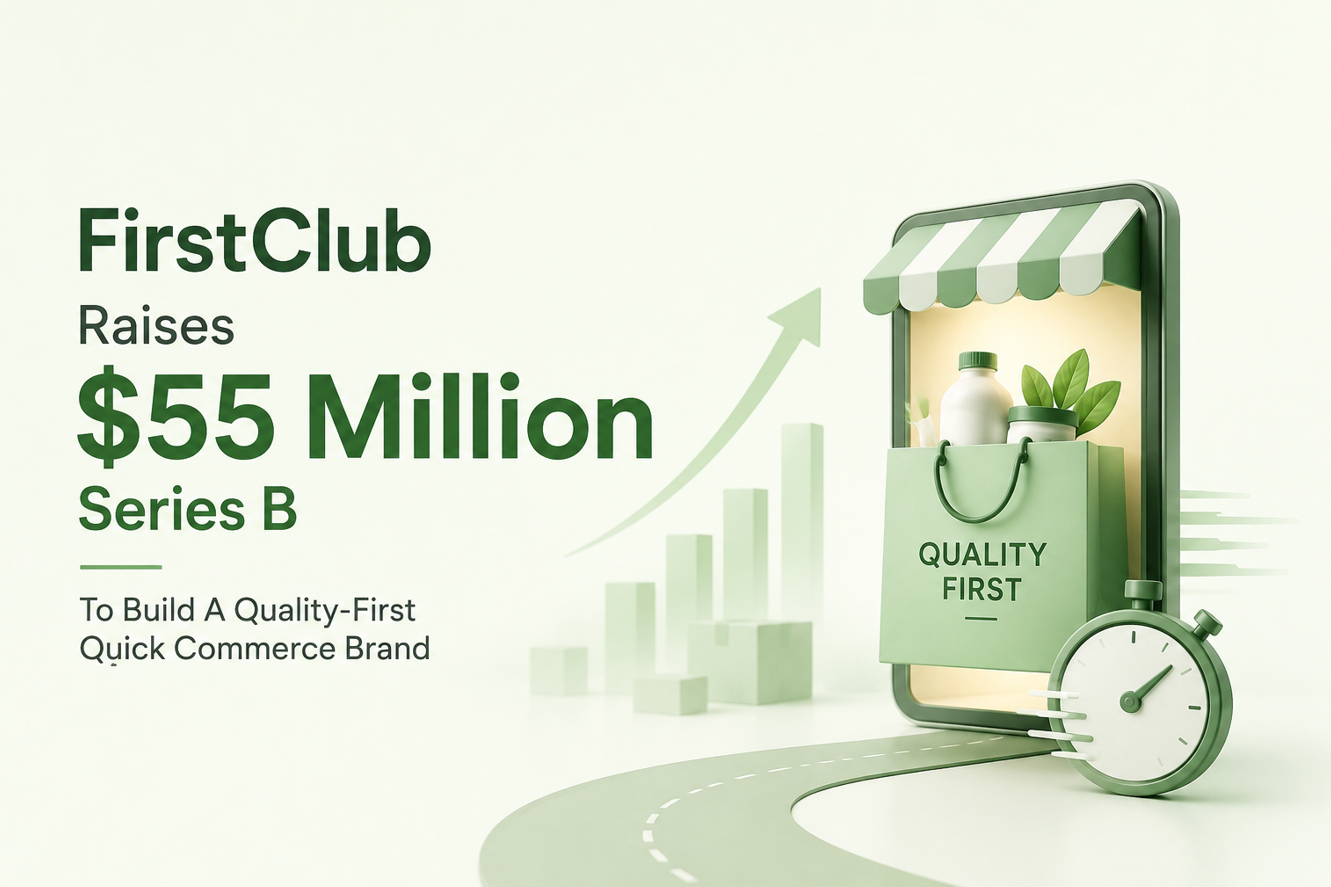
FirstClub, a Bengaluru-based quick commerce startup, has raised $55 million in Series B funding. The round was co-led by Peak XV Partners and Sofina, with participation from existing investors Accel, RTP Global and Paramark Ventures.
The funding has pushed FirstClub’s valuation to around $255 million, more than double its earlier reported valuation of $120 million in 2025. That is a strong jump for a company founded only in 2024.
But the bigger story is not just the money. FirstClub is trying to build a different kind of quick commerce platform. Instead of only promising faster delivery, it is focusing on quality, curation, fresh groceries, trusted sourcing and premium everyday products.
What FirstClub does
FirstClub was founded in 2024 by Ayyappan R, a former Flipkart executive who also served as CEO of Cleartrip and held senior roles at Myntra and Flipkart.
The startup operates in the quick commerce space, but with a premium and curated approach. It offers groceries, fresh produce and everyday products, but keeps the catalogue smaller and more selective than larger rivals.
This is important because most quick commerce platforms compete on speed, discounts and variety. FirstClub is trying to win customers who ask a different question – “Can I trust the quality of what I am buying?”
For example, a customer may not want 20 types of atta, oils or fruits. They may want fewer choices, but better-tested, fresher and more reliable products. That is the space FirstClub wants to occupy.
Funding details
FirstClub’s $55 million Series B round was co-led by Peak XV Partners and Sofina. Existing investors Accel, RTP Global and Paramark Ventures also participated. Reports say the company has now raised around $86 million in total funding. Before this, FirstClub had raised $8 million in seed funding in 2024 and $23 million in Series A funding in 2025.
The new capital will be used to expand store presence, strengthen supply chain, improve product quality systems, grow categories and support expansion beyond its current markets.
According to reports, FirstClub is currently active in Bengaluru and Hyderabad. The company plans to deepen operations in these cities before expanding further.
The model – Quality-first quick commerce
Quick commerce usually means groceries and daily essentials delivered in 10 to 30 minutes. Companies such as Blinkit, Zepto and Swiggy Instamart have made this format popular in India.
FirstClub is not rejecting speed, but it is trying to make quality the main promise. Its model is built around a curated product range, quality checks, better sourcing and premium grocery selection.
The company reportedly offers around 4,000 products, which is much smaller than the range offered by many quick commerce rivals. That may sound like a limitation, but it is part of the strategy. A smaller catalogue can be easier to control, inspect and standardize.
FirstClub also focuses on premium fresh produce and quality-sensitive categories. Reports mention that some of its popular products include items like avocados, persimmons and premium apples. This shows the company is not only chasing basic grocery orders, but also urban customers who are willing to pay for better quality.
Who will benefit from FirstClub’s growth
- The first group that may benefit is urban households that care about fresh and trusted groceries. These are customers who already use quick commerce, but are sometimes disappointed with product quality, substitution, packaging or freshness.
- The second group is premium and emerging consumer brands. FirstClub’s curated model may give smaller high-quality brands a better platform than crowded marketplaces where they compete mainly on price.
- The third group is fresh produce suppliers and food brands that can meet strict quality standards. If FirstClub scales well, suppliers with consistent quality may get access to a higher-value customer base.
- The fourth group is the wider quick commerce ecosystem. If FirstClub proves that quality can be a serious differentiator, larger platforms may also improve sourcing, testing, cold-chain handling and product transparency.
Why investors are interested
India’s quick commerce market is already crowded, but investors still see room for differentiated models. Speed is now expected. The next battle may be about trust, quality, profitability and customer loyalty.
FirstClub’s pitch is simple. Not every customer wants the cheapest or fastest option every time. Some customers want groceries they can trust, especially for family use.
This is where the startup’s premium model becomes interesting. If customers place higher-value orders and return frequently, FirstClub may build better unit economics than a platform relying only on discounts and speed.
Of course, this is not easy. Premium grocery is difficult. Fresh produce quality can change every day. Cold-chain systems are expensive. Customers are demanding. If an avocado, milk packet or vegetable order is poor, trust can break quickly.
Competitors in the market
FirstClub’s biggest competitors are Blinkit, Zepto and Swiggy Instamart. These platforms already have strong delivery networks, large customer bases and deep funding. BigBasket’s BB Now and Amazon Fresh also operate in grocery and quick delivery. JioMart remains another important player in the larger grocery and retail market.
FirstClub’s advantage is focus. It does not need to beat Blinkit or Zepto on every product and every city from day one. It can build a loyal base of premium grocery customers in selected cities.
Its challenge is scale. Quick commerce depends on dark stores, inventory, delivery partners, technology, cold chain and demand density. Expanding too fast can hurt quality, while expanding too slowly can give rivals time to copy the premium angle.
Why the timing matters
Indian consumers are becoming more selective. Many people now check ingredients, freshness, origin, packaging and health claims before buying food products. This is visible in categories like organic staples, clean-label snacks, premium fruits, dairy, healthy beverages and personal care.
At the same time, quick commerce has changed customer habits. People no longer want to plan every purchase days in advance. They expect fast delivery, but they also want confidence in what arrives at the door.
FirstClub is trying to combine these two shifts – speed and trust. If it succeeds, it may create a new sub-category inside quick commerce.
Conclusion with key takeaways
FirstClub’s $55 million Series B funding shows that investors are still willing to back strong quick commerce ideas, especially when the model is not just another speed race. The startup is betting on quality-first grocery delivery, a curated product range and premium urban households. With fresh funding from Peak XV Partners, Sofina and existing investors, FirstClub now has more room to expand stores, improve supply chain and build deeper customer trust.
Key takeaways
- FirstClub has raised $55 million in Series B funding.
- The round was co-led by Peak XV Partners and Sofina.
- The startup was founded in 2024 by Ayyappan R.
- FirstClub’s valuation has reportedly reached around $255 million.
- The company focuses on premium, curated and quality-first quick commerce.
Its major competitors include Blinkit, Zepto, Swiggy Instamart, BigBasket and Amazon Fresh.
Facts Input- ET Startups
Discover more from Newskart
Subscribe to get the latest posts sent to your email.

Comments are closed.