


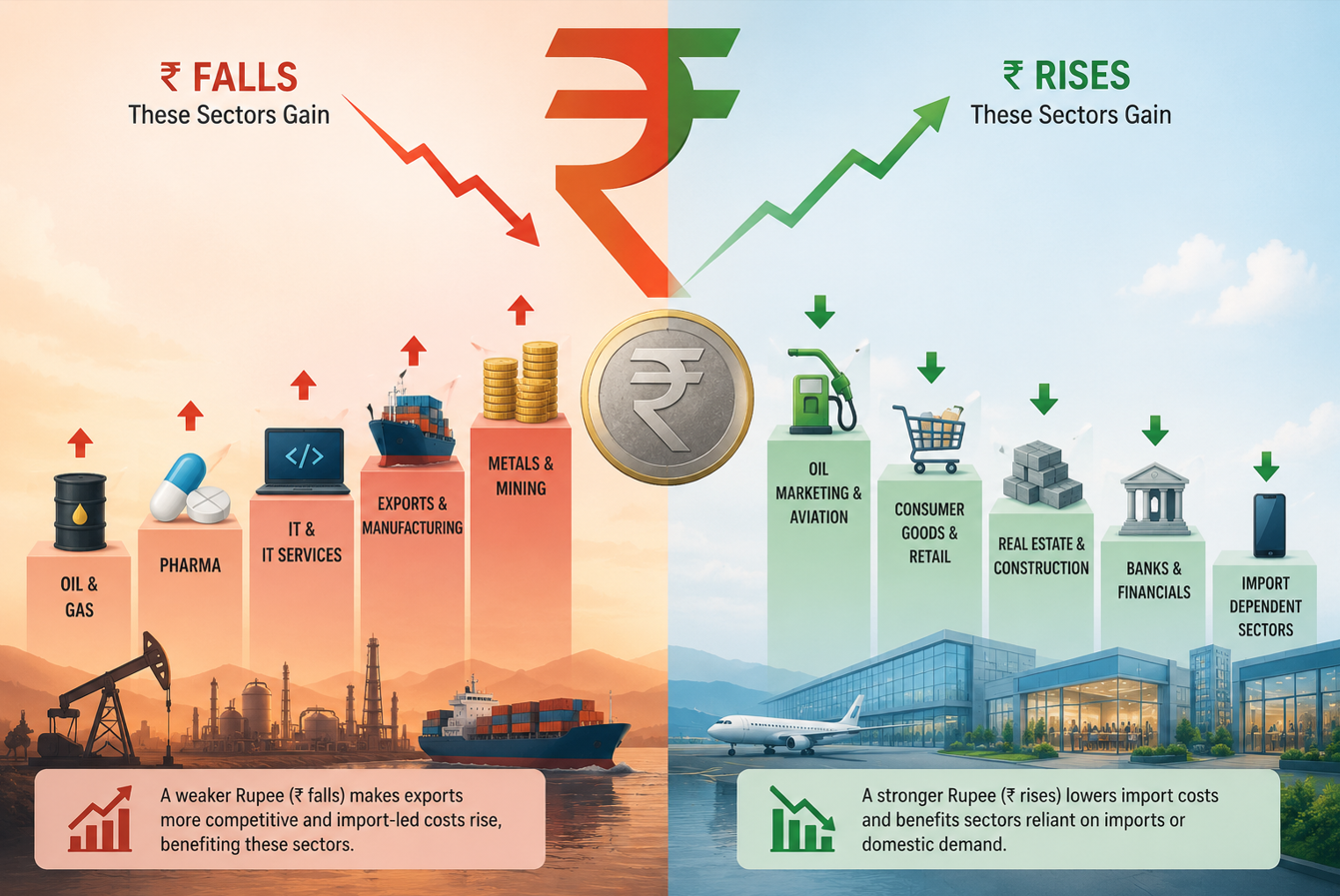
A falling rupee usually creates anxiety, but in stock markets, not all sectors react the same way. Currency impact depends on export vs import mix, hedging policy, raw material dependence and ability to pass costs to customers. Some businesses get hurt quickly because imports become expensive. Others gain because their dollar revenues translate into more rupees. That is why, during recent rupee weakness, investors have seen selective outperformance in sectors like pharma and parts of energy.
So, why do oil and pharma sometimes rise when INR falls, and which other sectors can benefit from the same trend?
Why oil and pharma can gain during rupee depreciation
Pharma companies with strong US and global exports often benefit directly from a weaker rupee. Their revenues are earned in dollars, but many costs are in rupees. So when USD earnings are converted back, reported revenue and margins can improve, especially if raw material inflation is controlled. Also you need to understand that Pharma gains is directionally right, but not universal because export-led pharma can benefit from USD revenue conversion and companies with high imported API dependence may see that benefit reduced.
Oil is more nuanced. India imports most of its crude, so a weak rupee generally raises costs for oil marketing companies. But upstream producers such as ONGC or Oil India can benefit in periods when global crude prices are firm, because their realizations can remain supportive. So “oil gains” is usually stock-specific, not sector-wide. Also, Selective Oil and Pharma Stocks Gain as rupee weakens so it is not a generic rule that all oil companies gains when INR falls. But overall, we can say that Oil sector gains when rupee falls is too broad. We can idealize it as company-specific. How, let’s see- upstream oil producers (like ONGC-type companies) may benefit in some conditions but OMCs (oil marketing companies)/import-heavy players can face margin pressure when crude is high and INR weak.
This is why investors should avoid broad assumptions. In a weak-rupee phase, pharma tends to have clearer currency tailwinds, while energy names need business-model-level analysis.
Other sub-sectors that may rise when rupee falls
The biggest beneficiaries are usually export-oriented sectors such as-
- IT services: It is seen that large dollar billing from global clients can support earnings conversion.
- Specialty chemicals: Chemical companies with export contracts may see better rupee realization.
- Textiles and garments: Textile exporters can gain competitiveness if input costs are managed.
- Auto ancillaries with export share: This is called selective benefit for firms with stable overseas demand.
At the same time, import-heavy sectors like aviation, paint, and consumer electronics can face margin pressure unless they pass costs to customers.
Conclusion
Rupee depreciation creates both winners and losers. Pharma and selected oil names can perform well, but the broader rule is simple which is businesses earning in dollars and spending largely in rupees usually benefit more. For investors, the smarter move is to track company-level currency sensitivity rather than buying entire sectors based on one macro headline.
Facts Input- Business Standard, FE, MarketScreener, Value Research
Discover more from Newskart
Subscribe to get the latest posts sent to your email.

Comments are closed.