


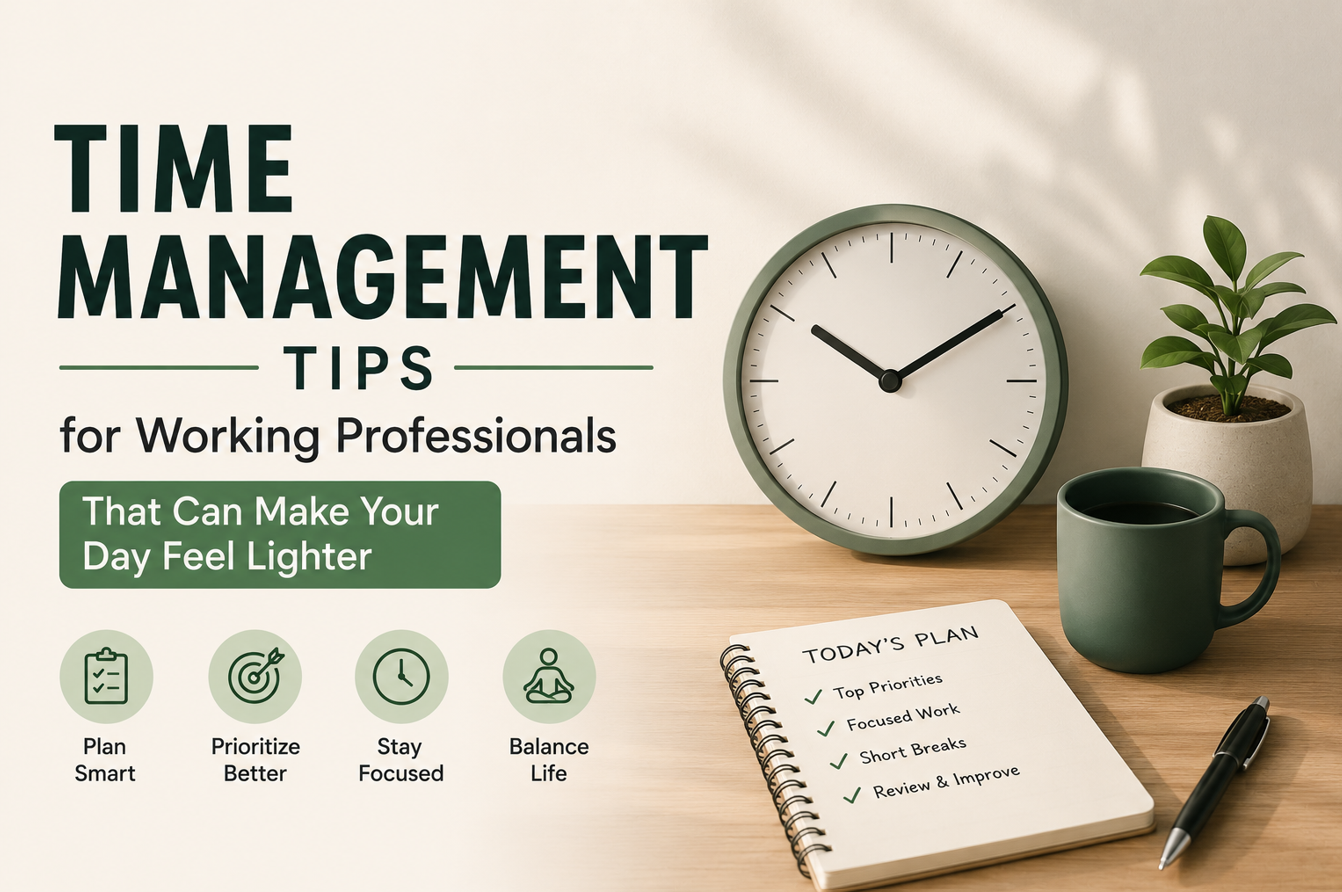
Most working professionals do not have a time problem only because they are lazy or careless. Many are stuck between meetings, messages, emails, deadlines, calls, family needs and small urgent tasks that keep breaking the day.
The result is familiar. You stay busy from morning to evening, but the most important work still remains unfinished. Then you either work late or carry stress into the next day.
Good time management does not mean filling every minute with work. It means choosing what matters, protecting your focus and finishing the right tasks with less panic. These simple time management tips for working professionals can help you work better without feeling drained every day.
Start your day with three priority tasks
A long to-do list can make you feel productive, but it can also confuse your mind. Instead of writing 15 tasks in the morning, choose the top three that truly matter.
Ask yourself – if I finish only three things today, which ones will make the day successful?
These may include sending a client proposal, completing a report, preparing for a meeting or solving a customer issue. Keep these tasks visible. Finish at least one of them before getting pulled into small work.
This gives your day direction. You stop reacting to everything and start working with purpose.
Use time blocks, not random effort
Time blocking simply means giving fixed time slots to important work. For example, you can keep 9.30 am to 11 am for deep work, 12 pm for emails, 3 pm for calls and 5 pm for review.
This works because your brain knows what to focus on. Without time blocks, the day often gets eaten by messages, meetings and quick interruptions.
You do not need a perfect calendar. Start with two protected blocks every day. Even 60 minutes of focused work can change the quality of your output.
Handle emails and messages in batches
Checking email every five minutes breaks your focus. The same happens with office chats and phone notifications.
Try checking messages in batches. For example, once in the morning, once before lunch, once in the evening and once before closing work. If your role needs faster replies, keep shorter but fixed windows.
Let your team know when you are doing focused work, especially if your workplace allows it. A simple status like “Working on report, will reply after 11.30” can reduce unnecessary interruptions.
Learn to say no politely
Many professionals lose time because they say yes to everything. Extra meetings, unclear tasks, last-minute requests and unnecessary calls can quietly fill the day.
Saying no does not mean being rude. It means being honest about capacity.
You can say –
“I can take this up tomorrow morning.”
“I can help, but I will need to move another task.”
“Can we discuss this in 10 minutes instead of a full meeting?”
“I may not be the right person for this, but I can suggest who handles it.”
Respecting your own time also helps others respect it.
Break big work into smaller steps
Large tasks create delay because they feel heavy. “Prepare quarterly report” sounds big. But “collect sales data,” “check expenses,” “make charts” and “write summary” feel easier.
Break the work into small steps and start with the first one. Progress reduces fear.
For example, if you need to make a presentation, do not start by designing slides. First write the main points. Then collect numbers. Then create slides. Then polish. This order saves time and avoids rework.
Use the two-minute rule carefully
If a task takes less than two minutes, do it immediately. This can include replying to a simple confirmation, saving a file, updating a small tracker or forwarding a document.
But be careful. Do not let 20 small tasks steal your full morning. The two-minute rule is useful for tiny tasks, not for avoiding important work.
If small tasks keep coming, collect them and finish them in one short batch.
Reduce meeting overload
Meetings are useful when decisions are needed. But many meetings happen only because nobody wrote a clear message.
Before accepting or setting a meeting, ask – what is the goal? Who really needs to attend? Can this be solved by email or a short update?
If you run meetings, keep an agenda and end with clear next steps. A 20-minute focused meeting is better than a 60-minute call where everyone leaves confused.
For working professionals, fewer unclear meetings can mean more time for real work.
Protect your best energy hours
Everyone has a time of day when their mind works better. Some people are sharp in the morning. Some work better in the afternoon or evening.
Use your best energy hours for difficult work. Do not spend that time only on email, admin work or casual scrolling.
If your mind is fresh in the morning, use it for writing, analysis, planning, coding, sales strategy or problem-solving. Keep routine tasks for lower-energy hours.
This small change can improve both speed and quality.
Keep a simple weekly review
Once a week, spend 20 minutes reviewing your work. Look at what went well, what got delayed, and what wasted time.
Ask yourself –
Which tasks took longer than expected?
Which meetings were useful?
Where did I lose focus?
What should I do differently next week?
A weekly review stops the same mistakes from repeating. It also helps you plan better before Monday pressure begins.
Use tools, but do not depend only on them
Apps can help, but they cannot manage your time for you. Calendar, reminders, notes, task managers and project tools are useful only when your priorities are clear.
You can use Google Calendar, Microsoft Outlook, Notion, Todoist, Trello, Asana or even a simple notebook. The best tool is the one you actually use daily.
Do not keep changing apps every week. That becomes another form of delay.
Take breaks before your brain gets tired
Working without breaks may look serious, but it often lowers quality. Short breaks help you reset.
After a focused work session, stand up, stretch, drink water or walk for a few minutes. Avoid using every break for social media because it may make your mind more restless.
Breaks are not wasted time. They help you return with better attention.
Benefits of better time management
Good time management gives more than productivity. It lowers stress because you are not always rushing. It improves work quality because you give important tasks proper attention. It also helps your reputation because you meet deadlines more calmly.
Over time, it can improve work-life balance. You may still have busy days, but fewer days will feel out of control.
For managers and team leaders, time management also improves decision-making. When your calendar is not packed with noise, you can think more clearly.
Conclusion – Key takeaways
Time management for working professionals is not about doing more and more. It is about doing the right work at the right time with better focus.
Start with three priority tasks, use time blocks, reduce random checking, say no politely, break big work into small steps and review your week. These habits look simple, but they can make your workday feel much lighter.
You may not control every deadline or meeting, but you can control how you plan, respond and protect your attention. That is where real productivity begins.
Disclaimer
This article is for general career and productivity guidance only. Workload, workplace culture and job expectations vary by company and role. If work stress is affecting your health, consider speaking with a manager, HR professional or qualified counsellor.
Discover more from Newskart
Subscribe to get the latest posts sent to your email.

Comments are closed.