


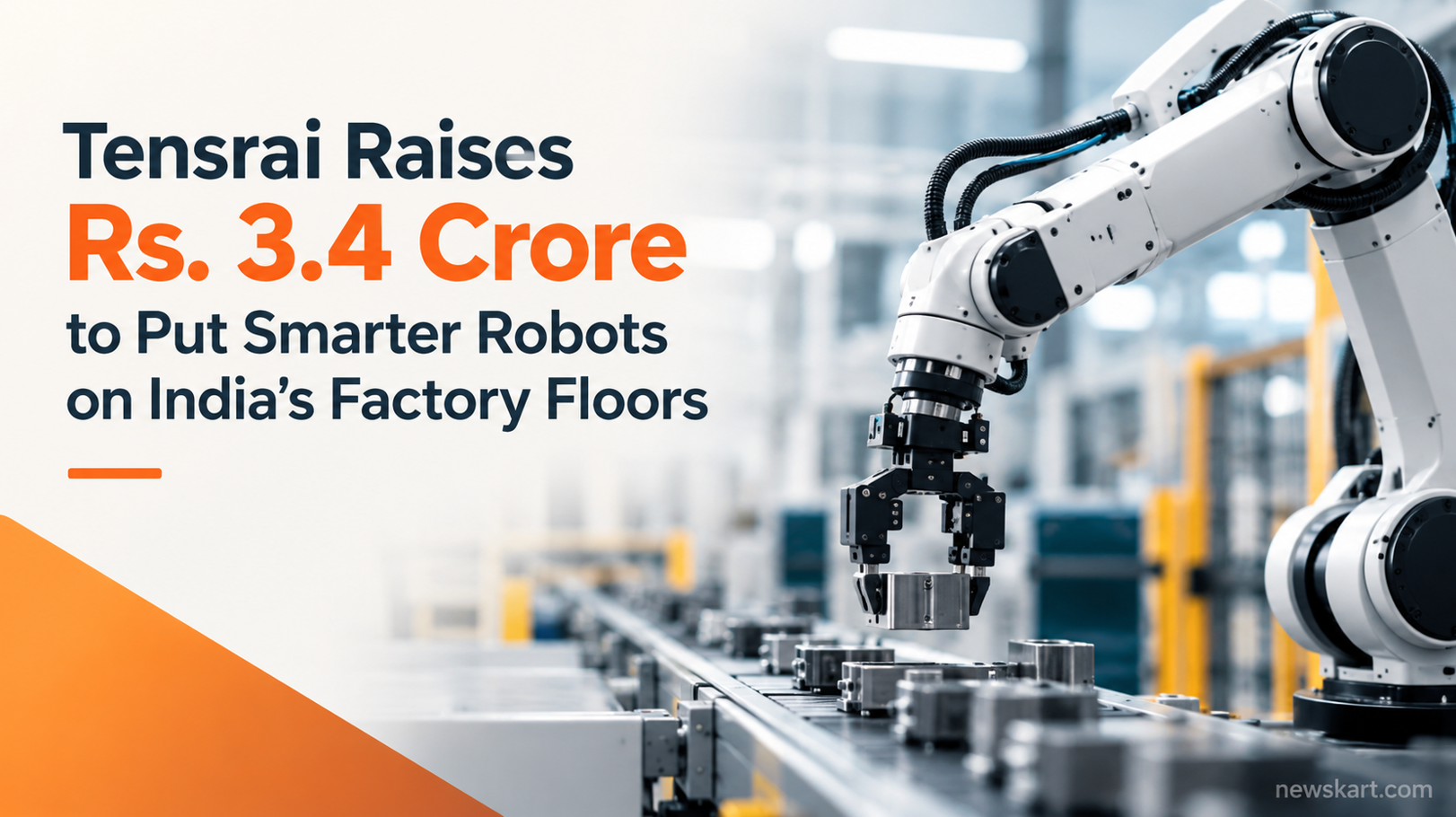
Robots have been used in factories for years, but most are built for one fixed task in one controlled space. Tensrai wants to make industrial machines more flexible, capable, and easier to deploy.
The Hyderabad-based startup has raised Rs. 3.4 crore in a Pre-Seed round to develop what it calls physical AI – technology that allows robots and industrial vehicles to understand their surroundings and carry out real-world work with less human control.
What Tensrai is building
Tensrai was founded in 2022 by Sai Nikhil Rao Gona, Venkata Sai Charan Chalamalasetty, Harshith Uppalapati, and Vivek Datta.
The company is developing an autonomy platform for robots, industrial vehicles, and machines. In simple words, it wants to give machines the ability to move safely, understand their environment, and complete useful physical tasks.
For example, a robot in a warehouse may need to move boxes from one area to another. In a factory, it could transport components between workstations. In an airport or hospital, it could support cleaning or material movement.
Tensrai’s platform is designed to work with new robots as well as existing industrial equipment. This retrofit approach is important because businesses may not want to replace every forklift, trolley, or machine they already own. Instead, they may be able to add autonomous features to suitable equipment.
Where the Pre-Seed money will go
As per Newzchain, the Pre-Seed round was backed by India Accelerator, Finvolve, Hyderabad Angels, and other angel investors. Tensrai plans to use the capital for technology development, engineering, deployment capabilities, and expansion in India and overseas markets.
The funding should help the startup improve the hardware and software needed to make its robots work in real environments. A warehouse floor is not always smooth, quiet, or predictable. There can be people walking around, moving vehicles, uneven surfaces, and changing layouts.
This is where physical AI differs from a regular software tool. A chatbot works with information on a screen. A physical AI system must understand the world around it and take action safely. Tensrai says its technology uses cameras and software to help machines navigate, identify surroundings, and perform tasks with limited human intervention.
The company also plans to earn money through robot sales, retrofitting existing machines, customized projects, and Robot-as-a-Service. Under the Robot-as-a-Service model, a customer pays for the use of a robot instead of buying it outright. That could make automation more affordable for businesses that do not want a large upfront investment.
The problem Tensrai wants to solve
Factories, warehouses, and large commercial sites often face shortages of skilled operators for repetitive or physically demanding work. Manual material movement can also be slow, especially when operations run around the clock.
Tensrai’s aim is not simply to replace workers. The stronger use case is helping people avoid repetitive, heavy, or potentially hazardous work while allowing teams to focus on supervision, maintenance, and higher-value tasks.
The startup will compete with warehouse-automation firms, industrial robotics companies, and makers of autonomous mobile robots. Its key challenge will be proving that its systems remain reliable across different sites and work conditions.
A robot that works well in a controlled demonstration must also work safely in a busy factory or uneven outdoor industrial yard. That is where practical deployment matters more than ambitious claims.
Discover more from Newskart
Subscribe to get the latest posts sent to your email.
