


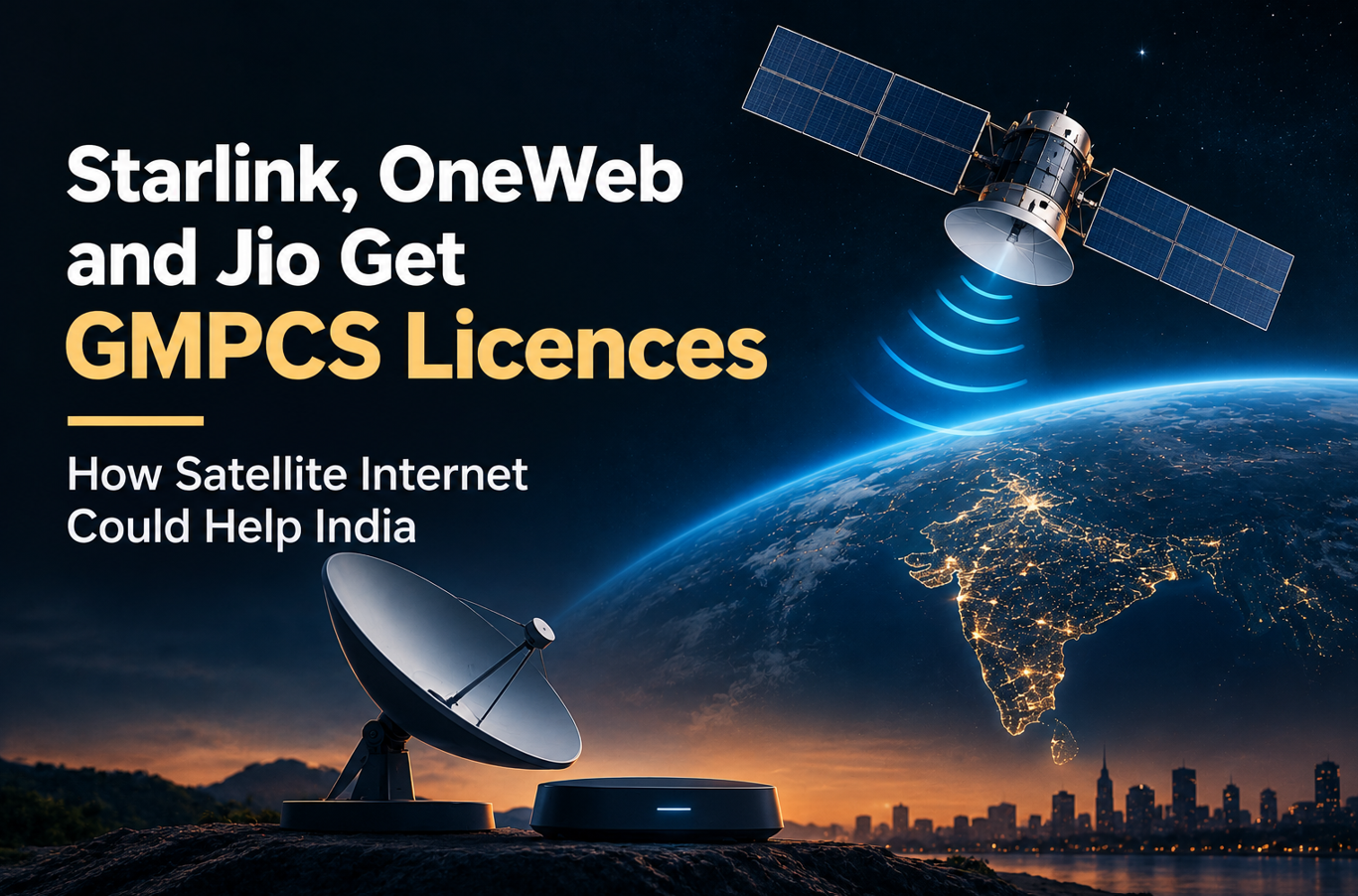
India’s satellite internet plans have moved closer to reality. Starlink, OneWeb India, and Jio Satellite Communications hold authorization to provide Global Mobile Personal Communication by Satellite, or GMPCS, services in the country.
A GMPCS licence allows a company to use satellite technology for communication services across its approved service area. The Department of Telecommunications says this framework is especially relevant for rural, remote, and underserved regions where fibre cables and mobile towers are difficult to build.
For people living in well-connected cities, satellite broadband may not seem urgent. But for a village in the mountains, a coastal community, or a border outpost, a satellite connection can be a practical way to get online when traditional networks are unavailable.
What a GMPCS licence means
GMPCS is a regulatory authorization for satellite-based communication services. It is one important part of the process, but it does not mean every licence holder has already started selling broadband plans to customers.
As per the DoT eServices portal, Jio Satellite Communications, OneWeb India Communications, and Starlink Satellite Communication are listed as GMPCS-authorized companies. They will still need to meet spectrum, security, technical, and other operational requirements before full commercial services can begin.
The recent approval of key satellite-spectrum recommendations by the Digital Communications Commission has provided more regulatory clarity. However, companies still have approvals to complete before a wide consumer launch.
How people in India could benefit
The biggest advantage is better access to the internet in difficult locations. Satellite broadband does not need a fibre cable running all the way to a home, school, clinic, or office. A user terminal on the ground communicates with satellites, which connect to the wider internet network.
A remote health centre could use the connection for video consultations with specialists in a city. A school in a hill district could access online lessons and digital learning resources. Small businesses in areas with weak mobile coverage could use internet services for payments, customer communication, and online orders.
Satellite services can also be valuable during emergencies. When floods, cyclones, or landslides damage mobile towers and fibre lines, satellite communication may help government agencies, rescue teams, hospitals, and local communities stay connected.
The companies preparing for the market
Starlink is SpaceX’s satellite internet service and mainly uses low-Earth-orbit satellites. It has signed agreements with Reliance Jio and Bharti Airtel to explore distribution and service support in India, subject to regulatory conditions.
OneWeb India is part of Eutelsat OneWeb and is backed by Bharti Enterprises. It is expected to focus strongly on enterprise, government, and remote-connectivity use cases.
Jio Satellite Communications is Reliance Jio’s satellite arm. According to DoT’s annual report, it plans to use SES’s O3b mPOWER medium-Earth-orbit satellite system.
Amazon Leo, formerly known as Project Kuiper, is another possible competitor. However, the government has said its GMPCS application remains under examination.
What this does not change yet
Satellite broadband will not immediately replace affordable mobile data or fibre internet in cities. Fibre is usually faster and more economical where it is already available. Satellite services may initially cost more because user terminals, satellite capacity, and ground infrastructure are expensive.
The real value will be in places where conventional internet cannot reach easily. This is where satellite broadband can fill a gap rather than compete directly with every mobile or fibre connection.
Key takeaways –
GMPCS licences for Starlink, OneWeb, and Jio are an important step toward satellite communication services in India. The biggest potential benefit is improved internet access in remote, coastal, mountainous, border, and disaster-affected areas.
Commercial launches still depend on remaining approvals and compliance steps. But once services begin, satellite broadband could help bring schools, clinics, small businesses, and communities into the digital economy.
Facts Input- DoT, PIB, DoT Annual Report, MC
Discover more from Newskart
Subscribe to get the latest posts sent to your email.

Comments are closed.