

Kily Raises Rs. 30 Crore From Sorin Investments To Build AI Agents For Ecommerce Growth


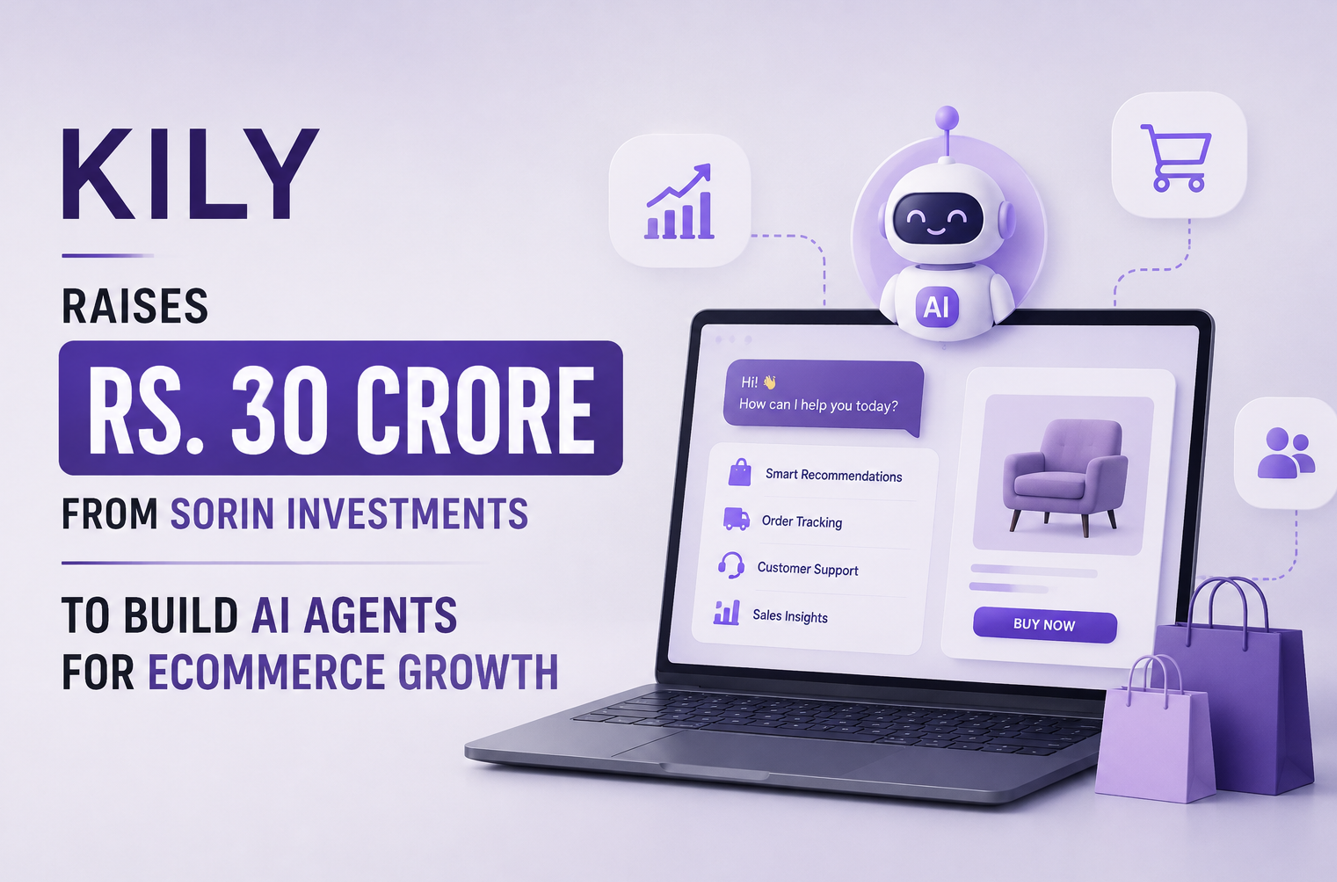
Kily, a Bengaluru-based AI startup, has raised Rs. 30 crore in funding from Sorin Investments, with participation from Razorpay and Wyser Capital. The company is building AI agents for ecommerce and quick commerce brands.
The startup was founded in 2025 by Sankalp Mehrotra and Anurag Singh. Both founders are alumni of Flipkart and Affle, which gives them direct experience in ecommerce, advertising, and digital growth.
Kily’s main promise is simple. It wants to help sellers and consumer brands manage online marketplace work without depending fully on manual teams. This includes product listings, pricing, ads, campaign performance, inventory signals and growth decisions.
What Kily does
Kily builds AI agents for ecommerce sellers.
An AI agent is software that can take action, not just give suggestions. In Kily’s case, these agents help sellers manage product listings, pricing and ads across marketplaces and quick commerce platforms.
For example, a skincare brand selling on Amazon, Flipkart and quick commerce apps may have hundreds of products. Each product needs the right title, keywords, price, images, ads, discounts and stock planning. If the team misses a change in competitor pricing or ad performance, sales can suffer.
Kily’s AI agents are built to monitor such areas regularly and suggest or take actions that can improve sales and profitability.
Why the funding matters
The Rs. 30 crore funding matters because ecommerce is becoming more complex for brands.
Earlier, a brand could focus mainly on one or two online channels. Now, it may need to manage Amazon, Flipkart, Myntra, Zepto, Blinkit, Swiggy Instamart, Nykaa, Meesho, its own website and more.
Each platform has different rules, ad formats, search behaviour, pricing pressure and customer habits. A small team may struggle to keep up.
Kily wants to become the AI layer that helps brands manage this complexity. The fresh money can help the startup improve its product, hire talent, strengthen marketplace integrations and work with more consumer brands.
Aim and purpose of Kily
Kily’s larger aim is to help ecommerce sellers grow profitably.
Many brands chase sales, but not all growth is healthy. If a brand spends too much on ads or gives discounts without planning, revenue may rise but profit may fall.
Kily’s platform focuses on areas that directly affect ecommerce performance. These include listing quality, keyword visibility, dynamic pricing, ad return, stock-out risk, campaign planning and sales analytics.
The purpose is not just automation. It is better decision-making.
For example, if a product is selling fast but stock is running low, Kily can help flag the risk early. If an ad campaign is spending money but not converting, the system can help adjust it. If a competitor changes price, the brand can respond faster.
Why brands need AI agents now
Online commerce has become a game of speed and attention.
A product listing must be searchable. The price must stay competitive. Ads must be watched often. Inventory must be ready. Reviews and conversion rates must be tracked.
Human teams can do this, but it becomes difficult when a brand has hundreds or thousands of SKUs. SKU means stock keeping unit, or simply one sellable product variant. For example, the same shampoo in 100ml and 250ml packs counts as different SKUs.
Kily’s website says its goal is to equip every ecommerce seller with a team of AI agents. In plain words, it wants AI to handle repetitive marketplace work so business teams can focus on product, brand and growth strategy.
Kily and WPP Media partnership
Before this funding update, Kily also entered a strategic technology partnership with WPP Media in India.
The partnership connects Kily’s agentic commerce technology with WPP Media’s commerce planning capabilities. The aim is to help brands respond faster to marketplace changes, improve planning and drive better business results across ecommerce and quick commerce.
This partnership is important because WPP works with large consumer brands. If Kily’s AI agents can support such brands at scale, the startup can move beyond small sellers and become useful for enterprise commerce teams.
Who invested in Kily
Sorin Investments led the Rs. 30 crore funding round. Razorpay and Wyser Capital also participated.
Sorin Investments is an early-stage investment firm founded by Sanjay Nayar, former KKR India CEO. The firm has backed several Indian startups and closed its maiden fund at Rs. 1,350 crore in 2024, according to report.
Razorpay’s participation is also interesting because it works closely with digital businesses, merchants and online payment flows. Wyser Capital adds another investor to the round.
Together, these investors show that Kily is being seen as part of the larger commerce infrastructure opportunity.
Competitors and market landscape
Kily operates in a fast-growing but competitive space.
Globally, companies such as Qeen.ai, Profitero, Pacvue, CommerceIQ and several retail media automation platforms are working on ecommerce growth, ads, pricing and marketplace intelligence.
In India, Kily may compete with ecommerce enablement firms, ad-tech platforms, marketplace analytics tools and agencies that help brands manage Amazon, Flipkart and quick commerce channels.
Its real challenge will be to prove that AI agents can perform better than manual teams or traditional software dashboards.
Kily’s advantage may come from its focus on Indian marketplace complexity. India’s ecommerce market is highly fragmented, with many platforms, languages, price-sensitive buyers and fast-moving quick commerce channels.
Future of Kily
Kily’s future depends on how well it can show measurable results.
Brands will not pay for AI because it sounds modern. They will pay if it improves sales, reduces wasted ad spend, prevents stock-outs, improves listing visibility or protects margins.
The startup may expand in three directions.
- First, deeper marketplace coverage. More integrations with ecommerce and quick commerce platforms can make Kily more useful.
- Second, stronger AI decision-making. The system must learn which actions improve sales and profit in different categories.
- Third, enterprise brand partnerships. Large consumer companies may need AI tools to manage thousands of products across several platforms.
If Kily gets this right, it can become a serious AI commerce platform from India.
Challenges ahead
The opportunity is strong, but the road is not easy.
Marketplace data can be messy. Different platforms change rules often. Ads and pricing decisions can affect margins quickly. Brands may also be cautious about allowing AI to take direct action without human approval.
Trust will be important. Kily must show clear reporting, controls and transparency so brands know what the AI is doing and why.
It will also need strong data security because sellers may connect sensitive sales, pricing and campaign information to the platform.
Conclusion with key takeaways
Kily’s Rs. 30 crore funding from Sorin Investments, Razorpay and Wyser Capital is a strong signal for India’s AI-led ecommerce market. The startup is trying to solve a real problem for brands: managing online sales across marketplaces is becoming too complex for manual work alone.
Founded in 2025 by Sankalp Mehrotra and Anurag Singh, Kily is building AI agents that help sellers manage listings, pricing and ads across ecommerce and quick commerce platforms.
Key takeaways –
- Kily has raised Rs. 30 crore from Sorin Investments, Razorpay and Wyser Capital.
- The startup was founded in 2025 by Sankalp Mehrotra and Anurag Singh.
- Kily builds AI agents for ecommerce sellers and consumer brands.
- Its platform helps manage listings, pricing, ads, analytics and marketplace growth.
- The startup recently partnered with WPP Media to support AI-led commerce in India.
Discover more from Newskart
Subscribe to get the latest posts sent to your email.

Comments are closed.