

InspeCity Raises Rs. 100 Crore to Take India’s Satellite Servicing Tech Closer to Space


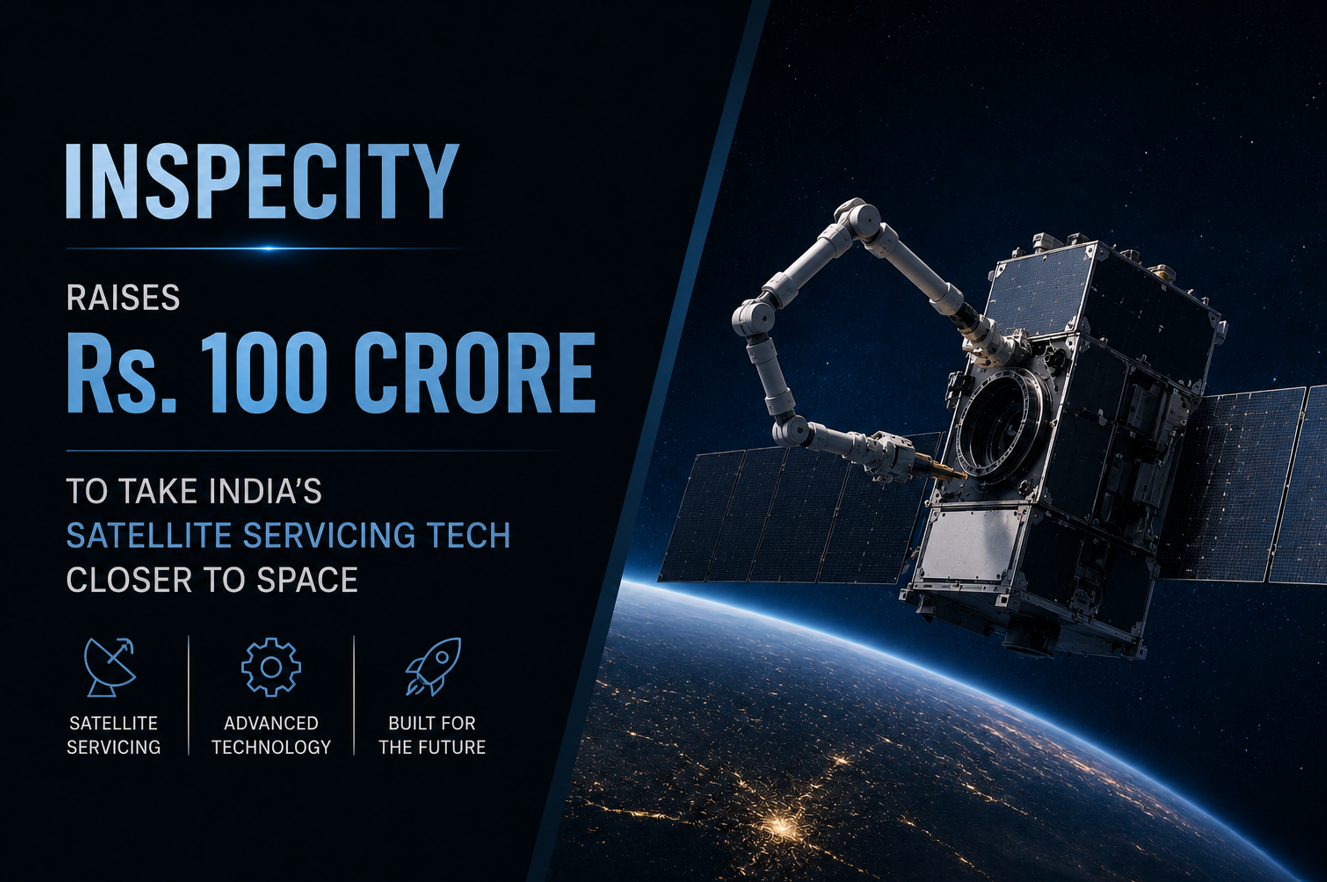
Indian spacetech startup InspeCity has raised Rs. 100 crore in a pre-Series A funding round, giving a strong push to its plan of building “service stations” for satellites in space.
The round was led by Speciale Invest and investor Ashish Kacholia. Antler Elevate, Antler India, Manish Gandhi, Shastra VC and others also joined the round.
This is an important moment for India’s private space sector because InspeCity is not building rockets or satellites in the usual way. It is working on something more specialized which is that helping satellites live longer, move better, and safely exit orbit when their job is done.
What InspeCity does
InspeCity is building technology for in-space servicing. In simple words, it wants to help satellites after they are already in orbit.
Today, if a satellite runs out of fuel, faces a technical issue, or reaches the end of its life, there are limited options. Many satellites become useless even when some parts are still working. Some also add to the growing problem of space debris.
InspeCity wants to change that with systems that can inspect, approach, dock with, refuel, repair, or safely remove satellites from orbit. Think of it like roadside assistance, but for spacecraft.
Founder and founding year
InspeCity was founded in 2022 by Arindrajit Chowdhury and Tausif Shaikh.
Arindrajit Chowdhury is a professor at IIT Bombay and serves as the founder and CEO of the company. Tausif Shaikh is also linked to IIT Bombay. The startup has been incubated in the IIT Bombay ecosystem and is based in Maharashtra.
Purpose of the Rs. 100 crore funding
The fresh funding will mainly be used to move InspeCity from testing individual technologies to proving them in real space missions.
The company plans to carry out four in-orbit missions over the next 12 to 18 months. These missions will help test important capabilities such as propulsion, sensing, autonomous movement, robotics, docking, and refuelling.
InspeCity is also expected to expand its engineering and manufacturing teams. It will work on commercializing its propulsion systems and other space-service offerings for satellite operators.
Its key platform is called VEDA, short for Vehicle for Life Extension and Deorbiting Activities. The company is also working on systems such as GITA for propulsion, CHAKSU for sensing and navigation, RAMA for robotic work, and SPARSH for docking and fuel transfer.
Why this matters
Satellites are expensive. They support communication, defence, internet, weather tracking, navigation, banking, agriculture, and disaster response. If a satellite can work for a few extra years through servicing or refuelling, the operator can save money and reduce waste in orbit.
There is also a safety angle. Old satellites and broken parts can collide with working satellites. A company that can help remove or manage such objects may become valuable as space becomes more crowded.
Competitors and market space
Globally, companies such as Astroscale, Starfish Space, Orbit Fab, and Northrop Grumman are working on satellite servicing, debris removal, refuelling, and life-extension technologies.
In India, InspeCity is part of a growing spacetech wave that includes companies working on rockets, satellites, propulsion, imaging, and space infrastructure. Its focus on in-orbit servicing makes it different from many startups that are mainly building launch vehicles or satellite platforms.
Conclusion – Key takeaways
InspeCity’s Rs. 100 crore pre-Series A round shows that investors are taking India’s deep-tech space startups more seriously.
The startup’s aim is clear: make satellites more useful after launch and reduce the problem of space debris. The funding will help it run four space missions, strengthen its team, and bring its servicing technology closer to commercial use.
If InspeCity can prove its systems in orbit, it could become an important Indian company in the future space economy.
Facts Input- YS, Entrepreneur, MC
Discover more from Newskart
Subscribe to get the latest posts sent to your email.

[…] where Indian startups such as Pixxel, Digantara, GalaxEye, Dhruva Space, PierSight, OrbitAID and InspeCity are also building different parts of the space technology […]