

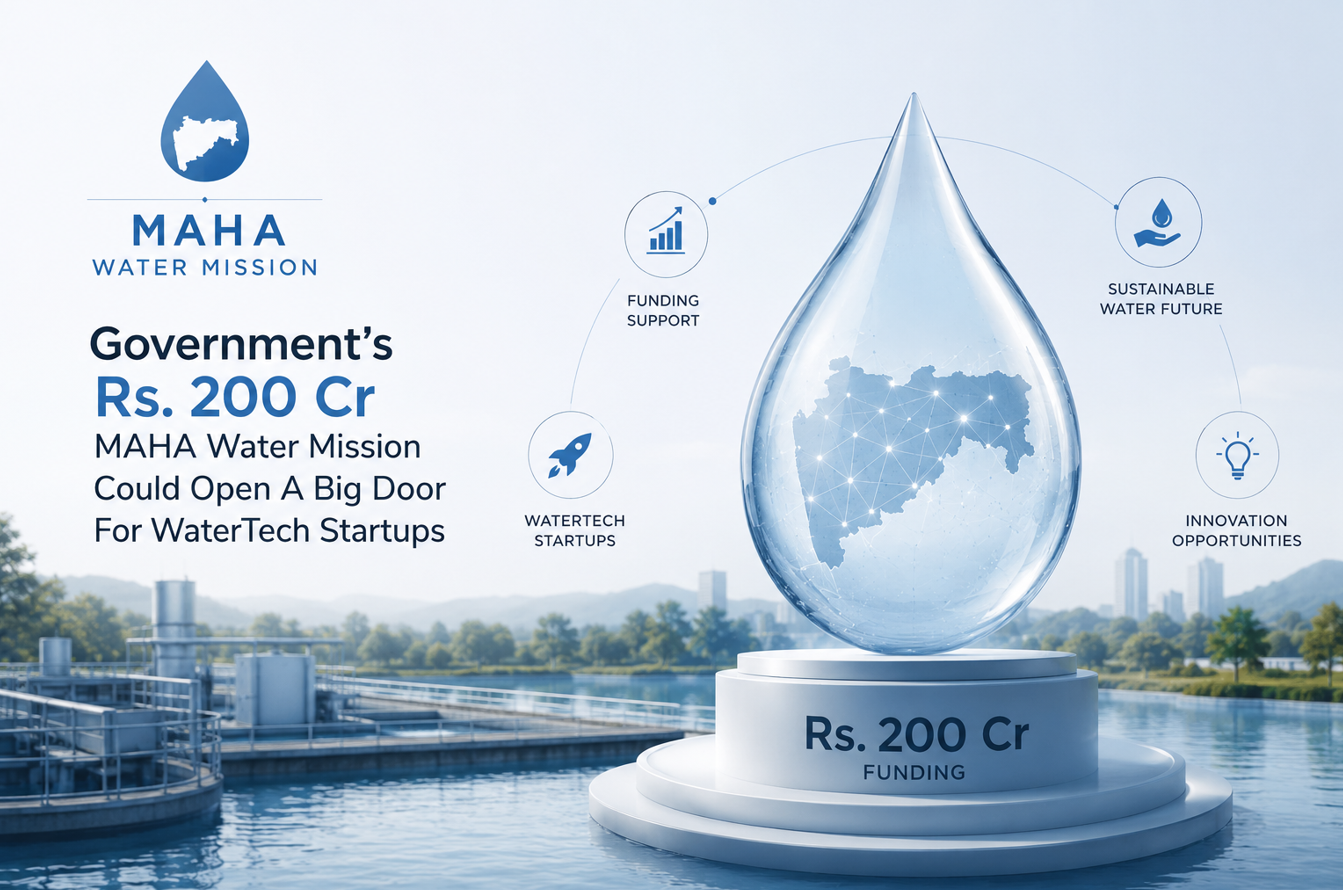
Government’s Rs. 200 Cr MAHA Water Mission Could Open A Big Door For WaterTech Startups


India’s water problems are not small. Some places face drinking water shortages, some struggle with polluted water, and many farmers still depend on uncertain rainfall. At the same time, climate change is making floods, droughts, and groundwater stress harder to predict.
To tackle this, the government has launched the Rs. 200 Cr MAHA Water Mission. The programme is being run by the Anusandhan National Research Foundation, or ANRF, in collaboration with the Ministry of Jal Shakti. It is designed to support research, field testing, and deployment of high-impact water solutions.
For startups, this is an important signal. The mission is not just about lab research. It wants universities, national labs, startups, MSMEs, and industry partners to work together on practical water technologies that can be tested in real conditions.
What Is MAHA Water Mission
MAHA stands for Missions for Advancement in High-Impact Areas. Under this framework, ANRF supports mission-mode research in sectors that matter for India’s future. Water is now one of those priority areas. The MAHA Water Mission has a total outlay of Rs. 200 Cr over five years. Selected consortium projects can receive support of up to Rs. 20 Cr each. A consortium means a team made up of different partners, such as a university, research lab, startup, MSME, or industry player.
The aim is simple – move good water ideas from research papers and prototypes into field-ready solutions. That could mean a low-cost drinking water system, a tool to monitor groundwater, a sensor for water quality, or a better way to reuse wastewater.
Who Will Benefit From This Mission
The direct beneficiaries will be research institutions, universities, national laboratories, Section 8 companies, and approved consortium teams. According to the official call for proposals, the lead applicant must come from an academic institution or national research laboratory.
Startups and MSMEs can benefit as collaborators. This is a very important detail. The mission’s official proposal document says startups, MSMEs, and industry partners can participate with academic or R&D institutions, but they will not receive direct ANRF funding under this particular mission. They must also contribute at least 10 percent of the total project budget, either in cash or kind. So, for startups, this is not a simple grant where a founder applies alone and receives money directly. The better way to understand it is this – water startups can join strong research-led projects, test their technology, access scientific expertise, build credibility, and use open-source mission outputs to improve products.
This can still be valuable. For a WaterTech startup, field validation is often more useful than a short marketing campaign.
What Kind Of Startups Can Participate
The biggest opportunity is for startups solving real water problems. A startup building AI-based groundwater mapping tools may fit the mission. A company making low-cost water testing kits could also be relevant. Startups working on wastewater recycling, smart irrigation, flood forecasting, water quality sensors, desalination support, greywater treatment, or climate-resilient water planning may also find good opportunities.
For example, a startup that makes IoT water meters for villages can partner with an engineering institute and a local government body to test the product in real conditions. A company working on wastewater reuse for small factories can collaborate with a research lab to improve treatment performance and validate results.
This is where the mission can help startups move from “promising product” to “trusted solution.”
The Five Focus Areas
The MAHA Water Mission is built around five priority themes.
- The first is water resource assessment and sustainable management. This includes groundwater mapping, aquifer recharge, glacier and snow monitoring, and better modelling of surface and groundwater systems.
- The second is drinking water. Here, the focus is on low-cost potable water solutions, especially for household and piped water supply systems.
- The third is water quality and ecological health. This can include water treatment, pollution monitoring, social hydrology, community-led innovation, and links between water, food, energy, and health.
- The fourth is water-use efficiency and circular economy. This is useful for startups working on water reuse, greywater management, industrial wastewater, agriculture water efficiency, and mining or allied sectors.
- The fifth is climate resilience and adaptation. This includes AI and machine learning tools, digital monitoring, environmental surveillance, and systems that help communities prepare for climate-linked water stress.
Why This Matters For India’s WaterTech Ecosystem
India has strong engineers, research institutions, and entrepreneurs. But water innovation is difficult because solutions must work in messy real-world conditions. A device that works in a lab may fail in a village, farm, factory, or flood-prone area. Water also has a public-good nature. The buyer may be a government body, municipality, industry, farmer group, or community institution. Sales cycles can be long. Testing can take months. Regulation and trust matter.
That is why a mission like this can help. It brings science, startups, institutions, and government priorities into one structure. If implemented well, it can reduce the gap between invention and deployment.
It can also create more serious WaterTech startups in India. Instead of building only small pilot products, founders may get a chance to work with larger validation programmes and national water challenges.
What Startups Should Do Now
Startups interested in the MAHA Water Mission should not wait passively. They should identify academic institutions, R&D labs, or national laboratories working in their area. A startup should prepare a clear note on its technology, current readiness level, pilot results, cost advantage, and field use case. The official call mentions technology readiness and field validation, so vague ideas may not be enough.
Founders should also be ready to contribute 10 percent of the project budget as required for startup, MSME, or industry participation. This contribution can be in cash or kind, but the role must be clearly defined.
Most importantly, startups should focus on problems that matter at scale. India does not need only polished dashboards. It needs affordable, durable, easy-to-maintain water solutions that can work across rural, urban, agricultural, and industrial settings.
Conclusion With Key Takeaways
The Rs. 200 Cr MAHA Water Mission is a serious push toward water innovation in India. It is designed to support technology development, validation, and deployment across drinking water, water quality, water efficiency, resource mapping, and climate resilience.
For startups, the opportunity is real, but the model must be understood correctly. Startups are expected to participate as collaborators with academic or R&D institutions, not as solo direct grant recipients under the main proposal route.
Key takeaways
- MAHA Water Mission has a Rs. 200 Cr outlay over five years.
- Selected consortium projects can receive up to Rs. 20 Cr.
- Startups, MSMEs, universities, labs, and industry partners are part of the mission ecosystem.
- Startups must collaborate with academic or R&D institutions and contribute at least 10 percent of the project budget.
The biggest beneficiaries will be WaterTech startups working on practical, scalable, field-ready solutions.
Discover more from Newskart
Subscribe to get the latest posts sent to your email.

Comments are closed.