

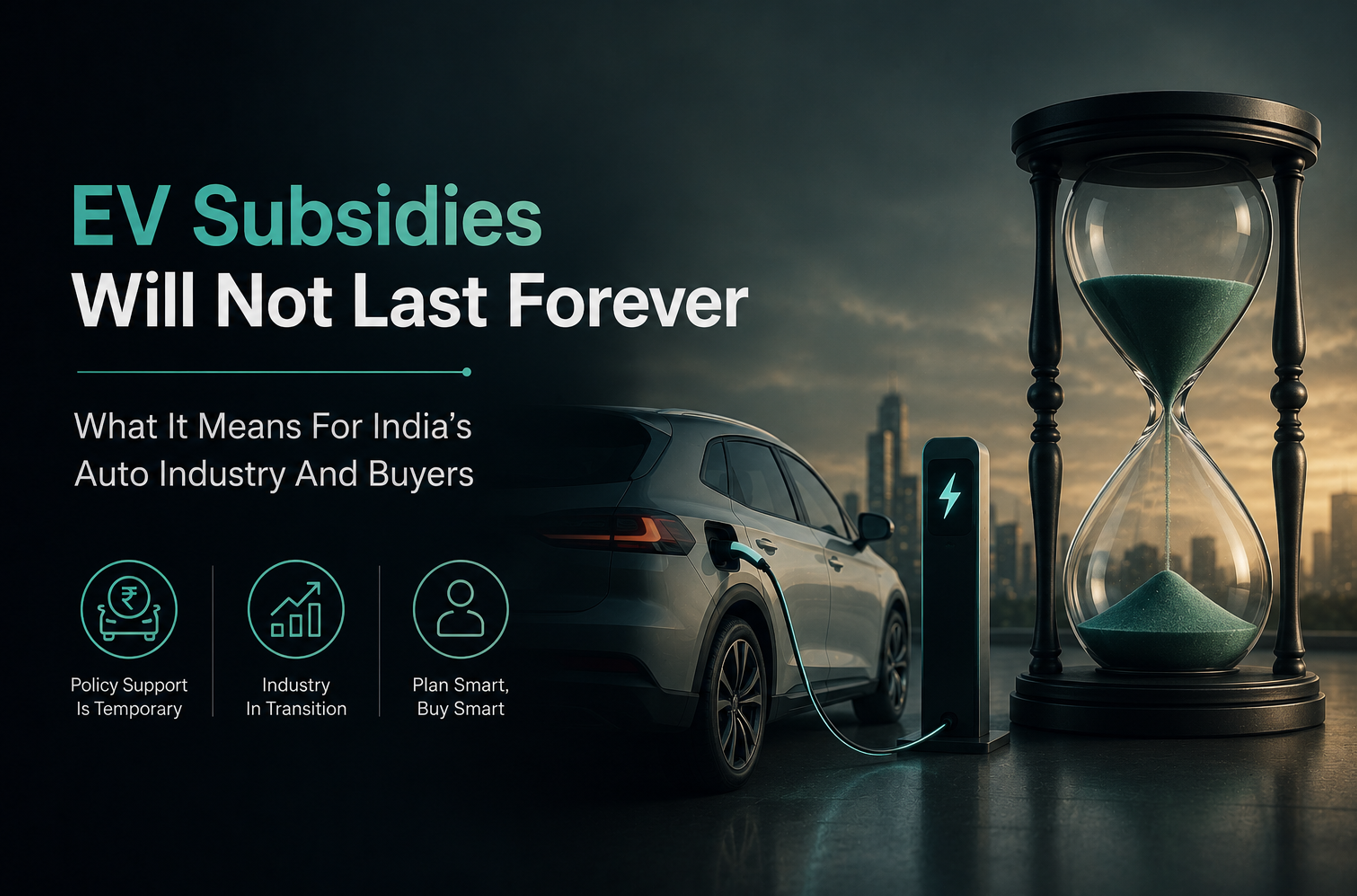
EV Subsidies Will Not Last Forever, What It Means For India’s Auto Industry And Buyers


India’s electric vehicle story has reached an important point. For the last few years, government subsidies helped make EVs more attractive for buyers and gave companies the confidence to launch new models. Now, the auto industry is being told to prepare for a future where this support will slowly reduce.
At the SIAM Annual Convention, Heavy Industries Secretary Kamran Rizvi said EV subsidies and government support will come to an end in the coming years, and companies must be ready to stand on their own. This does not mean subsidies will stop tomorrow. But it does mean the industry cannot depend on government discounts forever.
Why EV subsidies were given in the first place
EV subsidies were created to make electric vehicles cheaper for early buyers. In a new market, prices are usually high because batteries, motors, electronics and charging systems are still scaling up.
Schemes like FAME-II and PM E-DRIVE helped reduce the upfront cost of electric two-wheelers, three-wheelers, buses and charging infrastructure. The PM E-DRIVE scheme has an outlay of Rs. 10,900 crore, and later reports said support for electric two-wheelers was extended till March 31, 2028, with extra allocation for the segment.
In simple words, subsidies acted like a push. They helped buyers try EVs and helped companies build demand.
Will EV prices rise for buyers
Yes, EV prices can rise if subsidies reduce and companies do not cut costs at the same time.
For example, if an electric scooter currently gets a direct incentive, the buyer pays less at the showroom. Once that support goes away, the company has three choices. It can pass the full increase to the customer, absorb some cost itself, or reduce prices through better manufacturing and local sourcing.
The final effect will depend on the segment. Electric two-wheelers may feel the impact more because buyers are price-sensitive. Electric cars may be less affected by direct purchase subsidies, as many private electric cars already depend more on tax benefits, state incentives, lower running cost and brand offers.
What automakers need to do now
For companies, the message is clear. EVs must become strong products, not just subsidy-driven products.
Automakers will need to localize batteries, battery management systems, motors, controllers and other key parts. Localization simply means making more parts in India instead of importing them. This can reduce costs, improve supply, and protect companies from currency changes or global shortages.
They also need to spend more on research and development. Buyers will not accept weak range, slow charging, poor service or expensive battery replacement just because the vehicle is electric. The product has to make sense in daily life.
Companies such as Tata Motors, Mahindra, Ola Electric, Ather Energy, TVS, Bajaj, Hero MotoCorp, Hyundai, MG Motor and BYD will all face this pressure in different ways.
Effect on common people
For common people, the end of subsidies is not only bad news. It can also make the EV market healthier in the long run.
When subsidies reduce, only serious companies with good products, service networks and cost control will survive. This can reduce poor-quality launches and make buyers more careful.
But in the short term, some EVs may become costlier as per reports. A family planning to buy an electric scooter or car should compare the full ownership cost. This means looking at purchase price, charging cost, petrol savings, battery warranty, service cost and resale value.
For someone who rides 40 to 60 km daily and can charge at home, an EV may still save money even with lower subsidies. But for someone with low daily usage or no charging access, a petrol, CNG or hybrid vehicle may remain more practical.
Charging will become even more important
Rizvi also pointed to charging infrastructure as a key area for the industry. This matters because buyers do not choose EVs only by price. They also ask one simple question – where will I charge it?
More public chargers, apartment charging, office charging and highway charging can reduce fear among buyers. If charging becomes easy, people may accept EVs even without large subsidies.
Conclusion with key takeaways
The possible end of EV subsidies is a natural next step for India’s electric mobility market. Subsidies helped the market start. Now the industry has to prove that EVs can win on real value.
Key takeaways –
- EV subsidies in India are expected to reduce over the coming years.
- Prices may rise if companies cannot reduce battery and manufacturing costs.
- Electric two-wheelers could feel the impact more than premium EV cars.
- Automakers must focus on local parts, better batteries, charging and service.
- Common buyers should compare total ownership cost, not just showroom price.
References- ET, Business Today, PIB, Autocar India
Discover more from Newskart
Subscribe to get the latest posts sent to your email.

Comments are closed.