


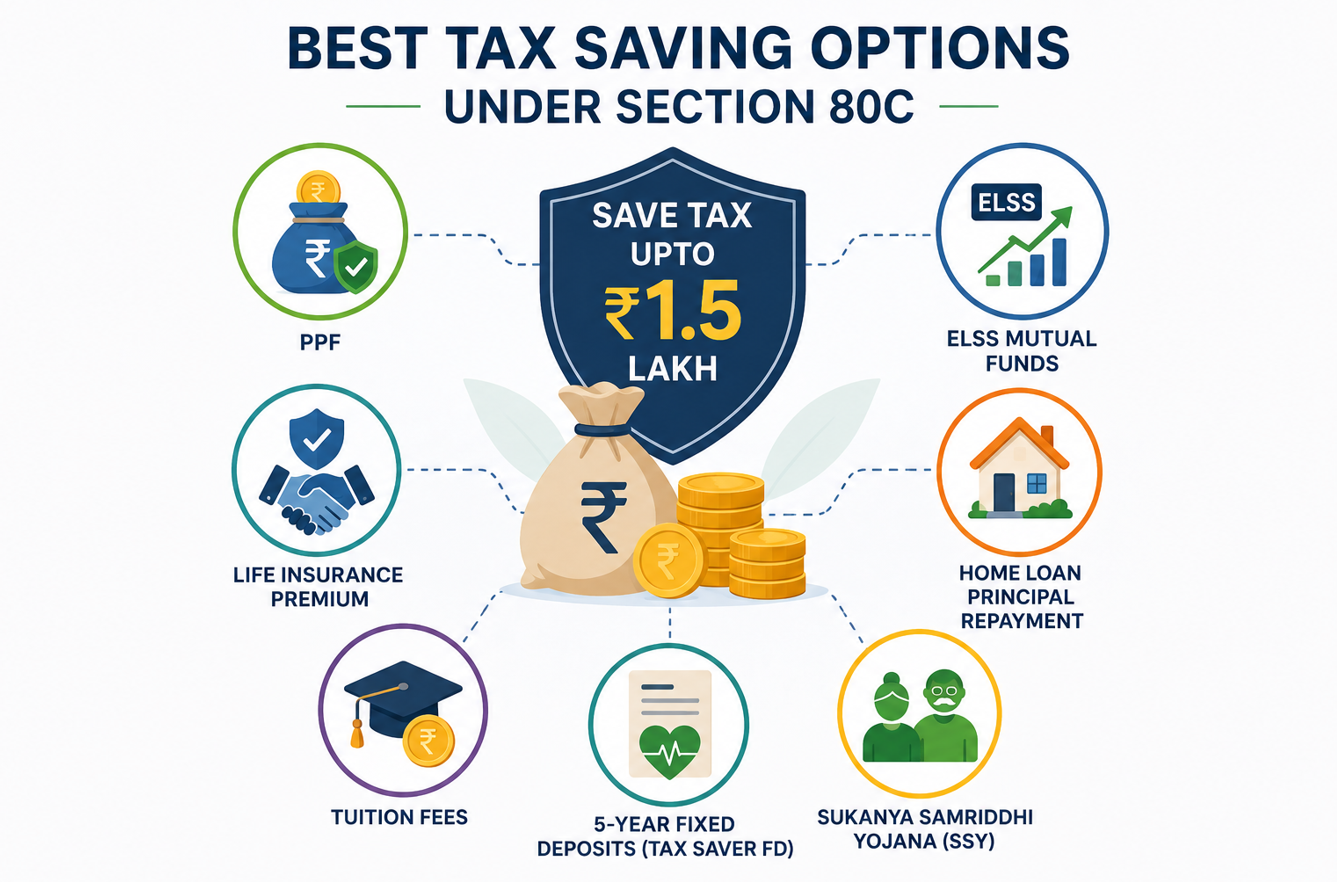
Tax planning is an important part of every individual who is in Job and it becomes easier when you focus on a few reliable options instead of investing in every product in the market. Under Section 80C, eligible individuals and HUFs can claim deductions up to Rs 1.5 lakh in a financial year. For many taxpayers, this is the first and most important step in reducing taxable income.
But there is one point you should remember in advance that these deductions are generally useful if you opt for the old tax regime. If you are in the new regime, most classic 80C benefits may not help in the same way. So, before investing, check your regime choice and then build your plan.
Most useful Section 80C options and who they suit
A good 80C strategy balances tax savings, safety, liquidity, and long-term goals. Here are the most practical choices most people consider.
Employee Provident Fund (EPF) is the basic part for salaried taxpayers which is deducted by the employer. This deduction/contribution is automatically counted in EPF under 80C, making it a built-in tax-saving tool. It is disciplined and retirement-focused, so it works well if you prefer low-effort planning.
Public Provident Fund (PPF) is popular among the investors. PPF offers government-backed safety and long-term compounding, though money is locked for a longer horizon with limited withdrawal rules. If your priority is stable wealth creation with tax efficiency, PPF is usually a strong pick.
ELSS (Equity Linked Savings Scheme) is suitable for those who can handle market movement and want growth potential. ELSS has one of the shortest lock-in periods among common 80C options. Because it is market-linked, returns are not fixed, so it fits investors with a medium- to long-term mindset.
Life insurance premium paid for eligible policies can also be claimed under 80C, subject to rules. This is useful when your insurance is protection-first. You should avoid buying high-cost policies only for tax deduction.
Home loan principal repayment can be claimed under 80C if conditions are met. For homebuyers already repaying a loan, this becomes a natural deduction without needing separate tax-saving investments.
Sukanya Smariddhi Yojna (SSY) is also an investment plans aimed to invest in the name of your daughters, whose account can be opened at the time of her birth till the age she turns 10 years old. You can opened max two accounts (i.e. for two daughters) and it attains decent interest and compounding on your investments over the period of the time. The matured amount can be withdrawn after a certain period of time i.e. after 21 years from the date of account opening.
Children’s tuition fees (for eligible institutions and conditions) also qualify, which helps families combine essential expenses with tax planning.
How to choose the right mix instead of just filling Rs 1.5 lakh
The best tax saving option is not one product, it is the right combination for your life stage. If you are early in your career, you may combine EPF with ELSS for growth and discipline. If you prefer stability, EPF plus PPF can create a safer structure. If you already have a home loan and insurance premium, part of your 80C may already be used before new investments.
A simple way to plan is-
- First count automatic deductions (EPF, home loan principal, tuition, insurance premium).
- Check how much 80C limit is still unused.
- Fill the gap with PPF or ELSS based on risk comfort and liquidity needs.
Do not invest in March in panic mode every year. You should start monthly or quarterly so cash flow stays comfortable and decisions are better. Also, you should keep proof documents organized for filing and verification.
Finally we can say that section 80C works best when tax saving is aligned with real goals like retirement, family protection, children’s education, or home ownership. If you choose products only for deduction, you may save tax today but hurt financial flexibility later. Plan early, pick intentionally, and let tax benefit come as a by-product of good investing.
Disclaimer
This article is for educational and informational purposes only and should not be treated as investment advice. Please consult with your investment or tax advisor before any investment.
Discover more from Newskart
Subscribe to get the latest posts sent to your email.

[…] Best Tax Saving Options Under Section 80C-Simple Guide for Smart Planning […]