

Airtel Priority Postpaid 5G Service Explained – Fair Internet Upgrade or VIP Lane Debate?


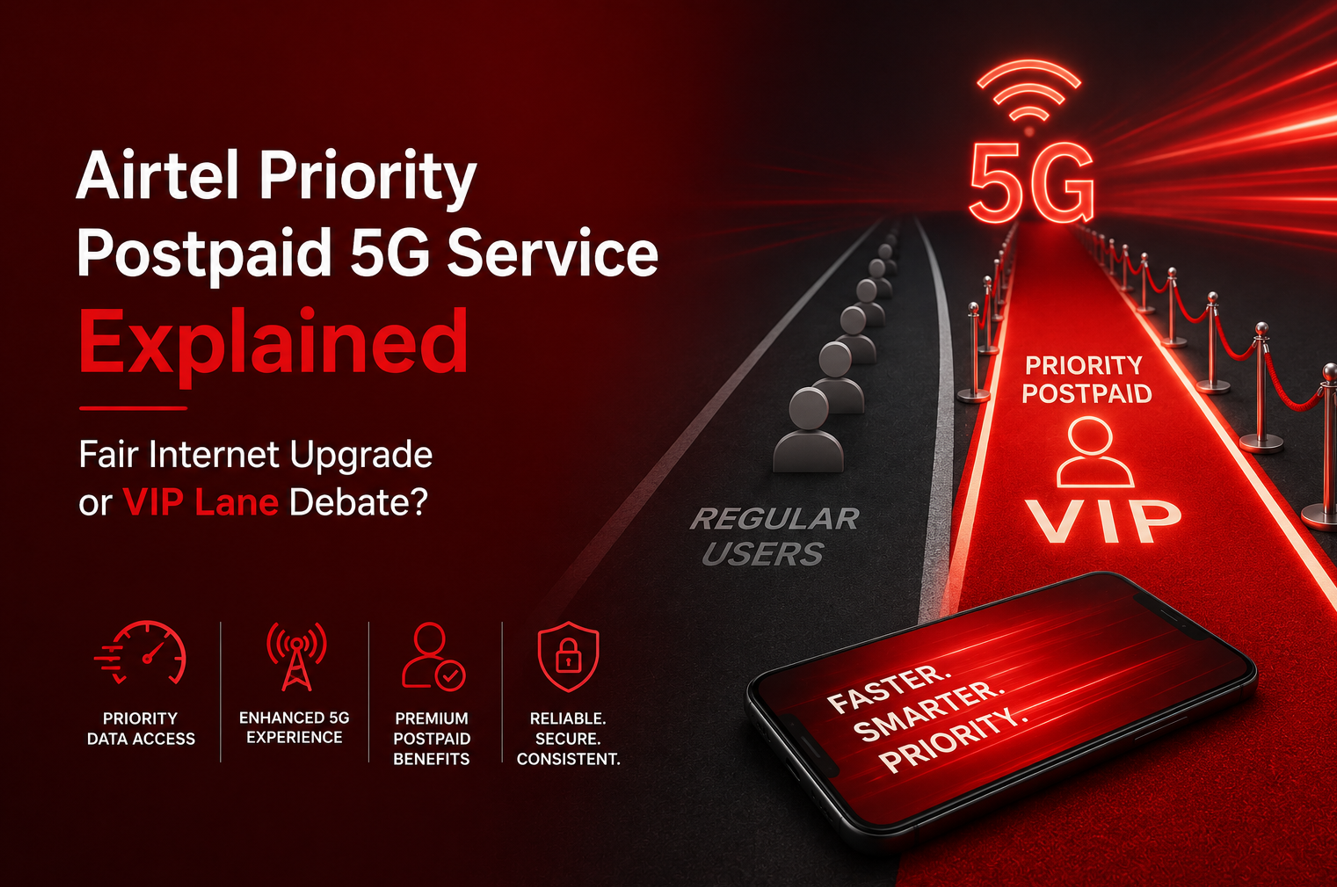
Airtel’s new Priority Postpaid 5G Service has started a fresh debate in India’s telecom market. The company says it is using 5G network slicing to give postpaid users a more consistent internet experience, especially in crowded places. Anyone who has tried to book a cab at a railway station, upload a payment screenshot at a market, or make a video call from a packed event knows how frustrating mobile data can become when too many people are using the same network.
But the debate is not only about speed. The bigger question is fairness. If postpaid users get a better network lane, what happens to prepaid users who also pay for internet? Is this smart use of 5G technology, or does it create a class divide on the internet? Let’s explore it in simple terms.
What Is Airtel Priority Postpaid 5G Service
Airtel Priority Postpaid is a new service for Airtel postpaid users. It was launched on May 19, 2026, and is available across Airtel postpaid plans starting at Rs. 449 plus GST.
The service uses 5G network slicing. This means Airtel can create a separate virtual part of its 5G network for a specific type of user or service. In this case, postpaid customers get a more stable and reliable network experience during high-traffic situations. Airtel calls this Fastlane technology. The idea is not that one app gets special treatment. Instead, the postpaid user’s overall 5G connection gets priority when the network is busy.
For example, if you are at a stadium, airport, metro station, concert, business district, or crowded market, your phone may struggle because many people are using data at the same time. Airtel says Priority Postpaid can help users get smoother connectivity in such situations.
The plans also include unlimited data and calling, 3000 SMS, spam and fraud alerts, and entertainment benefits depending on the plan. The family plan can go up to Rs. 1749 plus GST for five users, with extra benefits such as Netflix on selected plans.
Why Some People Support It
People in favour of Airtel Priority Postpaid say this is exactly what 5G was built for. Network slicing is one of the important features of 5G, and telecom companies around the world are expected to use it for different service levels. Their argument is simple – customers already pay different prices for different services. A person buying a higher broadband plan gets more speed. A business customer may get better support. A premium flight ticket gives more comfort. So, why should mobile networks be different if the technology allows it?
Supporters also say this can improve reliability for users who depend heavily on mobile internet. For working professionals, business owners, travellers, creators, delivery partners, or people who frequently work outside home, stable data can matter more than peak speed.
Airtel has also defended the service by saying it is content-neutral. In simple words, Airtel says it is not giving special treatment to Netflix, YouTube, WhatsApp, Instagram, or any particular app. It claims there is no blocking, throttling, zero-rating, or app-based preference.
The company has also reportedly told authorities that the service does not reduce quality for prepaid users. According to reports, Airtel said its 5G network capacity usage is still well below full capacity, and postpaid traffic is only a small part of total traffic. If that is true in real-world conditions, supporters will say there is no harm. Postpaid users get a premium experience, and prepaid users do not lose anything.
Why Critics Are Worried
The people against Airtel Priority Postpaid are not only complaining about one plan. Their concern is about the direction this could take. India has had a strong public debate on net neutrality for years. Net neutrality means internet providers should treat online content and services fairly, without blocking, slowing, or favouring specific apps or websites.
Airtel’s case is slightly different because it is not about favouring one app. It is about favouring one customer category i.e. postpaid users – over another – prepaid users. Critics worry that this may create a paid priority model for mobile internet. Today it is postpaid priority during congestion. Tomorrow it could become premium gamer plans, creator plans, office plans, or app-specific fast lanes. That is the slippery slope many users are worried about.
Another concern is prepaid fairness. In India, prepaid users are a huge part of the mobile market. Many prepaid customers pay regularly, use expensive recharges, and rely on mobile data for study, work, UPI payments, travel, and entertainment. If their experience becomes weaker during congestion while postpaid users get better performance, the divide may feel unfair.
Some users have also raised practical concerns online. They ask – if Airtel has enough 5G capacity, why not improve the experience for everyone? Why make consistency a premium benefit? Others worry that telecom companies may use “priority” plans to push people from prepaid to postpaid.
There is also a transparency issue. Most regular users do not understand 5G slicing, SA 5G, NSA 5G, capacity allocation, or network priority. If the company does not clearly explain what changes for prepaid and postpaid users, confusion will grow.
Is It Against Fair Use of the Internet
This is where the answer becomes more nuanced. If Airtel Priority Postpaid only gives postpaid users a separate network slice without slowing down prepaid users, without blocking apps, and without favouring specific websites, then it may fit within current telecom rules. That is Airtel’s position.
But fairness is not only a legal question. It is also a public trust question.
For many users, mobile internet is not a luxury anymore. It is used for payments, education, jobs, banking, maps, health services, and government apps. If priority data becomes common, regulators will need to make sure basic internet quality does not become poor for non-premium users.
The best way forward may be transparency. Airtel should clearly publish what Priority Postpaid changes, what it does not change, how prepaid users are protected, and whether independent quality checks can verify its claims.
Regulators like the Department of Telecommunications and TRAI also have an important role. They need to check whether the service affects prepaid quality during peak hours, whether network slicing is being used in a content-neutral way, and whether the offer follows India’s net neutrality framework.
So, is it fair? It can be fair if it improves premium service without hurting regular users. It becomes unfair if it quietly makes prepaid users second-class internet customers.
Competitors and What Could Happen Next
Airtel’s biggest competitor is Reliance Jio, followed by Vodafone Idea. If Airtel’s Priority Postpaid becomes popular and regulators allow it, other telecom operators may launch similar premium 5G plans. Jio has a large 5G network and could use its own version of priority services in the future. Vodafone Idea may also explore premium plans once its 5G rollout becomes stronger.
This could create more choice for users, but also more confusion. We may see plans built around gaming, office work, video calls, family use, cloud gaming, or creator uploads. Some of these could be useful. But they will need clear rules. The bigger market shift is clear. Telecom companies no longer want to sell only “data per day”. With 5G, they want to sell quality of experience. That can be good for innovation, but only if the basic internet remains open and fair.
Conclusion and Key Takeaways
Airtel Priority Postpaid 5G Service is one of India’s first major consumer examples of 5G network slicing. It promises more stable connectivity for postpaid users during busy network conditions.
For postpaid users, it can be useful but for prepaid users, it raises valid questions about fairness, transparency, and the future of net neutrality. This concern also need attention and to be looked by regulators as well.
Key takeaways
- Airtel Priority Postpaid was launched on May 19, 2026.
- Plans start at Rs. 449 plus GST.
- The service uses 5G network slicing to offer more consistent connectivity to postpaid users.
- Airtel says it is content-neutral and does not slow down prepaid users.
- Supporters see it as smart use of 5G technology.
- Critics worry it may create a paid priority system and weaken equal internet access.
The service may be fair if prepaid users are not harmed, but it needs strong transparency and regulatory checks.
Facts Input- Airtel, Gadgets 360, BS, ET, Outlook Business
Discover more from Newskart
Subscribe to get the latest posts sent to your email.

[…] Airtel Priority Postpaid 5G Service Explained – Fair Internet Upgrade or VIP Lane Debate? […]