

$600M for India Startups: Krafton–Naver–Mirae Fund Launch Explained, and Who Benefits the Most


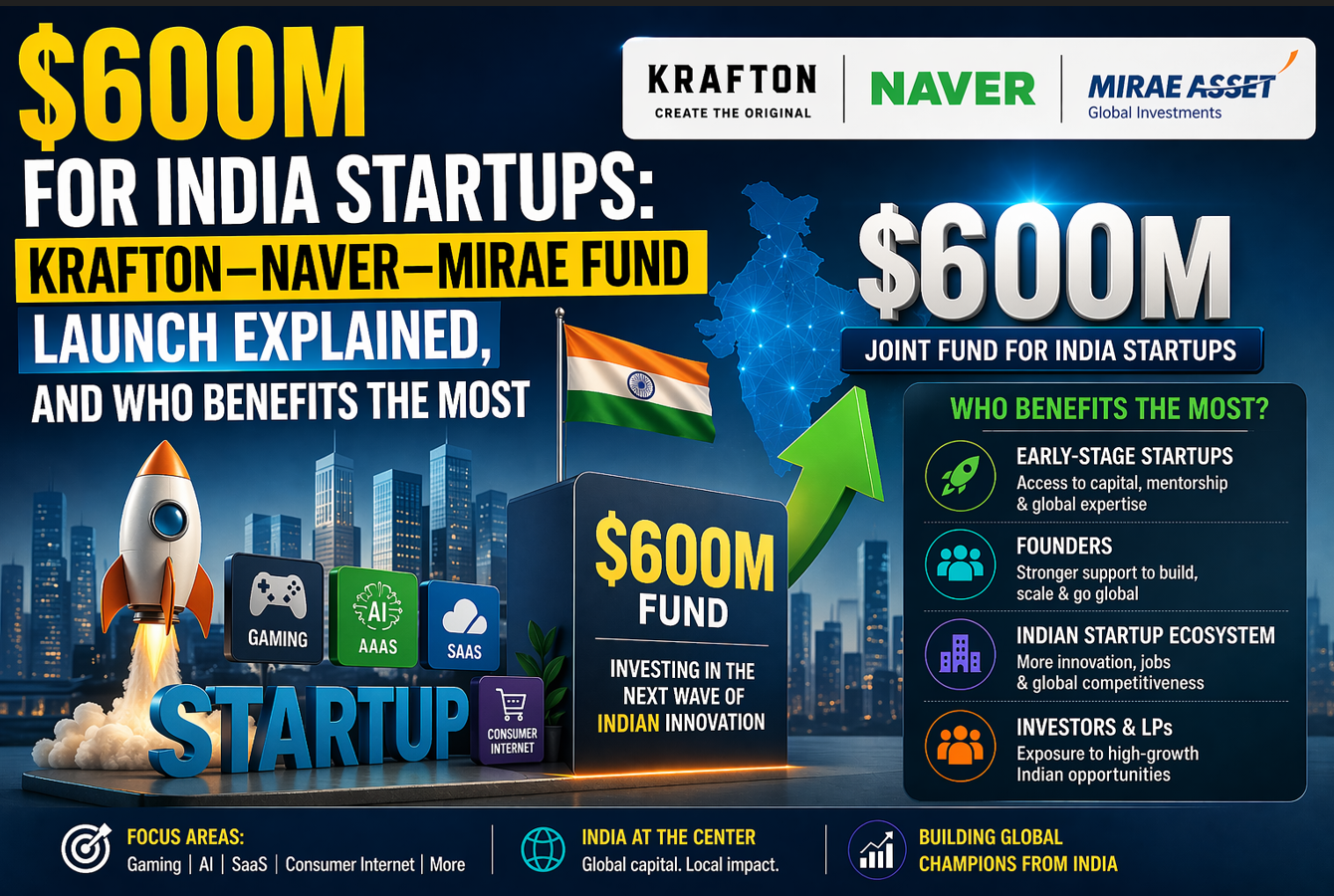
A major cross-border startup funding move has just landed in India. Krafton–Naver–Mirae launched India-focused $600M fund, and this could become one of the most important growth-stage capital pools for Indian tech companies this year.
This one is different for two reasons. First, it is backed by large Korean tech and investment groups with long-term strategic intent. Second, it is designed for India-focused technology growth, not a broad global vehicle where India is just one line item.
For founders, this means one thing clearly: there may soon be a stronger funding options available for companies that are scaling beyond early product-market fit and need bigger capital to grow faster.
What has been announced?
On April 21, 2026, Krafton, Naver, and Mirae Asset announced an India-focused “Unicorn Growth Fund” of around $600 million (widely reported as ₹6,000 crore). The fund is expected to focus on high-growth Indian technology companies, with Mirae Asset Venture Investments’ India platform playing a key role in management/advisory. Reports also indicate this vehicle is among the larger India-dedicated pools backed by an Asia-based technology-led partnership.
In simple terms: this is a scale-up fund, not a very early seed fund.
Why this launch matters right now
India’s startup ecosystem is active, but growth-stage funding can still be uneven. Many companies can raise seed capital, but fewer get large, patient capital when they need to expand distribution, improve unit economics, or prepare for IPO readiness.
This fund can help fill that middle-to-late growth gap. It also sends a confidence signal: global strategic investors still see India as a long-term innovation market, not just a short-term valuation story.
Which sectors are likely to be targeted?
Based on published reports and company statements, the broad focus appears to be India technology sectors such as:
- Digital platforms and consumer internet
- AI and software-led businesses
- New-age consumer and content ecosystems
- Deep-tech style opportunities in select areas
Different reports mention slightly different sector wording, but the common pattern is clear: tech-enabled, high-growth, scalable businesses.
Who will be benefitted the most?
1) Growth-stage startups
This is likely the biggest beneficiary group.
Founders who have already built traction but need larger capital rounds (for expansion, hiring, distribution, and product depth) may get another serious funding route. That is especially useful when capital markets are selective and investors want stronger business fundamentals.
2) Founders outside the “hype cycle”
Not every startup is in a fashionable category every quarter. A dedicated large pool can support strong businesses even when market attention shifts. If the fund stays thesis-driven, it can help overlooked but high-quality operators.
3) AI and software companies with enterprise value
If the fund actively backs AI/software plays, startups building real workflow products (not only surface-level AI wrappers) may benefit through both capital and strategic support.
4) Companies planning pre-IPO scale
Some reports suggest growth-stage and possibly pre-IPO style checks could be part of the approach. If true, this helps companies bridge the difficult phase between private growth and public market readiness.
5) India’s broader startup ecosystem
Even startups that do not raise from this fund can benefit indirectly. Why? A large active fund increases competition among investors, which can improve deal flow confidence and negotiation environments for founders.
Practical examples: what this could change on the ground
Let’s make it practical.
- A scaling fintech or commerce startup with strong metrics but delayed expansion due to capital constraints may now accelerate city-by-city rollout.
- A SaaS/AI startup that has product traction but needs enterprise GTM investment can pursue growth without cutting product ambition.
- A content-tech or consumer internet company can use larger rounds to improve retention, distribution, and monetization before late-stage pressure kicks in.
In all cases, the real impact depends on execution quality, not just cheque size.
Competitor funds and market context
This fund enters a competitive landscape where other domestic and global investors are also active in India’s startup market. Competing capital comes from:
- Large global venture and growth funds
- Sovereign and institutional-backed vehicles
- India-focused private growth investors
- Corporate venture arms from major technology groups
So this is not “new money in an empty market.” Instead, it is a strong new participant in a crowded but opportunity-rich market.
That competition can be healthy for founders if it increases disciplined, long-term capital availability.
Risks and reality check
A large fund does not automatically solve startup challenges. Key risks remain:
- Capital may concentrate in a few large winners
- High expectations on growth can pressure unit economics
- Cross-border strategic priorities can influence investment pace
- Sector cycles (especially AI and consumer internet) can change quickly
For founders, the takeaway is simple: strong metrics and business clarity still matter more than funding headlines.
What this means for India in the next 12–24 months
If deployment is steady and disciplined, this fund could help India in three ways:
- Support stronger growth-stage company pipelines
- Improve late-stage funding confidence
- Create more globally competitive Indian tech companies
If combined with better governance and sustainable growth, this can also improve long-term IPO quality from India’s startup ecosystem.
Conclusion: big fund, bigger signal
Krafton–Naver–Mirae India-focused fund has brought the deeper message which is even more important. India is being treated as a strategic innovation market where global tech capital wants to build long-term exposure.
Who benefits most? Growth-stage founders with real traction, scalable models, and strong execution discipline. For the ecosystem, this is more than a funding event. It is a confidence event.
Facts Input- ToI
Discover more from Newskart
Subscribe to get the latest posts sent to your email.

Comments are closed.