

EDF Backs 128 Startups With $139.23 Million, Giving India’s Deep-Tech Ecosystem A Quiet Push


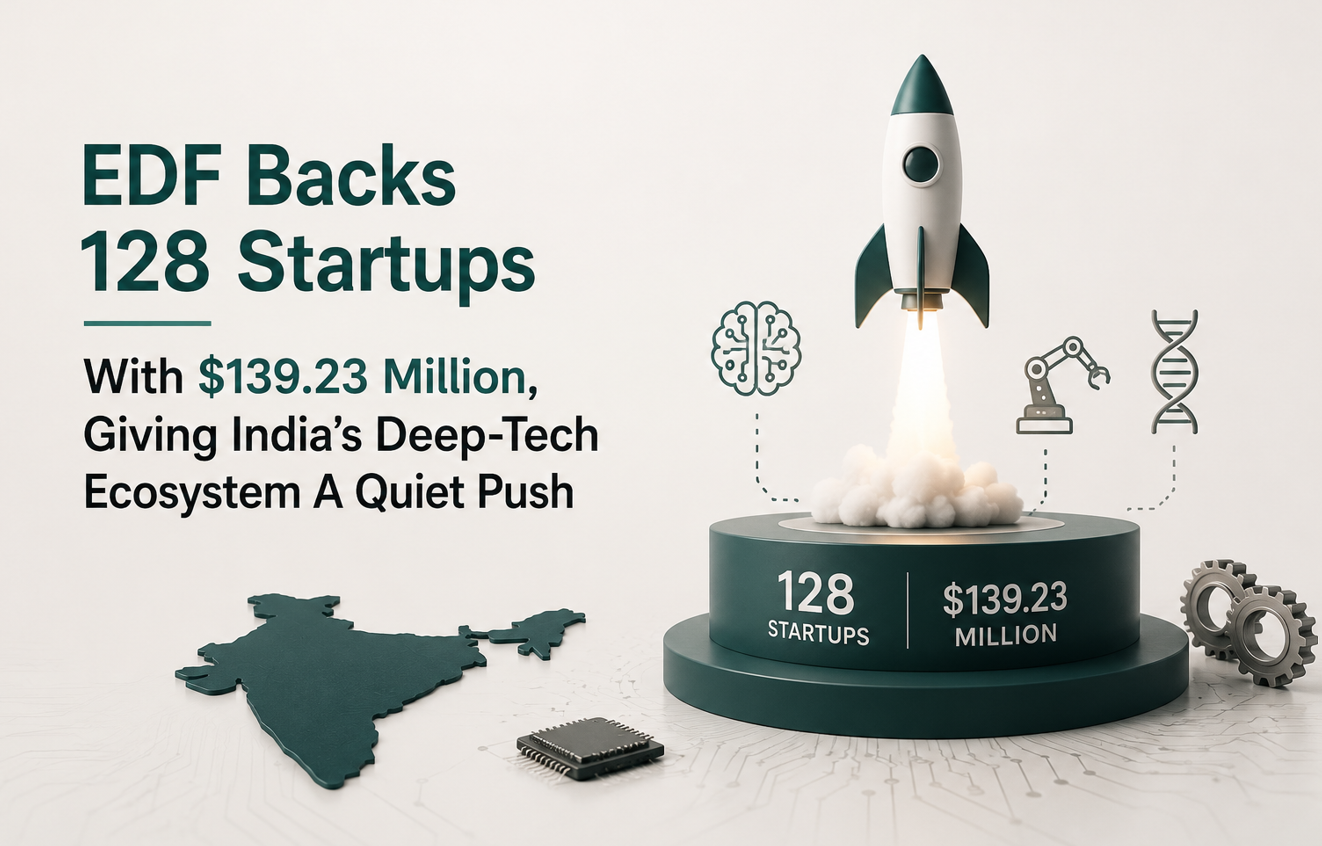
India’s deep-tech startup ecosystem has received a steady push from the Electronics Development Fund, better known as EDF. According to official government data, EDF-backed daughter funds have invested Rs. 1,335.77 crore, or about $139.23 million, across 128 startups and ventures.
EDF works differently. It is a government-backed fund-of-funds, which means it invests in venture funds, and those funds then invest in startups.
The model appears indirect, but it has a clear purpose. It helps bring professional fund managers, private investors and government-backed capital together to support startups working in serious technology areas like electronics, nanoelectronics, IoT, robotics, drones, AI, healthtech and cybersecurity.
What is EDF
The Electronics Development Fund was launched by the Government of India on 15 February 2016. Its main aim is to support research, development and entrepreneurship in electronics, nanoelectronics and information technology.
EDF is backed by the Ministry of Electronics and Information Technology, or MeitY. Canara Bank acts as the trustee and sponsor, while Canbank Venture Capital Funds Ltd. manages the fund.
In simple language, EDF does not usually write cheques directly to startups. Instead, it invests in professionally managed “daughter funds”. These daughter funds are venture capital or angel funds registered in India. They use their own investment judgment to back startups that fit the broader technology mission.
Why this model matters
A fund-of-funds model is useful because the government does not have to pick every startup directly.
Startup investing needs market knowledge, sector understanding and regular portfolio monitoring. Venture funds already have teams for this work. By investing through them, EDF can support more startups while still using professional fund management.
Think of it like this. Instead of one large institution trying to find every promising startup on its own, it backs multiple experienced fund managers. Those fund managers then search for companies in different technology areas.
This helps spread risk and increases reach.
How much has EDF supported
As of 30 September 2025, EDF had invested Rs. 257.77 crore in eight daughter funds. These funds then invested Rs. 1,335.77 crore across 128 startups and ventures.
The larger amount was deployed by the daughter funds, while EDF’s own investment into those funds was Rs. 257.77 crore.
The official data also says these supported startups have created more than 23,600 jobs in high-technology sectors. They have also created or acquired 368 intellectual properties, or IPs. In startup language, IP can include patents, designs, software, technical processes or other protected innovation.
EDF-backed daughter funds have also exited from 37 investments, and EDF has received Rs. 173.88 crore in cumulative returns from exits and partial exits.
Where the money went
EDF has backed eight daughter funds. These include Unicorn India Ventures Trust, Aaruha Technology Fund – 1, Endiya Seed Co-creation Fund, Karsemven Fund, pi Ventures Fund 1, YourNest India VC Fund II, Ventureast Proactive Fund – II and Exfinity Technology Fund Series II.
These funds have invested in startups across several frontier technology areas.
Some startups are working on Internet of Things, where devices are connected and exchange data. A simple example is a smart factory machine that alerts the maintenance team before it breaks down.
Some are in robotics and drones. These can be used in agriculture, warehouses, mapping, defence, inspection and disaster response.
Others are in AI and machine learning, where software learns from data to make predictions or automate decisions. Healthtech and cybersecurity startups are also part of the supported ecosystem.
Why this matters for India
India has become a large electronics and digital market, but the country still wants to build more of its own technology at home.
That is where EDF becomes important. It supports startups that can create local designs, products and intellectual property. This helps India move beyond assembly and services into deeper technology creation.
For example, if an Indian startup builds a cybersecurity product for local enterprises, it can reduce dependence on foreign tools. If another startup creates drone technology for farms or infrastructure, it can serve Indian conditions better than imported products.
The long-term goal is clear. India wants stronger domestic capability in electronics, IT and advanced technologies.
Why startups need this kind of capital
Deep-tech startups are harder to build than many app-based businesses.
A consumer app can be tested quickly. A hardware or electronics startup may need prototypes, labs, testing, manufacturing partners, certifications and longer development time. This usually needs patient capital.
For example, a robotics startup cannot simply launch a website and start selling. It must build hardware, test movement, check safety, improve design, manage parts, and support customers after deployment.
Similarly, a cybersecurity startup needs strong technical validation before customers trust it with sensitive systems.
EDF-backed capital helps such startups survive the early and difficult stages.
Competitors and similar support systems
EDF is not the only startup support mechanism in India. It works alongside other public and private funding channels.
The Startup India Fund of Funds, managed through SIDBI, supports venture funds that invest in startups across broader sectors. The Startup India Seed Fund Scheme helps early-stage startups with proof of concept, product trials and market entry. BIRAC supports biotech startups. iDEX supports defence innovation.
Private venture capital firms such as Accel, Peak XV Partners, Blume Ventures, Matrix Partners India, Lightspeed, pi Ventures, Endiya Partners and YourNest also invest in Indian startups.
EDF’s difference is its sector focus. It is more closely linked to electronics, IT and technology-led product development.
Challenges ahead
The EDF numbers are encouraging, but some challenges remain.
- First, India still needs more deep-tech capital. Hardware, AI infrastructure, electronics and semiconductor-linked startups need larger and longer funding cycles.
- Second, startups need better access to labs, testing facilities and manufacturing partners. Money alone cannot solve everything.
- Third, India must turn more research into commercial products. Creating IP is good, but building globally competitive businesses from that IP is the harder part.
- Fourth, funding should spread beyond a few strong startup hubs. Reports show Karnataka has received a large share of EDF-linked support, which reflects its strong tech ecosystem. Over time, more states will need to build similar capacity.
Conclusion with key takeaways
EDF’s support for 128 startups shows how targeted government-backed capital can help build India’s technology ecosystem. The fund may not make daily headlines like large private VC rounds, but its impact is visible in jobs, IP creation, fund activity and deep-tech startup support.
The most important point is that EDF’s role is indirect but strategic. It strengthens venture funds that then back startups in advanced technology areas. This helps India build a wider innovation base in electronics, IT and future-facing sectors.
Key takeaways –
- EDF-backed daughter funds have invested Rs. 1,335.77 crore, or about $139.23 million, across 128 startups and ventures.
- EDF itself has invested Rs. 257.77 crore in eight daughter funds.
- The fund was launched by the Government of India on 15 February 2016.
- Supported startups work in areas such as IoT, robotics, drones, AI, healthtech and cybersecurity.
- EDF-backed startups have created more than 23,600 jobs and 368 intellectual properties.
Facts Input- PIB-Gov
Discover more from Newskart
Subscribe to get the latest posts sent to your email.

Comments are closed.