

100×100 Launches $100 Million Climate Fund to Build 50 Startups Across India and Southeast Asia


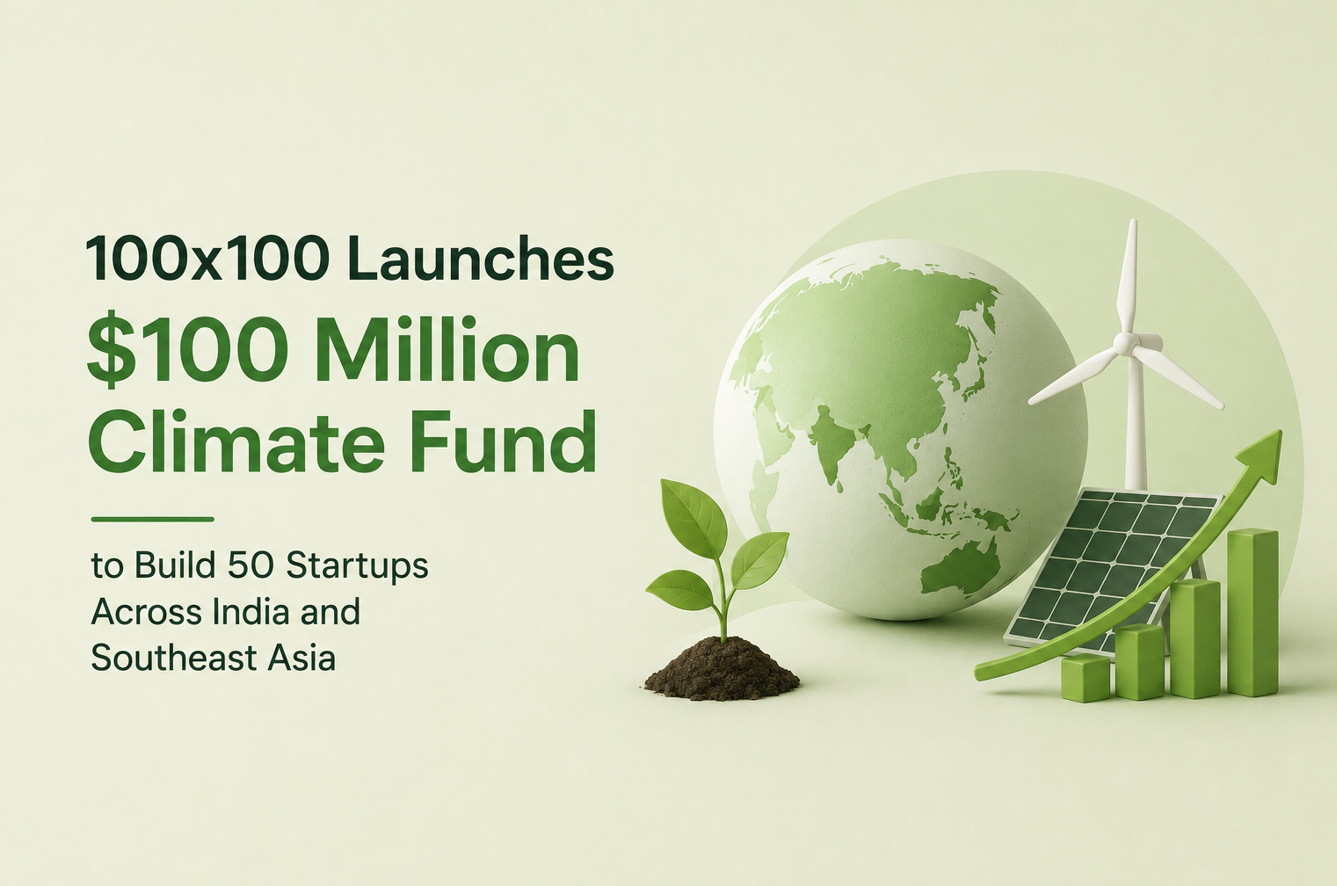
Singapore-based climate venture builder 100×100 has launched its second fund with a target corpus of $100 million. The fund, called Fund II, aims to create and scale 50 climate-focused companies across India and Southeast Asia.
This is a notable update for the climate startup market because 100×100 is not following the usual venture capital playbook. Instead of only investing in existing startups, it wants to build new companies from the ground up.
That difference matters. Climate startups often need more than money. They need sector knowledge, technical planning, industrial partners, early customers and patient execution. 100×100 wants to bring those pieces together and build companies that can become both commercially strong and climate-relevant.
What 100×100 is planning
According to DealStreetAsia, 100×100’s new fund will focus on creating companies across agriculture, energy, industry, materials and buildings. These are sectors where emissions are high and where practical solutions can have a large impact. The firm was earlier known as Wavemaker Impact and later rebranded as 100×100 to operate as an independent fund manager. Its first fund had a size of $60 million and closed in 2023.
The first fund has already co-founded 27 companies across eight Asian countries. These companies have together raised more than $28 million from external investors, according to the report.
Why the name 100×100 matters
The name 100×100 reflects the firm’s ambition. It wants to build companies that can each reduce or avoid 100 million tonnes of carbon dioxide equivalent and also reach $100 million in annual revenue. That is a bold target, but it explains the model clearly. The firm is not just looking for green ideas. It wants climate companies that can become large businesses.
This approach is important because climate impact and business strength need to move together. A product that helps the planet but cannot make money will struggle to survive. A business that grows fast but does not reduce emissions will not solve the climate problem. 100×100 is trying to find the middle path.
Founder and partner details
100×100’s six-partner investment team includes Guillem Segarra, Marie Cheong, Paul Lam Wai, Quentin Vaquette, Steve Melhuish and Subhadeep Sanyal.
The firm was established by members of the team behind climate investment platform Wavemaker Impact. In the article, founding partner Marie Cheong said that solving major emissions problems also represents a major economic opportunity.
This is the core idea behind climate venture building. The climate challenge is huge, but so is the business opportunity for companies that can solve real problems at scale.
Why India and Southeast Asia are key markets
India and Southeast Asia are natural markets for a climate venture builder. Both regions are growing fast, and that growth creates energy demand, construction demand, food demand and transport demand.
At the same time, these regions face climate pressure. Heatwaves, air pollution, water stress, waste problems and changing farming conditions are already visible. That creates space for practical climate companies. A startup that helps factories save energy can reduce bills and emissions. A company that helps rice farmers reduce methane can support both agriculture and climate goals. A solar company that makes rooftop power easier can help homes and businesses cut electricity costs.
This is why 100×100’s focus is not limited to one sector. Climate problems are spread across the economy, so the fund’s scope is also wide.
Examples from the first fund
DealStreetAsia mentioned Rize and Helios as examples from 100×100’s earlier portfolio.
Rize is an agri-tech startup focused on reducing methane emissions from rice farming. This is important because rice cultivation is a major source of methane, a greenhouse gas that has a strong warming effect.
Helios is a residential solar company in the Philippines. Its work fits into a wider trend where households and small businesses are looking for cleaner and cheaper electricity options.
These examples show the kind of companies 100×100 may continue to build – businesses that solve specific climate problems while serving real customers.
Purpose of the VC fund
The purpose of Fund II is to build climate companies that can scale across India and Southeast Asia. This means 100×100 is likely to look for problems that are large, repeatable and commercially attractive.
For example, a solution for industrial energy efficiency can be sold to many factories. A better cooling technology can serve homes, offices and commercial buildings. A cleaner material can be used by manufacturers across different markets.
The fund’s purpose is not only financial return. Its stated model is also linked to emissions reduction. But for that impact to be real, the companies must survive, grow and reach customers beyond pilot projects.
Scope and opportunity
The scope is large because the chosen sectors touch everyday life.
- Agriculture can include cleaner rice farming, better fertiliser use, water-saving tools and supply chain improvements.
- Energy can include solar, storage, grid software, energy efficiency and clean power access.
- Industry can include tools that help factories reduce fuel use, lower waste or meet climate reporting rules.
- Materials can include lower-carbon construction products, recycled inputs or alternatives to high-emission raw materials.
- Buildings can include cooling, insulation, power management and smarter energy use.
This makes Fund II more than a narrow climate fund. It is a company-building platform for multiple climate-heavy parts of the economy.
Challenges ahead
- The biggest challenge is execution. Building 50 companies is not easy, especially in climate sectors where sales cycles can be long and technical risk can be high.
- The second challenge is capital. Climate companies often need more follow-on funding than software startups. Hardware, pilots, factories, field teams and regulatory approvals can all require money.
- The third challenge is local market understanding. India, Indonesia, Vietnam, Singapore and the Philippines have different rules, customer needs and infrastructure realities. A model that works in one country may need changes in another.
Conclusion with key takeaways
100×100’s $100 million second fund is a strong signal for climate venture building in Asia. Its aim is ambitious – create 50 companies across India and Southeast Asia that can reduce emissions and grow into large businesses.
The fund comes at a time when investors are becoming more careful, but also more serious about climate companies with clear business models. If 100×100 can build practical startups that customers actually use, it could play a meaningful role in the region’s climate economy.
Key takeaways
- 100×100 has launched Fund II with a target corpus of $100 million.
- The fund aims to build 50 climate-focused companies across India and Southeast Asia.
- 100×100 was formerly known as Wavemaker Impact.
- Its first $60 million fund closed in 2023 and co-founded 27 companies across eight Asian countries.
The new fund will focus on agriculture, energy, industry, materials and buildings.
Facts Input- DealStreetAsia
Discover more from Newskart
Subscribe to get the latest posts sent to your email.

Comments are closed.