

TCS Wants AI Agents To Match Human Employees In 3 Years, What It Means For Jobs And Future Work


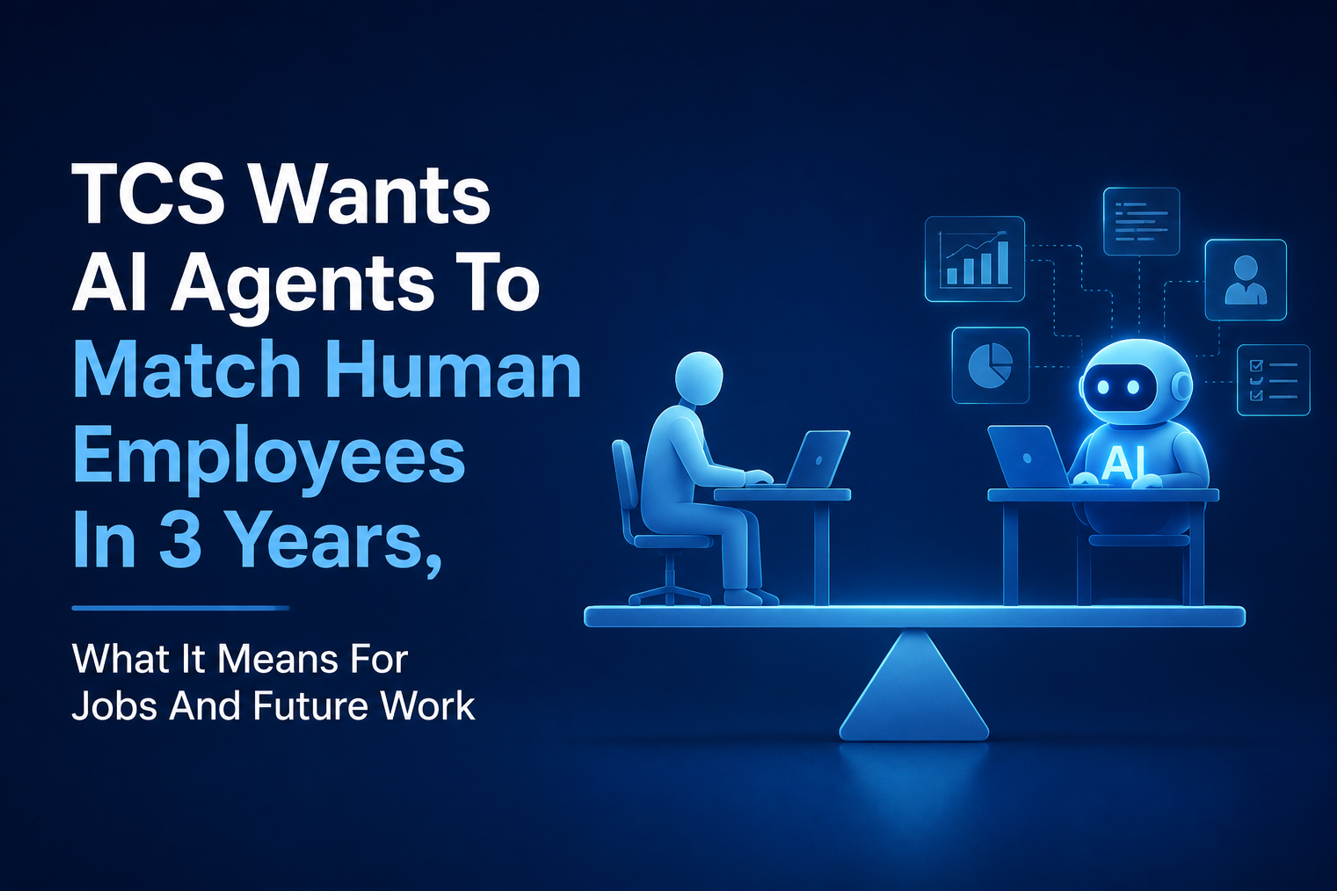
Tata Consultancy Services, India’s largest IT services company, has made a bold prediction about the future of work. TCS Chairman N Chandrasekaran has said the company could have as many AI agents as human employees within the next three years. That line sounds dramatic at first. It may make many people wonder whether AI will replace lakhs of IT workers. But the real meaning is more layered. TCS is not simply talking about removing humans and adding software. It is talking about a new operating model where human employees and AI agents work together on coding, testing, support, operations, documentation, customer service and business processes.
This is a major signal for India’s IT industry. If TCS moves in this direction, other companies may follow faster. The next few years could change hiring, training, productivity and the type of skills young professionals need.
What TCS actually said
At TCS’ 31st Annual General Meeting, Chairman N Chandrasekaran said the company may have an equal number of AI agents and human employees in about three years. He also said the company will not hire at the same large scale as it did in the past, because AI agents will take over parts of work. TCS is already working on what it calls a human plus AI model. The company has created internal AI transformation programs, built AI tools for services, and set up a dedicated AI and service transformation unit.
In simple words, TCS wants AI to become part of normal delivery work, not just a side experiment.
About TCS and why this statement matters
Tata Consultancy Services was founded in 1968 and is part of the Tata Group. It is one of the world’s largest IT services and consulting companies, serving clients across banking, retail, telecom, manufacturing, healthcare, insurance and many other sectors. Because TCS employs lakhs of people and works with major global companies, its AI plans are closely watched. When a smaller startup says it will use AI agents, it is interesting. When TCS says it, the impact can reach employees, clients, colleges, freshers and the broader job market.
This is why the statement has become a major workforce story.
What are AI agents
An AI agent is a software system that can complete tasks with some level of independence. A normal chatbot may answer a question. An AI agent can understand a goal, take steps, use tools and report back with results. For example, in an IT project, an AI agent may check code, find bugs, write test cases, prepare documentation or monitor system alerts. In HR, it may help with onboarding, employee queries or training recommendations. In finance, it may process invoices, flag errors or prepare reports.
The important point is that AI agents still need human supervision, especially in complex work. They can move faster than humans in repetitive tasks, but they may make mistakes, misunderstand context or need approval for sensitive decisions.
How this could change TCS jobs
The first big change may come in routine work. Tasks such as basic code writing, testing, data checking, ticket handling, report generation and documentation could become more automated.
This does not mean every job disappears. It means the shape of many jobs may change. A software engineer may spend less time writing basic code and more time reviewing AI-generated code, designing architecture and solving difficult problems. A support engineer may use AI to diagnose issues faster. A business analyst may use AI to prepare first drafts of process maps or requirement documents.
The employee’s value may shift from doing every small step manually to guiding, checking and improving AI-supported work.
Impact on freshers and hiring
Freshers may feel the biggest pressure. Indian IT companies have traditionally hired large numbers of graduates and trained them on projects. If AI agents handle entry-level repetitive work, companies may reduce volume hiring or expect freshers to become productive faster. This is why skill-building becomes very important. Basic coding alone may not be enough. Freshers will need to understand AI tools, cloud platforms, data, cybersecurity basics, business processes and prompt-based workflows.
A fresher who can use AI responsibly, verify outputs and understand business context may have a better chance than someone who only knows textbook programming.
Will AI agents replace employees
Some jobs will definitely be affected. Companies may need fewer people for low-complexity, repetitive tasks. Hiring may become more selective. The old model of adding more people for every new project may slowly weaken. But replacing humans fully is not simple. Enterprise IT work involves judgment, client communication, accountability, security, domain knowledge and problem-solving under pressure. AI agents can support this work, but they cannot take full responsibility in the way experienced professionals do.
So the better way to understand this shift is not “AI versus humans.” It is “humans who know how to work with AI versus humans who do not.”
What employees should learn now
Employees should start building practical AI skills. This does not mean everyone must become an AI scientist. But everyone should understand how AI tools can improve their own work. Software professionals can learn AI-assisted coding, testing automation, cloud AI platforms and model evaluation. Business analysts can learn data interpretation, workflow automation and AI documentation tools. Support teams can learn AI monitoring, ticket triage and incident response systems.
Soft skills will also matter more. Communication, judgment, client handling, ethics and domain understanding will become harder to automate.
What it means for clients
For TCS clients, AI agents could mean faster delivery and lower operating costs. Projects may move quicker if AI can prepare drafts, run tests, scan systems and reduce manual effort. A bank may get faster software updates. A retailer may improve customer support. A telecom company may detect network issues earlier. A manufacturer may use AI to predict equipment problems.
But clients will also ask tough questions. Is the AI secure? Who is responsible if it makes a mistake? Can the system explain its decisions? Does it follow data protection rules? These questions will shape the future of enterprise AI.
Competitors and industry check
TCS is not alone in this race. Infosys, Wipro, HCLTech, Tech Mahindra, Cognizant, Accenture, IBM and Capgemini are also investing heavily in AI-led services. Indian IT companies are also using tools from Microsoft, Google Cloud, AWS, ServiceNow, GitLab and other enterprise platforms. Many are building internal AI labs, industry-specific AI solutions and employee training programs.
This means the competition will not be only about headcount. It will be about who can deliver better AI-supported outcomes for clients.
Conclusion with key takeaways
TCS’ plan to have as many AI agents as human employees in three years is one of the strongest signs yet that India’s IT services model is changing. The future may not be about replacing every worker, but it will certainly reward people who can work well with AI.
Key takeaways
- TCS Chairman N Chandrasekaran said the company may have as many AI agents as human employees in three years.
- AI agents are software systems that can perform tasks such as coding support, testing, documentation, monitoring and process automation.
- TCS may not hire at the same scale as before because AI can handle parts of routine work.
- Freshers and employees will need stronger AI, cloud, data and business skills.
The future workforce will likely be human plus AI, where people guide, verify and improve AI-driven work.
Facts Input- BS
Discover more from Newskart
Subscribe to get the latest posts sent to your email.

[…] is entering a crowded but fast-growing field. TCS, Infosys, HCLTech, Tech Mahindra, Cognizant, Accenture and IBM are all pushing enterprise AI […]