

Supreme Court Extends Third-Party Insurance Tenure, What It Means For Vehicle Owners And Accident Victims


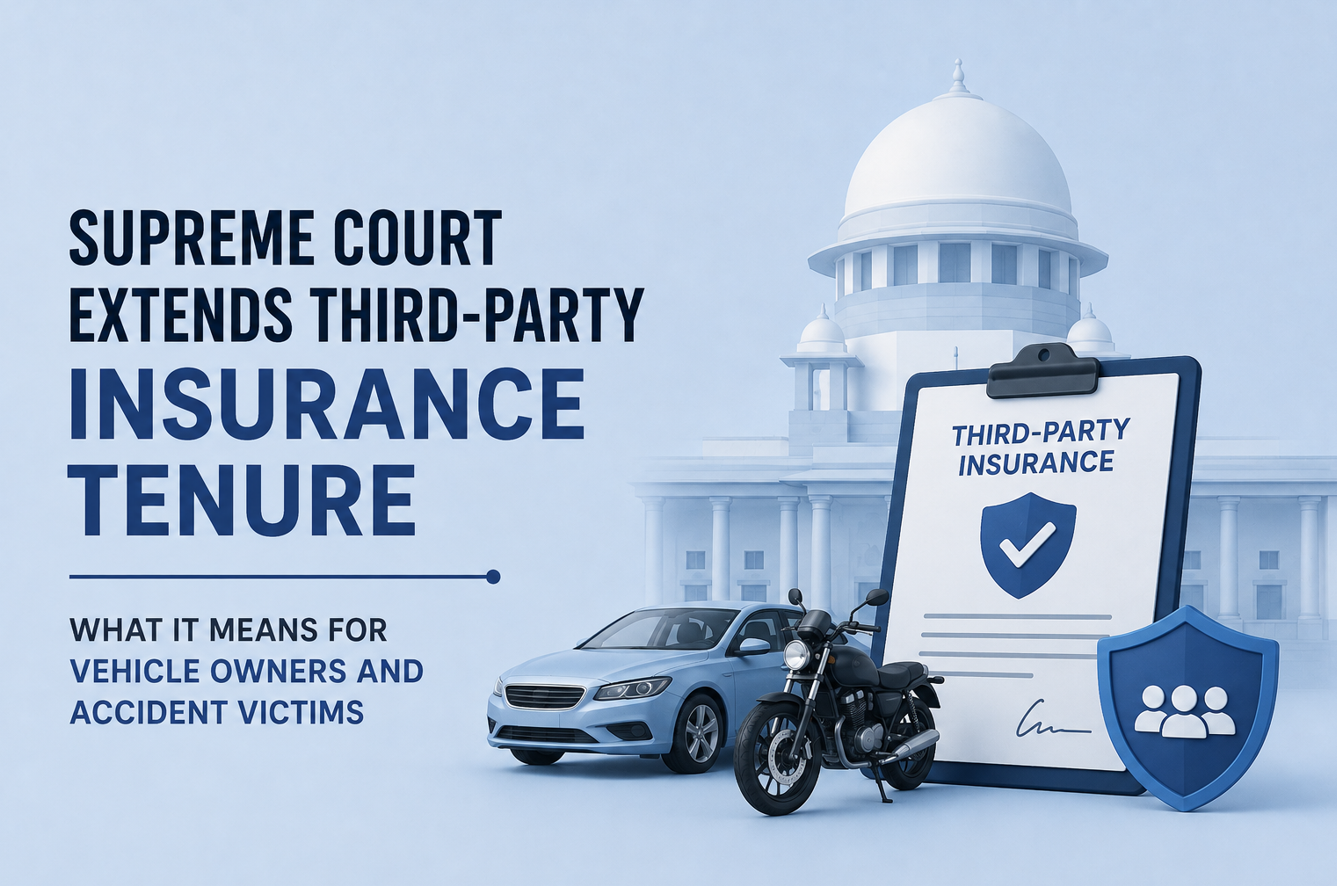
The Supreme Court has given an important direction that can change how new vehicle insurance is sold in India. On 4 August 2026, the court ordered that the mandatory third-party insurance period for new vehicles should be increased by one year.
This means new private cars will now need “four years” of third-party insurance at the time of purchase, instead of three years earlier. New two-wheelers will need “six years” of third-party insurance, instead of five years earlier.
The direction is aimed at a serious road safety and compensation problem. A large number of vehicles in India are still running without valid insurance, even though third-party motor insurance is legally mandatory.
What has changed
Until now, new private cars had to be sold with three years of third-party insurance. New two-wheelers had to be sold with five years of third-party insurance.
After the Supreme Court’s latest order, this tenure will increase by one year.
So, the new structure is simple.
New private cars will need four years of third-party insurance.
New two-wheelers will need six years of third-party insurance.
The court has directed IRDAI to issue the necessary directions immediately. This applies to third-party insurance, which is the legally required cover that protects accident victims and third parties.
What is third-party insurance
Third-party insurance is the basic motor insurance required by law.
It does not pay for damage to your own vehicle. Instead, it covers legal liability if your vehicle causes injury, death or property damage to another person.
For example, if a car hits a pedestrian, third-party insurance can help pay compensation to the injured person or their family. If the vehicle has no insurance, the victim may have to fight a long legal battle to recover compensation.
That is why third-party insurance is not just a vehicle-owner formality. It is a protection system for accident victims.
Why this order was needed
The Supreme Court noted a major enforcement gap. Reports cited by the court said nearly 56 percent of vehicles on Indian roads do not have valid insurance. Another figure highlighted was 16.54 crore uninsured vehicles out of 30.48 crore vehicles.
This is a huge concern.
If an uninsured vehicle causes an accident, the victim or family may suffer twice. First, they face injury, death or loss. Then they may struggle for years to get compensation.
The court said the purpose of mandatory insurance is not only to compensate victims but also to prevent them from being dragged into prolonged litigation.
In simple words, insurance should make accident compensation faster and more reliable.
Who will be benefitted
Accident victims will be benefitted the most. If more vehicles remain insured for longer, victims have a better chance of receiving compensation without extreme delay.
Families of accident victims will also benefit. In cases of death or permanent disability, compensation becomes critical for household survival.
Vehicle owners may benefit too, because longer third-party cover reduces the chance of forgetting renewal in the first few years.
Police and enforcement agencies can also benefit if the insurance system becomes more digital and easier to verify.
The insurance industry may gain from wider coverage, though insurers may also face higher long-term risk and pricing challenges.
No insurance, no fuel proposal
The Supreme Court also asked IRDAI, in consultation with the Ministry of Road Transport and Highways, to develop a pilot project linking fuel purchase with valid insurance status.
This does not mean the rule has been implemented across India immediately.
The idea is being examined as a pilot project. If it works, a vehicle without valid insurance may be denied fuel at petrol pumps until insurance is renewed.
The court also suggested using Automatic Number Plate Recognition cameras, VAHAN data and Insurance Information Bureau data to identify uninsured vehicles and issue e-challans.
Why this matters for common people
For a vehicle owner, this means insurance compliance may become stricter.
Earlier, many people bought insurance at the time of vehicle purchase and then ignored renewals later. With longer initial coverage and digital checks, skipping insurance may become harder.
For buyers, the upfront cost of a new vehicle may increase slightly because third-party insurance will be for a longer period. But this also means protection lasts longer.
For road users, the change can improve safety and financial protection.
Will own-damage insurance also increase
No, this order mainly concerns third-party insurance.
Own-damage insurance is different. It covers damage to your own vehicle due to accident, theft, fire, flood or other covered events. It is optional unless required by a lender.
A buyer can still choose own-damage cover separately, depending on need.
The court has also accepted a broader four-layer structure for private vehicle insurance, including mandatory third-party cover and optional covers such as personal accident, occupant or pillion cover, and own-damage insurance.
Conclusion with key takeaways –
The Supreme Court’s order to increase third-party insurance tenure is meant to close a serious gap in India’s road safety system. Too many vehicles are running without valid insurance, leaving accident victims vulnerable.
The new rule will make third-party cover longer for new vehicles and may be followed by stronger digital enforcement.
Key takeaways –
New cars will need four years of third-party insurance.
New two-wheelers will need six years of third-party insurance.
The order was issued on 4 August 2026.
The court flagged the problem of crores of uninsured vehicles.
Accident victims and their families are the biggest beneficiaries.
Facts Input- AutoPunditz
Discover more from Newskart
Subscribe to get the latest posts sent to your email.

Comments are closed.