

Scaler co-founder Anshuman Singh has launched Arcfront, Wants to Teach AI How Experts Actually Work


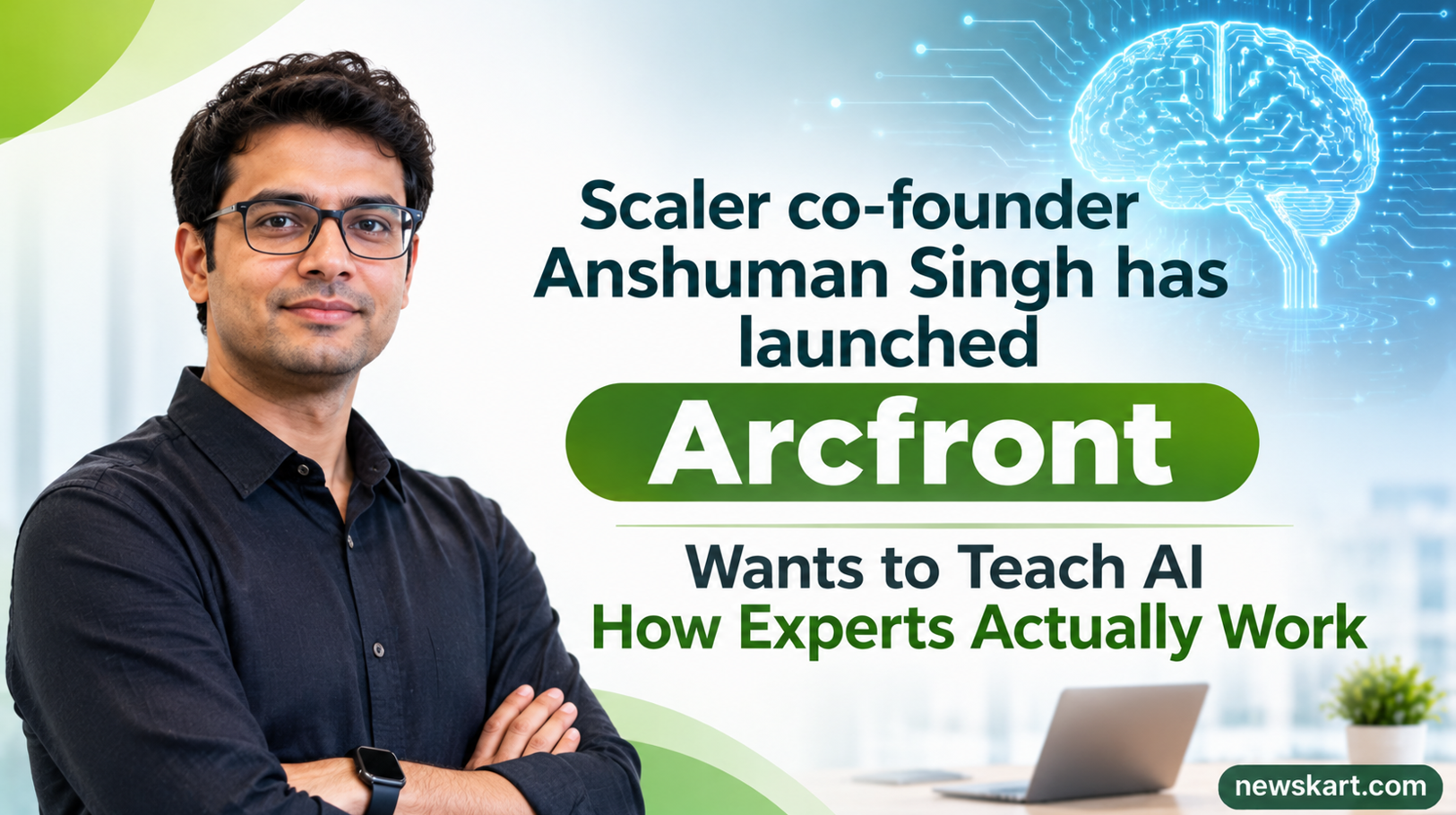
AI models can write emails, generate code, and answer questions. But they often struggle when work becomes messy, uncertain, and dependent on professional judgement.
That is the gap Arcfront wants to address. The new AI research and training-data startup, launched by Scaler co-founder Anshuman Singh and Naman Bhalla, focuses on turning records of real expert work into training material for advanced AI models.
Instead of teaching a model only the final answer, Arcfront’s goal is to capture how a skilled person reached that answer – including revisions, rejected options, mistakes, trade-offs, and final outcomes.
What is Arcfront?
Arcfront describes itself as a company that studies how real work gets done and turns that record into training data for frontier AI models.
Its core idea is called Decision Arc Data. This means collecting the full path from a problem to a verified outcome.
Imagine a hospital team deciding how to handle a complicated case, an engineer diagnosing a software failure, or a cybersecurity analyst responding to a potential attack. The final action is useful, but it does not show the whole picture. The choices considered, information ignored, tests run, and decisions changed along the way are often where human expertise lives.
Arcfront wants to convert this richer record into three types of AI resources – training data, reinforcement-learning environments, and evaluations.
Why AI training data needs to evolve
Earlier AI systems could learn from neatly labelled examples. A picture might be marked “cat” or “car.” A support ticket might be labelled “refund” or “technical issue.”
But workplace tasks are not always so clear.
An experienced site reliability engineer may reject three possible fixes before identifying the real cause of an outage. A lawyer may compare several arguments before advising a client. A doctor may revise an initial view after seeing new test results.
Arcfront’s bet is that AI models need this kind of real-world decision trail if they are to become more reliable assistants for professional work as per report.
The company says it is building reinforcement-learning environments in areas including software engineering, site reliability engineering, cybersecurity, and collaborative workplace tasks. It also lists sector-specific evaluations for healthcare, life sciences, legal services, and finance.
Who is behind the startup?
Arcfront is being built by Anshuman Singh and Naman Bhalla.
Singh is best known as the co-founder of Scaler, the technology education platform. Bhalla previously led AI products at Scaler and has worked as a software engineer at Google. Scaler co-founder Abhimanyu Saxena has also been described by Singh as providing support to the new venture.
Arcfront’s public launch came in November 2026. Its website identifies Evaratus Inc. as the legal entity, while reports have linked Evaratus to the former Scaler AI Labs unit. The exact ownership structure and relationship with Scaler have not been publicly detailed, so it is best not to assume Arcfront is a separate, fully independent company until the founders provide more clarity.
How could Arcfront help AI companies?
For frontier AI labs, better data can be as important as better computing power.
A model may score well on coding questions but still fail in a real software company if it cannot understand changing requirements, incomplete information, and the cost of making a wrong decision. Arcfront’s data could help AI developers train models to handle such situations more carefully.
For example, an AI coding assistant might be shown a real engineering task with multiple failed attempts, test results, code reviews, and the final production fix. Rather than learning only what code was eventually accepted, it could learn why other approaches failed.
This may also help companies test models before they are used in sensitive fields. A finance, healthcare, or legal organization needs more than a chatbot that sounds confident. It needs evidence that the model behaves safely and accurately in realistic situations.
The privacy and consent challenge
Arcfront’s idea is powerful, but it also raises important questions.
Professional records can contain confidential information, personal data, trade secrets, patient details, customer information, or sensitive financial material. A company working with real workplace data must have clear consent, strong anonymization, secure access controls, and well-defined data rights.
The value of real-world expert data is high precisely because it is difficult to collect responsibly. Arcfront’s long-term reputation will depend not only on the quality of its datasets, but also on how carefully it handles this trust.
Competitors and the market opportunity
Arcfront enters a growing market for AI training data, model evaluations, and expert feedback.
Scale AI, Surge AI, Turing, Mercor, and several specialist data firms operate in related areas. Some focus on data labelling, some connect AI companies with expert contributors, and others build testing environments for AI agents.
Arcfront’s differentiator is its focus on the complete decision path from situation to outcome. If it can collect this data ethically and prove that it improves model performance, it could become a valuable supplier to major AI labs.
The company has claimed that four of five frontier AI labs became customers within its first year. Since Arcfront has not publicly named those customers, the claim should be treated as a founder statement rather than independently verified market evidence.
Conclusion and key takeaways
Arcfront is not trying to build another chatbot. It is trying to supply the real-world decision data that could make future AI systems more useful in professional settings.
Its ambition is clear – teach AI models not just to provide an answer, but to understand the path, context, and judgement behind it. That is a difficult task, especially in sensitive industries. But it is also one of the most important problems in the next phase of AI development.
Discover more from Newskart
Subscribe to get the latest posts sent to your email.
