


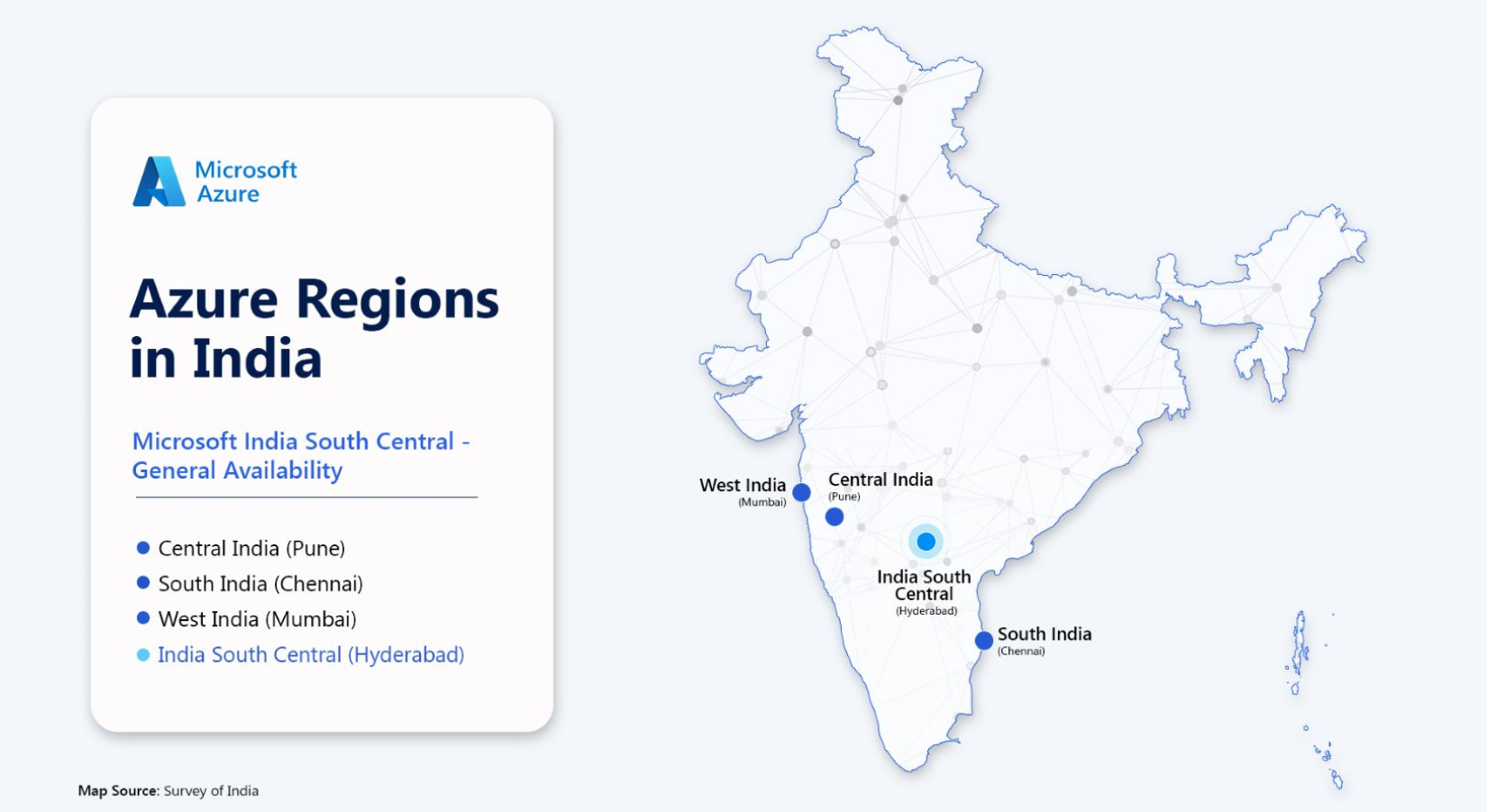
Microsoft has launched its new Hyderabad cloud region, officially called “India South Central“, marking a major expansion of its cloud infrastructure in India. With this launch, Microsoft now has four cloud regions in the country.
The new Hyderabad region is important because India’s demand for cloud computing and AI services is growing very fast. Companies are using cloud platforms to run apps, store data, manage payments, train AI tools, protect systems and serve customers across the country.
For Indian users, the benefit is simple. More local cloud capacity can mean faster digital services, better reliability, stronger data control and more support for AI-driven products.
What is the India South Central cloud region
A cloud region is a group of data centres in a specific geographic area. These data centres host servers, storage systems, networking equipment and security systems that power cloud services.
Microsoft’s Hyderabad cloud region is called India South Central. It has been built to support Azure, AI, data, security and enterprise workloads closer to Indian customers.
This is Microsoft’s fourth cloud region in India. Its existing Indian regions include Central India, South India and West India. The Hyderabad region adds more local capacity at a time when businesses, startups and government-linked organizations are moving more workloads to the cloud.
Why Hyderabad was chosen
Hyderabad has become one of India’s strongest technology cities. It already has a large base of IT companies, global capability centres, startups, research teams and skilled cloud professionals.
The city also has growing data centre activity. Along with Mumbai, Hyderabad is now seen as one of India’s fastest-growing data centre markets.
For Microsoft, Hyderabad offers a strong mix of talent, enterprise demand, state-level technology focus and infrastructure growth. That makes it a practical location for a large cloud region.
Why this launch was needed
The need comes from three big changes.
- First, Indian businesses are moving more systems to the cloud. Banks, hospitals, retailers, manufacturers, edtech platforms, fintech companies and government agencies all need reliable digital infrastructure.
- Second, AI adoption is rising. Tools like copilots, chatbots, document intelligence, code assistants, voice AI and analytics platforms need heavy computing power. This computing demand cannot be served well only from distant regions.
- Third, data residency is becoming more important. Many companies want sensitive data to stay inside India or be processed closer to Indian users. A local cloud region gives them more control and more architectural choices.
How Indian users can benefit
The most visible benefit can be lower latency.
Latency means delay. If a user in India accesses an app hosted closer to them, the response can be faster. This matters for banking apps, ecommerce checkouts, hospital systems, gaming platforms, AI tools and business software.
For example, if a healthcare company runs patient records and appointment systems on local cloud infrastructure, doctors and staff may get faster access. If a fintech startup runs payment or credit systems on local servers, it can improve response time for users.
For everyday users, this may show up as smoother apps, quicker logins, faster AI responses and fewer service delays.
Benefits for startups
Indian startups can gain a lot from the Hyderabad cloud region.
A young AI startup may need powerful cloud infrastructure to build and run models. A SaaS company may need reliable hosting for Indian enterprise customers. A gaming startup may need low-latency servers. A fintech startup may need secure infrastructure that meets compliance expectations.
Having more cloud capacity inside India can help such startups build locally and scale globally.
It can also reduce the pressure of depending too heavily on overseas regions for Indian workloads.
Benefits for large enterprises
Large companies need cloud infrastructure that is fast, secure and reliable.
For sectors such as banking, insurance, telecom, healthcare, manufacturing and retail, downtime can be expensive. Local cloud regions can help companies create stronger disaster recovery and backup plans.
For example, a bank can design systems across multiple Indian cloud regions. If one region faces disruption, critical workloads can shift or recover through another region. This improves business continuity.
Enterprises also benefit from data control. More local infrastructure makes it easier to plan sensitive workloads under Indian compliance and internal risk policies.
Benefits for AI adoption
The Hyderabad cloud region comes at a time when AI is becoming central to business technology.
Companies are using AI for customer support, document review, fraud detection, coding, product recommendations, supply-chain planning, call-centre automation and internal productivity.
AI workloads need more compute power than many traditional applications. They also need strong networking, storage and security.
Microsoft has been investing heavily in AI and cloud infrastructure in India. The Hyderabad region can support this larger AI push by giving Indian businesses more local access to cloud and AI services.
What it means for government and public services
Government services increasingly depend on digital infrastructure.
Public platforms for welfare delivery, citizen services, healthcare, education, agriculture and employment need secure and scalable systems. Local cloud infrastructure can help improve reliability and data handling for such services.
This does not mean every government system will automatically move to Microsoft’s cloud. But more Indian cloud capacity gives public-sector bodies more options when they modernize digital systems.
Competitors
Microsoft is not alone in this race.
AWS, Google Cloud, Oracle Cloud and other cloud providers are also expanding in India. AWS has major infrastructure in Mumbai and Hyderabad. Google Cloud has regions in Mumbai and Delhi NCR. Oracle also serves Indian enterprise cloud demand.
This competition is good for Indian businesses. More cloud regions mean better choices, stronger pricing pressure, better local support and faster innovation.
For Microsoft, the advantage is its deep enterprise base. Many Indian companies already use Microsoft 365, Windows Server, SQL Server, Azure, GitHub, Dynamics and security products. The Hyderabad region can make Microsoft’s full cloud and AI stack more attractive for these customers.
Challenges to watch
The launch is important, but a data centre region is not magic by itself.
Cloud costs still need careful management. Many companies move to cloud and later struggle with bills because they do not optimize usage.
Skilled talent is another challenge. India needs more cloud architects, cybersecurity professionals, AI engineers, data engineers and infrastructure specialists.
Sustainability also matters. Data centres consume large amounts of power and water. Microsoft has spoken earlier about renewable energy and responsible data centre operations, but users and policymakers will continue watching how hyperscale data centres manage environmental impact.
Conclusion with key takeaways
Microsoft’s Hyderabad cloud region is a big infrastructure milestone for India’s digital economy. It brings more local cloud capacity at a time when businesses are adopting AI, cloud platforms and data-heavy applications faster than ever.
For Indian users, the benefit can be faster services, better reliability and more secure digital experiences. For businesses, it can support AI adoption, data residency, disaster recovery and enterprise growth.
Key takeaways –
- Microsoft has launched its Hyderabad cloud region, called India South Central.
- This is Microsoft’s fourth cloud region in India.
- The new region can help Indian businesses with cloud, AI, data and security workloads.
- Users may benefit from lower latency, better reliability and stronger local data options.
- The launch strengthens India’s position as a growing cloud and AI infrastructure market.
Facts Input and Image Credit- MS
Discover more from Newskart
Subscribe to get the latest posts sent to your email.

[…] Industries is another company in the broader AI materials space, with work linked to data centre infrastructure and advanced […]