

Kepler Aerospace Raises $8 Million to Build Smart Satellite Swarms for Defence and Space Missions


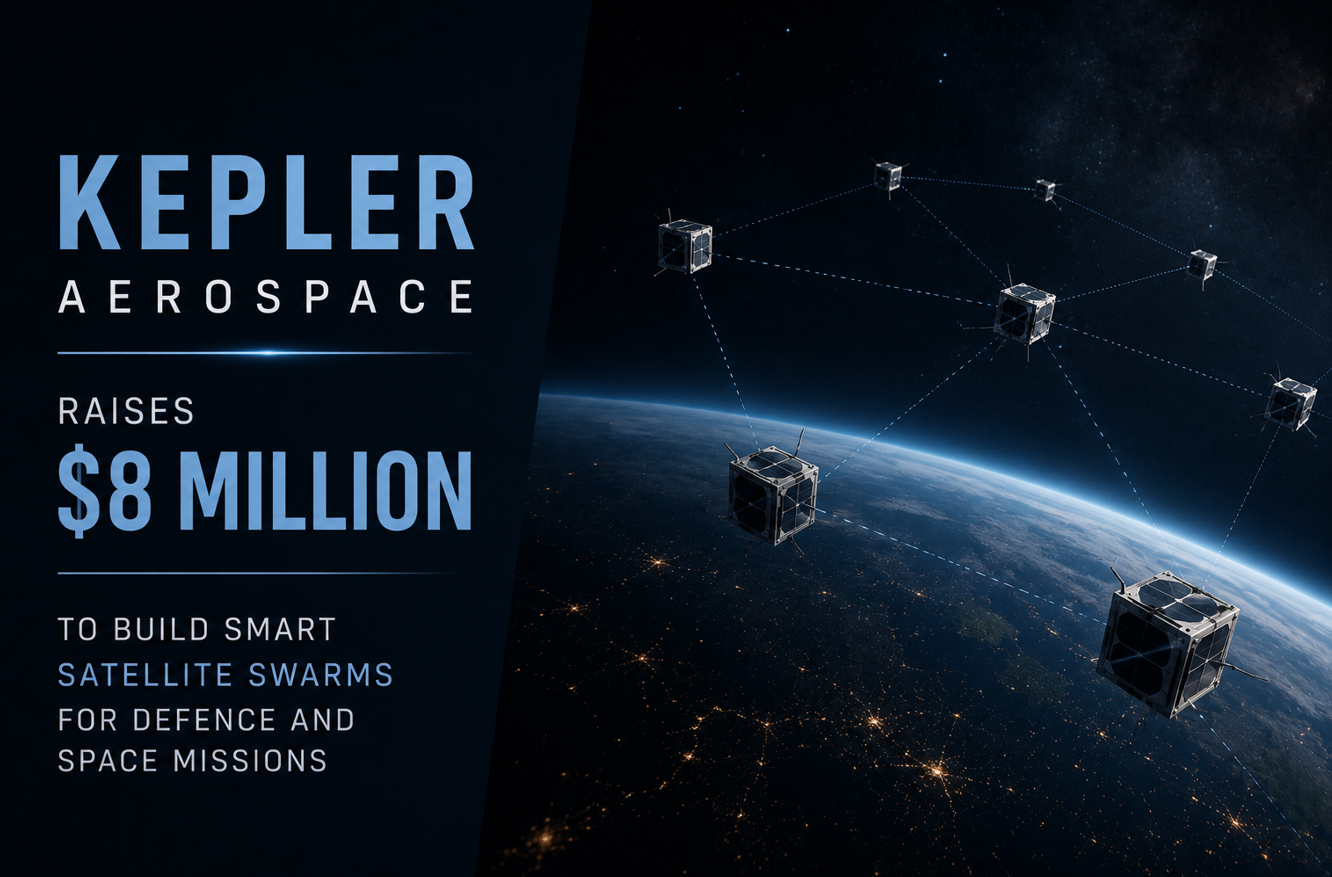
Bengaluru-based spacetech startup Kepler Aerospace has raised $8 million in a seed funding round led by Blue Ashva Capital. Finvolve and India Accelerator co-led the round, with other investors also taking part.
This is Kepler Aerospace’s first external funding round since it was founded in 2018. The company is working on a very focused mission which is building satellite systems that can support defence, surveillance, space infrastructure and mission operations.
What Kepler Aerospace does
Kepler Aerospace builds space infrastructure and mission operations technology. In simple words, it helps satellite operators manage space missions through hardware, software, ground systems and control support.
The startup works across satellite avionics, ground infrastructure, mission operations and intelligence platforms. Avionics means the electronic systems used inside satellites and spacecraft. Mission operations means tracking, controlling and managing satellites after they are launched.
Kepler also runs a network of more than 70 ground stations, which help with satellite communication, tracking and command operations.
Founder and founding year
Kepler Aerospace was founded in 2018 by Navneet Singh and Kiran V. Sharma.
Navneet Singh is the co-founder and CEO, while Kiran V. Sharma is the co-founder and chief strategy officer. Reports say both founders met during their time at ISRO, which gives the company strong roots in India’s space ecosystem.
Aim of the startup
Kepler Aerospace wants to build autonomous satellite swarms for intelligence, surveillance and reconnaissance, also called ISR.
This sounds complex, but the idea is simple. Instead of one satellite waiting for instructions from Earth, a group of satellites can work together in orbit. They can share information, coordinate tasks and respond faster.
For defence use, this can be important. If a country needs to monitor movement across land, sea or border areas, faster satellite intelligence can help decision-makers act quickly. Kepler wants to reduce the time taken to collect and process such intelligence from weeks or months to much shorter timelines.
Purpose of the funding
The fresh $8 million funding will be used to launch Kepler’s first six swarming ISR satellites. These satellites are expected to form an autonomous constellation that can support India’s defence space needs.
The company will also use the money to scale its Mission Operations as a Service and Avionics as a Service businesses. This means Kepler can support other satellite companies with operations, hardware systems and mission infrastructure.
Over the next 12 to 24 months, Kepler also plans to expand its engineering team, move into a new facility and strengthen its commercial offerings.
Why this matters
India’s private space sector is growing quickly. Earlier, most space activity was led by government agencies. Now, private startups are building launch vehicles, satellites, imaging tools, propulsion systems, ground stations and defence-linked space platforms.
Kepler Aerospace fits into this larger shift. Its focus is not only on building satellites, but also on making them smarter, more connected and easier to operate at scale.
Competitors and market space
Kepler Aerospace operates in a space where Indian startups such as Pixxel, Digantara, GalaxEye, Dhruva Space, PierSight, OrbitAID and InspeCity are also building different parts of the space technology stack.
Globally, it may be compared with companies working on satellite intelligence, mission operations and space infrastructure. Kepler’s defence-linked autonomous swarm focus gives it a distinct place in India’s spacetech market.
Conclusion – Key takeaways
Kepler Aerospace’s $8 million seed round is a strong signal for India’s deeptech and spacetech ecosystem.
The startup aims to build autonomous satellite swarms that can improve defence surveillance and space-based intelligence. The funding will help it launch six satellites, grow its mission operations business and expand its avionics services.
If Kepler can prove its technology in orbit, it could become an important Indian player in the future of defence-focused space infrastructure.
Facts Input- ToI, Kepler-Aerospace, StartupTalky, Entrepreneur India
Discover more from Newskart
Subscribe to get the latest posts sent to your email.

Comments are closed.