

India’s New Employment Policy Draft Amid AI Disruption: Will It Really Protect Jobs or Just Delay the Shock?


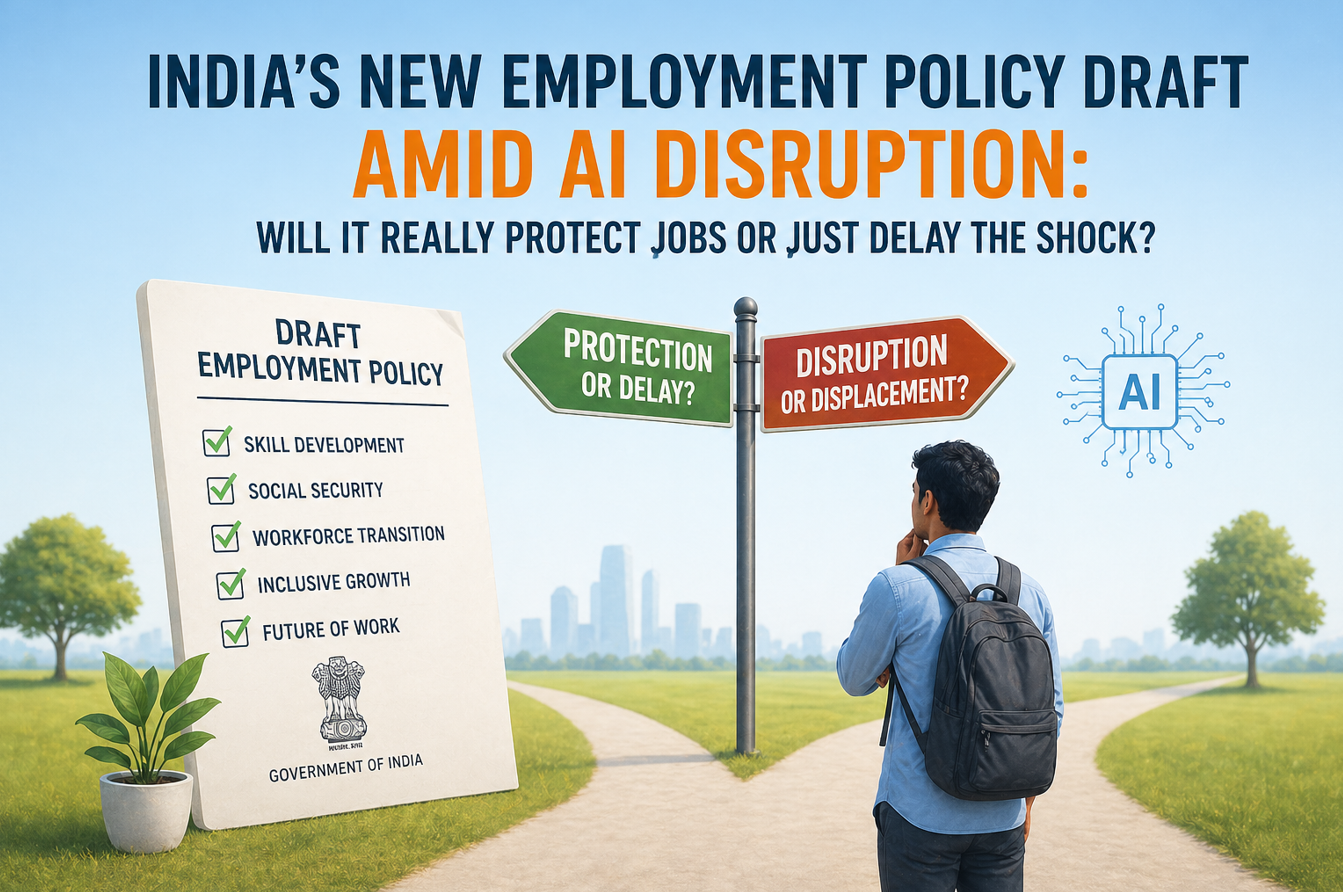
AI is no longer a future topic in India’s job market. It is already changing hiring, entry-level roles, and skill requirements across IT, BPO, retail, finance, and services. In this context, reports say the government is drafting a new National Employment Policy to respond to AI-led disruption and wider labor-market stress. That sounds promising, but people are asking a practical question, will this policy actually protect jobs, or will it only offer general promises while the market changes faster than policy can keep up?
This article breaks the issue into simple, useful points: what the draft policy signals, what protection can realistically look like, where risks remain, and what workers should do right now.
What Is Being Reported About the New Policy
Recent Indian media reports indicate that the Centre is preparing a new National Employment Policy focused on:
- Labor market activation
- Better employment quality and wage concerns
- Sectoral transition due to AI and automation
- Protecting workers while technology adoption accelerates
Some reports cite estimates that 12–18 million jobs could be affected in 2025–2026, especially in white-collar and process-driven functions. At the same time, demand for AI-skilled roles is expected to rise sharply.
So this is not a simple “jobs will vanish” story. It is more a “jobs will change faster than workers can adapt” story.
Why This Matters Right Now
For many years, disruption talk stayed abstract. In 2026, it feels immediate for three reasons:
- Entry-level pressure is visible
Roles once handled by fresh graduates in support, operations, and basic analysis are increasingly being automated or redesigned. - Task replacement is faster than role replacement
AI often removes parts of a job first. Over time, that can shrink full roles unless workers upskill. - Companies now expect AI fluency
Even non-technical roles increasingly require comfort with AI tools, data workflows, and productivity platforms.
Because of this, policy timing matters. If support systems come too late, many workers face a painful transition phase.
What “Job Protection” Can Realistically Mean
A lot of people interpret job protection as “no job losses.” That is usually unrealistic in technology shifts. A better policy goal is transition protection.
In practical terms, a strong employment policy should include:
- Large-scale reskilling pathways
State-linked training that maps to real hiring demand, not generic certificates. - Transition income support
Temporary support for workers displaced by automation while they retrain. - Regional job-mapping dashboards
Clear district/state data on where jobs are shrinking and where new demand is rising. - Industry-linked apprenticeships
Fast pipelines from skilling programs to actual employers. - SME automation support with worker safeguards
Helping smaller firms adopt AI without sudden workforce shocks.
If the policy includes measurable outcomes in these areas, it can genuinely reduce disruption pain.
Will It Protect Jobs? The Honest Answer
The short answer: it can protect people better than it can protect every existing job.
That distinction is important.
- No policy can freeze the market and stop all AI-driven change.
- But a good policy can reduce unemployment duration, protect incomes during transition, and increase re-employment quality.
So success should be measured by:
- How quickly displaced workers get new jobs
- Whether their income recovers
- Whether regional inequality widens or narrows
- Whether youth hiring improves in new sectors
If these metrics improve, the policy is working even if some old roles fade.
Practical Example: How This Could Affect Different Workers
Case 1: BPO entry-level employee
Routine workflow tasks may reduce. But with support, the worker can move to customer-resolution, compliance support, or AI-ops monitoring roles.
Case 2: IT services fresher
Basic code generation may commoditize entry tasks. But workers trained in testing, integration, cloud ops, and AI workflow governance can remain competitive.
Case 3: Retail operations staff
Back-end process automation may reduce manual roles. But demand can rise for omnichannel, digital operations, and inventory intelligence roles.
The lesson is clear- job titles may stay similar, but skill requirements are changing rapidly.
Competitor Angle: What Other Countries Are Doing
Countries such as Singapore, parts of the EU (European Union), and some East Asian economies have increasingly focused on:
- Skills-credit models
- Industry-co-funded re-employment programs
- Strong labor data systems
- Targeted support for vulnerable categories
India’s scale is far larger, so direct copying is difficult. But policy design can still borrow one key idea: link training money directly to hiring outcomes.
What Workers Should Do Now (Without Waiting for Policy)
Do not wait for full policy rollout. Start with a personal transition plan:
- Map your role into tasks
Identify which 30–40% tasks in your job can be automated soon. - Build one adjacent skill stack
Example: Excel-only analyst to data + BI + AI assistant workflows. - Add proof of work
Small projects, public portfolio, real workflow demos matter more than certificates alone. - Practice hybrid communication
AI-era value shifts toward judgment, domain understanding, and decision clarity. - Track sectors with rising demand
Cybersecurity, AI implementation, healthcare tech, climate-tech operations, and industrial automation are seeing stronger pull.
Policy Risk Areas to Watch
Even a good draft can fail in execution. Key risk zones are:
- Training without placement outcomes
- Urban bias in opportunity access
- Delayed rollout across states
- Weak data on micro-level job transition
- Exclusion of informal workforce realities
For policy credibility, implementation quality matters more than announcement quality.
Final Takeaway
The reported new employment policy is a timely and necessary signal from the government. It recognizes that AI disruption is not theoretical and that workforce transition now needs a national response. Will it protect jobs? Not every existing job. But it can protect workers, incomes, and career continuity if it is built around measurable skilling, transition support, and employer-linked outcomes.
For professionals and students, this is the real mindset shift, the safest career path in 2026 is not “job security by default,” but “adaptability by design.” If policy and individual action move together, AI disruption can become an upgrade cycle instead of a social shock. So overall, this is a good move from the government side to protect worker’s interest and their career.
Facts Input- The Tribune, Moneycontrol, ET, Economic Times (Feb 17, 2026)
Discover more from Newskart
Subscribe to get the latest posts sent to your email.

[…] Court of China presented ruling on AI layoff and Government of India also created new employment policy draft amid AI disruption to protect the workforce interest and worker protection against such layoffs which is a positive […]
[…] Updated government guidance on AI-linked restructuring, India is preparing new employment policy and draft is presented […]