

India’s Indigenous 4G Push Is Reshaping Telecom-What It Means for Users, Industry, and 5G/6G Readiness


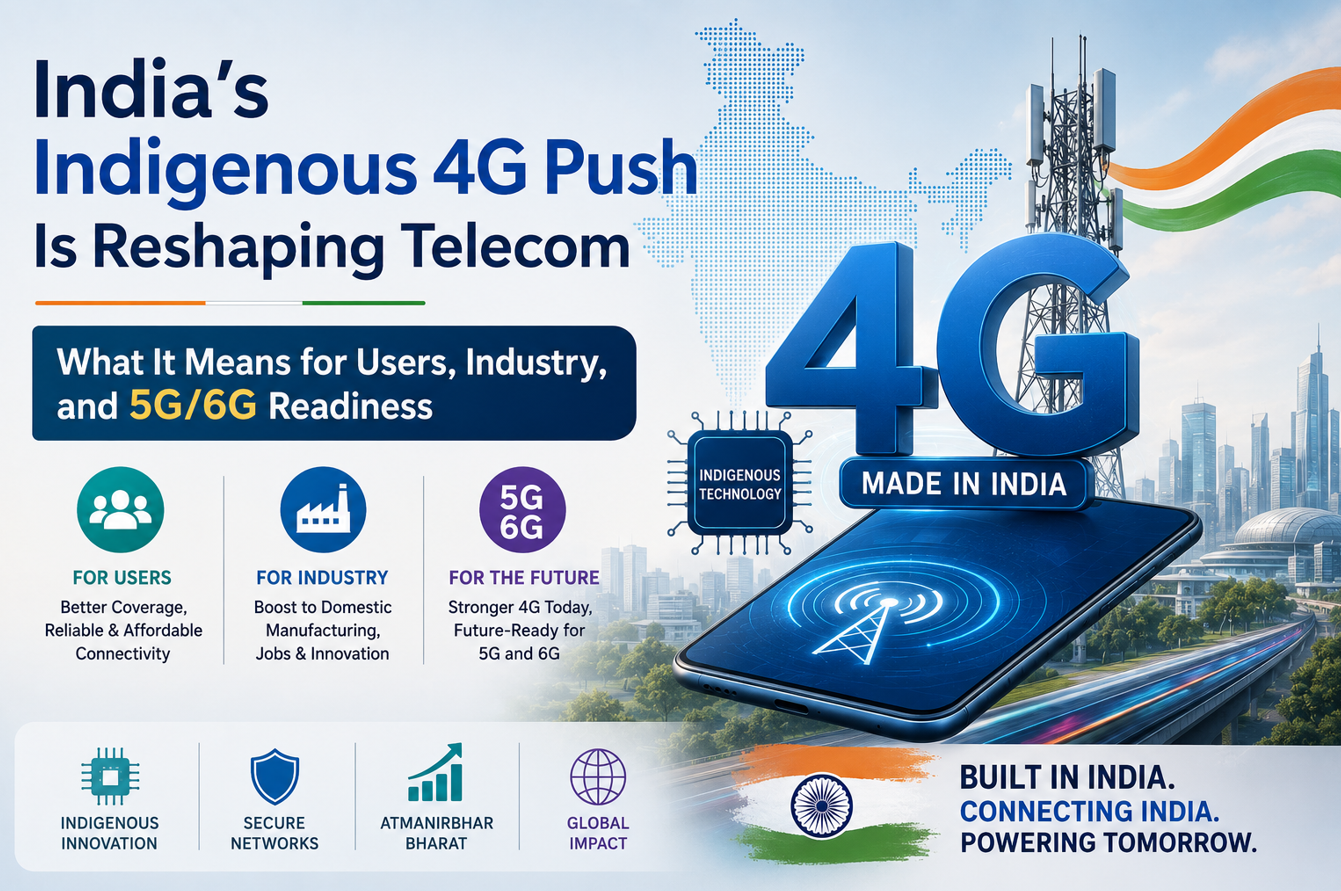
India’s telecom story is entering a new phase. For years, the country depended heavily on foreign vendors for core mobile network technology. Now, with BSNL’s large-scale rollout of an indigenous 4G stack, that pattern is changing. This is not just another policy update on telecom, but it has practical implications for network reach, digital sovereignty, domestic manufacturing, and the long-term roadmap to 5G and 6G.
Now the big question is that what does India’s indigenous 4G push actually mean for ordinary users and for the telecom ecosystem? Let’s break it down.
What Is the Indigenous 4G Push?
India’s homegrown 4G program is being executed primarily through BSNL with a consortium model with other players as well-
- C-DOT: core network technology
- Tejas Networks: radio access network (RAN) equipment
- TCS: system integration and deployment orchestration
Government and industry statements over 2025–2026 describe this as a “Bharat Telecom Stack” approach, designed and scaled within India. Recent remarks by the Minister of State for Communications said BSNL has stabilized this indigenous 4G network and that deployment has moved beyond proof-of-concept into mass rollout.
In plain terms this is not a lab experiment anymore. It is being used in real network expansion at national scale.
Why This Matters Beyond BSNL
1) Reduced dependency on external vendors
When a country can design and deploy key telecom layers at home, it has more strategic control over upgrades, security, and long-term costs.
2) Better policy alignment with Atma-nirbhar Bharat
Telecom is critical infrastructure. A domestic stack supports the larger national goal of self-reliance in strategic technologies.
3) Stronger domestic ecosystem
A nationwide rollout creates demand for Indian R&D, component supply chains, field engineers, and telecom software expertise.
4) Export potential over time
If performance and reliability mature well, Indian telecom products can eventually be offered in other developing markets looking for cost-effective alternatives.
So this is both a connectivity project and an industrial capability project.
What It Means for Users on the Ground
For regular subscribers, especially in under-served and rural regions, the most important question is network quality. Users care about call drops, data speed, and consistent coverage, not just technology labels.
The indigenous 4G push can help users in three practical ways-
- Wider coverage where network presence was weak
- Improved service continuity as legacy networks are modernized
- Better inclusion for digital payments, education, telemedicine, and e-governance
A simple example we can take like if a village gets stable 4G for the first time, that can change how people access banking, job information, school content, and government services. That said, rollout quality can vary by region during scale-up. Some users have reported service issues in early phases, which is common in large network transitions. Stabilization and optimization are therefore as important as installation numbers.
Current Progress Signals-Where We Stand in 2026
Recent official and industry reporting points to a few clear milestones-
- BSNL’s indigenous 4G network has moved into large deployment scale.
- The technology stack is being treated as 5G-upgradable in roadmap discussions.
- Government statements suggest major improvement in stability after early scaling challenges.
- Follow-on expansion discussions continue for deeper footprint in underserved areas.
In short, India is in the execution-and-optimization stage: beyond initial launch, but still working on quality consistency at full scale.
How This Connects to India’s 5G and 6G Roadmap
Many people ask that if India is talking about 6G, why focus so much on 4G now? Because telecom growth is layered. A strong 4G foundation still matters for-
- nationwide digital inclusion,
- fallback reliability,
- enterprise and rural connectivity,
- and operational capability building before next-generation jumps.
Also, many engineering capabilities needed for a domestic 4G stack (core software, radio engineering, integration discipline, field operations) are reusable building blocks for future 5G/6G innovation.
So this is not backward-looking. It is foundational work for future network sovereignty.
Conclusion
India’s indigenous 4G push is one of the most significant telecom infrastructure developments in recent years. It is not only about one operator or one technology generation. It is about building national capability in a sector that underpins digital economy growth. If rollout quality continues to improve and domestic players keep innovating, this initiative can strengthen India’s telecom resilience today while supporting a stronger transition to 5G and 6G tomorrow. The message is clear which is that India is no longer just consuming telecom technology at scale. It is increasingly learning to create, deploy, and evolve it from within.
Facts Input- ET Telecom, TCS press release, PIB feature on indigenous 4G stack, ET, DoT/TEC workshop
Discover more from Newskart
Subscribe to get the latest posts sent to your email.

[…] better network lane, what happens to prepaid users who also pay for internet? Is this smart use of 5G technology, or does it create a class divide on the internet? Let’s explore it in simple […]